Epic banned hand-written code. The Pentagon tried a language mandate for ten years.
Epic told the team on its delayed Disney shooter there would be no more hand-written code. The Pentagon required Ada for new software in 1987, watched programs ignore the waivers, and in 1997 switched to judging the engineering plan instead.

On 12 October Bloomberg reported that Epic Games had told the team building its unannounced Marvel and Star Wars shooter there would be "no more hand-written code", according to Inven Global's write-up. One of the game's directors reportedly said in an internal message that all art would be "generated with full AI workflows" too. The game had been aimed at next March. Inven says the team hasn't been given a new date.
Epic's communications director, Jake Jones, said the company is "embracing AI-accelerated development". Tim Sweeney posted the same day that a "huge strategic redirection" was under way. In a reply he said the biggest change is the much shorter time between having an idea and playtesting it.
The question I'm working on: does a rule about how the work is done get you the result the rule is for?
My first reaction was that this is a cost cut with a new name
Epic laid off more than 1,000 people in March. A rule against hand-written code sounds like the next step.
That reaction doesn't hold up well against what Epic has said. It said in March that those layoffs weren't about AI. Sweeney says the goal isn't the same work with fewer people but more and better output from everyone. And the reason he gives is a real one. He argued that many recent big-budget failures came from teams that couldn't playtest their game systems for most of development. Getting to a playable version sooner is a fair thing to want.
So I don't think the goal is the problem. What interests me is the form of the rule. Sweeney's reason is an outcome: time from idea to playtest. The rule the team heard is about a tool.
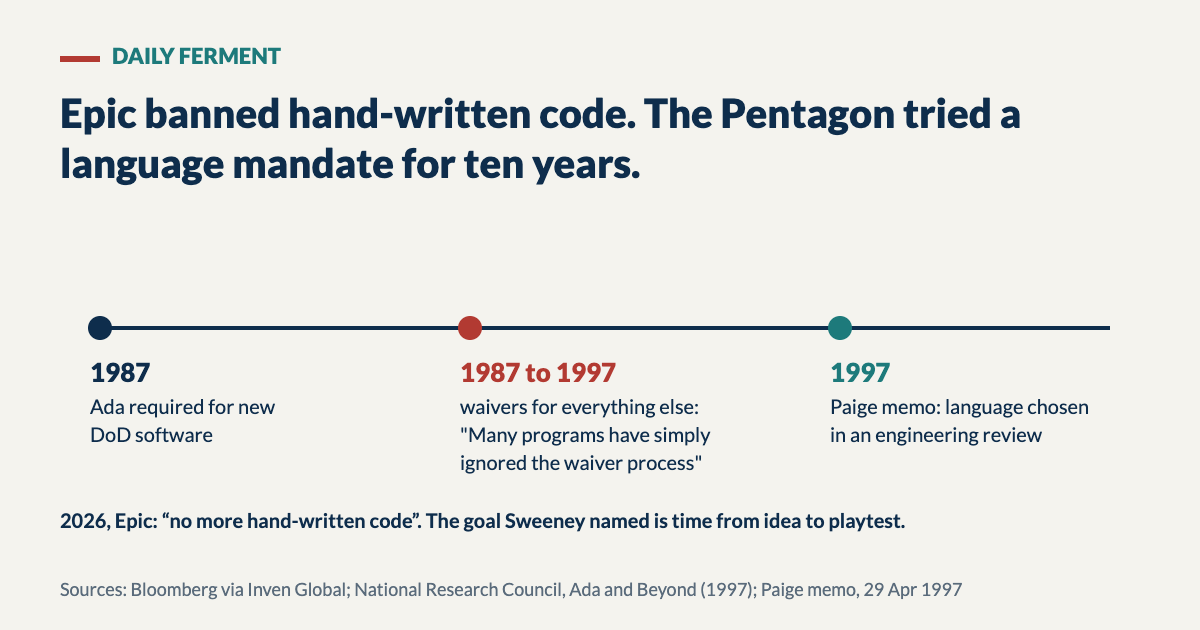
The cross: the Pentagon's Ada mandate
The US Department of Defense built a programming language in the 1970s, called Ada. In 1987, the National Research Council's 1997 report says, its use "was required for new software development". Programs that wanted to use something else needed a waiver.
Ten years later the Council looked at how that went, at the request of Emmett Paige, the assistant secretary responsible. Its findings are blunt. "DOD's current Ada requirement and the related waiver process have been weakly implemented. Many programs have simply ignored the waiver process." It also found the requirement "overly broad in its application to all DOD-maintained software." Barry Boehm, who chaired the committee, told FCW that for logistics systems built by gluing together commercial products, "Ada does not give you an advantage there."
The Council's fix was not a better waiver process. It recommended keeping Ada for warfighting software, where it had a real track record, and making language choices "part of an integrated software engineering process." Paige's memo of 29 April 1997 did that. It eliminated the Ada requirement "in favor of programming language selections made in the context of system/software engineering analyses", and dropped the waivers.
Put plainly: the DoD stopped asking "did you use Ada?" and started asking "show us your engineering plan."
What that suggests for an AI-first rule
A tool rule creates two groups: people who follow it and people who need an exception. The second group either asks for a waiver or quietly works around it. Inven reports that some developers on Epic's call hoped the policy would be reversed, or doubted it would work. That's the same starting point the waiver files came from.
An outcome rule doesn't need waivers. If the measure is the time from an idea to a playable build, a developer who gets there faster with Claude is fine, and so is one who gets there faster by writing twenty lines by hand. Either way you can see it. Sweeney already named the measure. The rule the team heard is one step removed from it.
I wrote before about OpenAI firing contractors for using AI to rate its models. That was the mirror image: a ban on a tool instead of a mandate, enforced by guessing who had used it. Both rules check the method because the method is easier to point at than the result.
Where the comparison breaks
Ada was a language the DoD controlled, applied to thousands of contractors across many years. Epic is one company, one team and one boss, and a boss can see far more of the work than a Pentagon office could see of a contractor's code. The waivers that got ignored at DoD might simply never come up at Epic.
AI tools also change month by month, and Ada didn't. A mandate can be a way to force a team to learn something new quickly, and that's a better argument for it than anything the DoD had. If Epic drops the rule in six months because the team has learned the tools, the rule will have done its job.
And I only know what Bloomberg's sources said. Bloomberg relied on anonymous sources and internal messages, as Inven notes. The full wording of the rule may be softer than "no more hand-written code."
What I'm confident of, and what I'm not
What Epic's team was told, and what Epic and Sweeney said, is established from Bloomberg's report as relayed by Inven Global and Quartz, with the caveat that Bloomberg's sources are anonymous. The Ada mandate, the ignored waivers and the 1997 change are established from the National Research Council report and the Paige memo. That Epic's rule will follow the same path is inferred. Whether it gets this game out sooner is a guess.
The claim, in one sentence: a rule about which tool to use ends up enforced by exceptions that people ignore, while a rule about what the tool is for, like the time from an idea to a playtest, can be checked directly; the Pentagon reached that conclusion after ten years of mandating Ada.
Sources
Seungjin Kang, Inven Global, "Epic delays Disney shooter amid shift to AI-first model: 'No more hand-written code'", 12 October 2026. https://www.invenglobal.com/articles/27085/epic-delays-disney-shooter-amid-shift-to-ai-first-model-no-more-hand-written-code
Colleen Cabili, Quartz, "Epic Games delays Disney Marvel shooter, mandates AI-first development", 12 October 2026. https://qz.com/epic-games-disney-shooter-delay-ai-101226
National Research Council, Computer Science and Telecommunications Board, Ada and Beyond: Software Policies for the Department of Defense, 1997, executive summary. https://nap.nationalacademies.org/read/5463/chapter/2
John Monroe, FCW via Nextgov, "Report suggests DOD limit Ada use", 10 November 1996. https://nextgov.com/digital-government/1996/11/report-suggests-dod-limit-ada-use/247956
Linda Brown, AdaHome, "Weight of 1997-04-29 Paige memo", 21 May 1997. https://adahome.com/articles/1997-05/po_memoweight.html