MongoDB's CEO left for Meta. Why didn't the reassurance work?
MongoDB answered every question after its CEO left for Meta, and the stock still fell 17%. Reassurance that costs nothing to give can't answer the question a sudden exit raises.

At 8:30 in the morning New York time on Monday, 28 September, MongoDB announced that its chief executive, CJ Desai, was stepping down "effective immediately" to take a role at Meta. Meta announced the same day that he'd lead its new enterprise AI business. He had been MongoDB's CEO for eleven months.
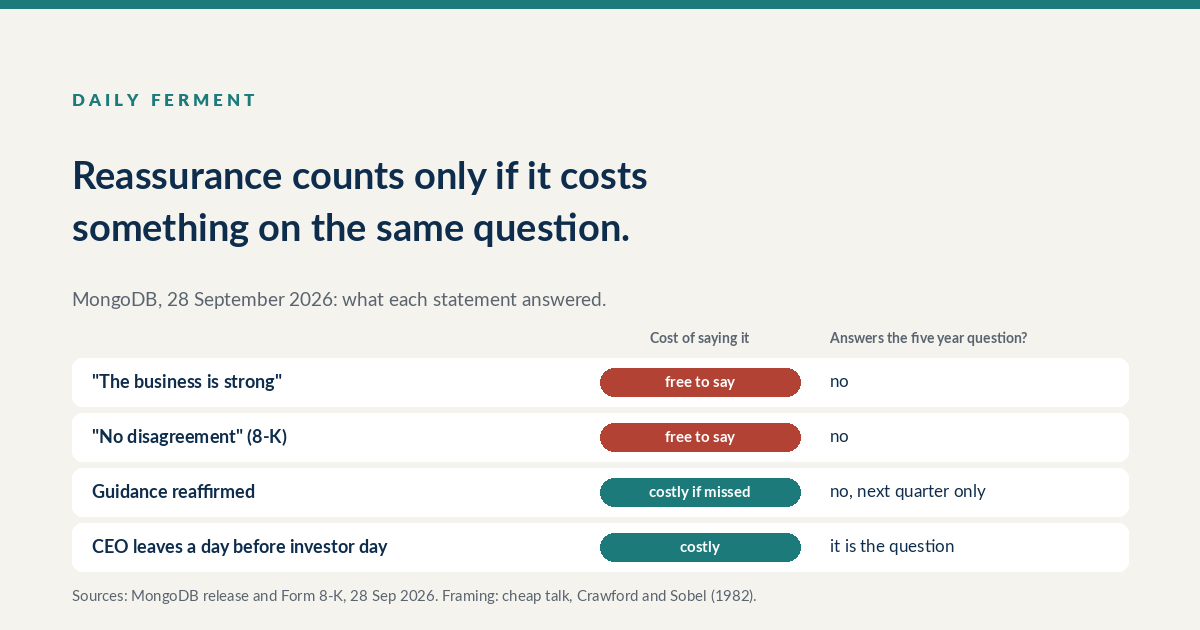
MongoDB did nearly everything a company is supposed to do in that situation. It brought back Dev Ittycheria, who ran the company from 2014 to 2025, as interim CEO. It said it had hired a search firm. It reaffirmed its third quarter and full year guidance. Its chairman, Tom Killalea, said: "MongoDB's business is strong". Its filing with the SEC says Desai's decision "is not due to any disagreement with the Company or any matter relating to the Company's operations, policies or practices."
The stock fell anyway. Investing.com had it down 17.09%; other outlets caught intraday moves of 20% and more.
Its investor day, where the company lays out its long-term strategy, is scheduled for today, 29 September, at Nasdaq. It's running as this goes up.
What I'm trying to work out is why a company can answer every question and still lose a sixth of its value in a morning.
Why did MongoDB stock fall if the business is fine?
Because none of the answers addressed the question the market was asking. Every reassurance MongoDB gave was something it could say at no cost whether or not it was the whole story. The one thing in the announcement that did carry a cost was the departure itself: the person with the best view of the company chose to leave it, and chose to leave the day before he was due to present its future.
The filing has a detail that got less attention. Desai told the company on 24 September, and the board appointed Ittycheria on the 26th. The company had four days' notice. Investors had one.
Isn't a 17% fall just an overreaction?
That was my first reaction. The guidance was reaffirmed, the numbers haven't changed, and the interim CEO is the one who built most of the business. William Blair said much the same, keeping its rating and writing, according to Investing.com, that "business trends remain intact despite the leadership change."
But the same firm also said, in the line Stocktwits led with, that the announcement "creates more questions than answers." I think both of those are true, and the gap between them is the story. The business trends are the question MongoDB answered. The more questions are the ones it couldn't.
I should be fair about other explanations too. The stock already carried a premium valuation, and a strategy set by one CEO may simply be up for review under the next. Those could account for a lot of the move, and I can't separate them from what follows. I'm offering one reading, not the only one.
What is cheap talk, and why does it matter here?
Game theory has a name for statements that cost nothing to make. Cheap talk is communication where "messages do not directly affect the payoffs of the game." Vincent Crawford and Joel Sobel showed in 1982 that when the speaker and listener want different things, cheap talk can carry little or no information, and staying uninformative is always one possible outcome.
That describes a company announcing a CEO departure quite precisely. "The business is strong" and "no disagreement" are what a board would say if the departure meant nothing, and also what it would say if it meant something. Because the words would be the same either way, a careful listener can't learn much from them. Nobody has to be lying for that to hold. The statements simply cost nothing to make.
The reaffirmed guidance is different. It does cost something: if MongoDB misses it, the company loses credibility it can't get back quickly. So it's a real signal. But it's a signal about the next quarter. The question a sudden exit raises is about the next five years: what the strategy is, whether the person who designed it still believes in it, and who will carry it. A costly signal on the wrong question still doesn't answer the right one.
What should a manager do when a key person leaves suddenly?
This is where it moves out of the stock market and into any team.
When a senior engineer or a delivery lead resigns two weeks before a launch, the team doesn't mostly ask who'll pick up their tickets. They ask what the person saw. The manager's reflex is the same as MongoDB's board: the project is fine, it's nothing to do with the work, we have cover. All of that may be true, and all of it costs nothing to say, so it lands the way MongoDB's release did.
What I'd try instead is a signal that costs something on the same question. If the worry is whether the launch is sound, keep the date and publish the risk list where everyone can see it, so that being wrong would be visible and embarrassing. If the worry is whether the person knew something, give the team a way to ask them directly before they go. Whatever they say is worth more than anything I could say on their behalf.
I haven't tested this across enough departures to say it works, so treat it as a proposal.
What I'm confident of, and what I'm not
The filing, the release and the analyst lines are established; they're quoted from the documents. That the fall is mostly about what the timing signals is my inference, and a premium valuation or a strategy reset under an interim CEO could explain as much of it. The advice for team leads is a guess I haven't tested.
The claim, in one sentence: after a sudden senior exit, reassurance only counts if it would cost the people giving it something on the same question the exit raised, and guidance for the next quarter doesn't answer a question about the next five years.
It's related to the Microsoft billing piece from Monday night, in a way that isn't obvious at first. There a friendly number turned out to mean something else once you wrote the formula down. Here a set of friendly statements turned out to mean less than their authors hoped, once you ask what each would have cost to say if it weren't true.
Sources
MongoDB, "MongoDB Announces CEO Transition", 28 September 2026. https://www.stocktitan.net/news/MDB/mongo-db-announces-ceo-n3bgvh7i0flh.html
MongoDB, Form 8-K, Item 5.02, filed 28 September 2026. https://www.stocktitan.net/sec-filings/MDB/8-k-mongo-db-inc-reports-material-event-cff3f230b657.html
TechCrunch, "Meta launches enterprise AI platform, hires MongoDB CEO to lead new initiative", 28 September 2026. https://techcrunch.com/2026/09/28/meta-launches-enterprise-ai-platform-hires-mongodb-ceo-to-lead-new-initiative/
Investing.com, "MongoDB shares fall as CEO Desai departs for Meta after 11 months", 28 September 2026. https://www.investing.com/news/analyst-ratings/mongodb-shares-fall-as-ceo-desai-departs-for-meta-after-11-months-93CH-4920779
Stocktwits, "MDB Stock Drops After CEO Exit To Meta: William Blair Says Announcement 'Creates More Questions Than Answers'", 28 September 2026. https://stocktwits.com/news-articles/markets/equity/mdb-stock-plunges-after-ceo-leaves-for-meta-right-before-investor-day/cZMSCgORBQD
Wikipedia, "Cheap talk", citing Crawford and Sobel, "Strategic Information Transmission", Econometrica 50(6), 1982. https://en.wikipedia.org/wiki/Cheap_talk