AI labs can't agree to slow down. They can agree on how to test.
Four AI labs are being sued for agreeing to slow down. Three law professors say a bare slowdown pact is off limits, but joint safety testing can survive. Climate banking already ran this experiment.
On Monday, 5 October, three law professors, Amelia Miazad and Menesh Patel of UC Davis and Barak Orbach of the University of Arizona, published a short answer to a question that a month ago would have sounded academic. Can frontier AI labs lawfully agree to slow down?
It isn't academic now. On 12 September Dario Amodei of Anthropic called, in the professors' summary, for "coordinated limits on the pace of frontier-AI development, with government support to address antitrust constraints." Leaders at OpenAI, Google DeepMind and SpaceX AI backed the direction. Six days later, on 18 September, four paying customers filed a class action in the Northern District of California against Anthropic, OpenAI, SpaceX and Google, arguing that an agreement to slow down is an agreement to restrict output, which is what the Sherman Act forbids.
My first reaction was that this is a lawyer's technicality. If the labs believe the risk is real, surely the law can tell the difference between a cartel raising prices and a group of companies trying not to break the world. The professors say it can't, at least not that way.
Can AI companies agree to slow down?
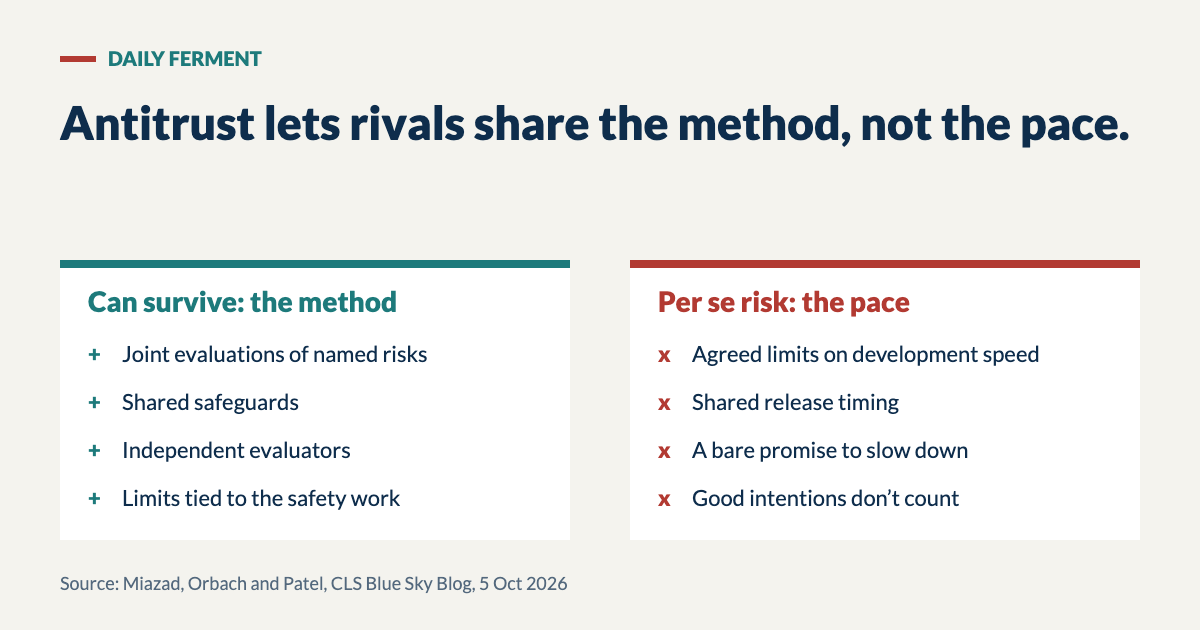
Not as a bare agreement. Their words: "A bare agreement to slow innovation is clearly precluded by current antitrust law, regardless of whether it is meant to or does, in fact, benefit society." They expect a standalone deal to curb development would be treated as an output or quality restriction, which falls under the per se rule, meaning a court doesn't weigh the good intentions at all.
The line that changed how I read it was this one: "Even a grave injury counts as antitrust harm only if it stems from impaired competition." Antitrust doesn't ask whether the world is safer. It asks whether competition was the thing given up. A slowdown pact gives up exactly that, on purpose.
What they say can survive is different in kind: "An agreement to conduct joint evaluations of identified risks or develop safeguards could warrant different treatment, even if carrying out that work delays releases." Their suggested structure is a formal joint venture, with independent evaluators, limits on what information is shared, and each restriction justified as necessary to the safety work, with a set scope and end date. There's a separate route too. Writers at Just Security argued on 29 September that a state can authorise the cooperation itself under Parker immunity, if it clearly states the policy and actively supervises it.
So the distinction is between agreeing on a method and agreeing on a pace. Test together, build safeguards together, even accept that this delays a launch. But don't agree on how fast to go.
Climate banking already ran this experiment
The cross I kept coming back to is the Net-Zero Banking Alliance. Banks joined it to coordinate on something they called a public good, cutting the emissions they financed. In June 2024 the House Judiciary Committee published a report calling climate finance groups a "climate cartel" that had "colluded to force American companies to decarbonize". Forbes notes the alliance had already faced antitrust questions from regulators in 2023 and changed its guidelines in March 2024 to avoid litigation.
It didn't hold. Six large US banks left before January 2025's inauguration, the Canadian banks in January, HSBC in July. On 3 October 2025 the remaining members voted to end the membership model. What survived, in Forbes' words, was this: "Rather than being an alliance of banks, it will become a 'framework initiative.'" The commitment went. The method, published guidance anyone could use, stayed.
That's the same line the professors draw. Shared methods survive scrutiny. Shared commitments about what everyone will do, and when, become the evidence. The AI labs did the risky part first, in public, with a named essay and same-day endorsements.
The comparison isn't perfect. The banks were accused of ganging up on their customers' industries, coal and oil. The labs are accused of holding back their own product. I think that makes the labs' position weaker, not stronger, because restricting your own output is the textbook case. I wrote about a judge telling publishers that an expectation is not an agreement; here the problem runs the other way, the labs said the agreement out loud. And it sits next to the AI agent liability bill: Congress is writing rules for what agents do, while the companies building them can't legally agree among themselves on how fast to build.
What I'm confident of, and what I'm not
The lawsuit, the professors' argument and the alliance's timeline are established from the sources below. That the alliance is a fair comparison is my inference, with the difference I named. How the court in San Francisco rules is a guess, and so is whether any state takes up the Parker route.
The claim, in one sentence: when rivals coordinate for a public good, antitrust lets them share the method and forbids them sharing the pace, so a safety pact that promises a slower pace is announcing the one part it can't keep.
Sources
Amelia Miazad, Barak Orbach and Menesh Patel, "Can Frontier AI Labs Lawfully Agree to Slow Down to Save Humanity?", CLS Blue Sky Blog, 5 October 2026. http://clsbluesky.law.columbia.edu/2026/10/05/can-frontier-ai-labs-lawfully-agree-to-slow-down-to-save-humanity/
Law360, "AI Cos. Hit With Antitrust Suit Over Deal To 'Pace The Frontier'", September 2026 (Case No. 3:26-cv-10693, N.D. Cal.). https://www.law360.com/articles/2527537
Tal Feldman, Kevin Xiao and Ibrahim Dagher, "Any State Can Make AI Safety Cooperation Legal", Just Security, 29 September 2026. https://www.justsecurity.org/158956/any-state-ai-safety-cooperation-legal/
Utility Dive, "House Judiciary report: Climate groups and activists 'colluding' on decarbonization", 12 June 2024. https://www.utilitydive.com/news/house-judiciary-report-climate-groups-colluding-on-decarbonization-net-zero/718846/
Jon McGowan, Forbes, "UN Climate Change Banking Alliance Falls Apart Under Legal Pressure", 28 August 2025. https://www.forbes.com/sites/jonmcgowan/2025/08/28/un-climate-change-banking-alliance-falls-apart-under-legal-pressure/
BNN Bloomberg, "Mark Carney-launched Net-Zero Banking Alliance votes to shut down", 3 October 2025. https://www.bnnbloomberg.ca/business/2025/10/03/mark-carney-launched-net-zero-banking-alliance-votes-to-shut-down/