A judge says Google never made publishers a deal. Now it picks who gets one.
Judge Mehta threw out Penske's AI Overviews case: "an expectation is not an agreement." The same week, Google is paying about 100 publishers it chose.

On Thursday, 1 October, US District Judge Amit Mehta dismissed Penske Media's antitrust case against Google over AI Overviews, and Chegg's alongside it. Penske, which owns Variety, The Hollywood Reporter and Rolling Stone, had said its organic affiliate revenue fell by more than a third from its peak, and tied that to the AI summaries at the top of Google's results.
Two days earlier, The Information reported that Google is paying about 100 publishers it invited, for content that contributes to those same answers. I wrote about that pilot on Saturday. Put the two side by side and the picture changes.
Can publishers sue Google over AI Overviews?
They can, and this suit failed on the bargain. Penske's main theory, under the Sherman Act, was reciprocal dealing: publishers give Google their content and Google gives them traffic in return, and AI Overviews broke that exchange.
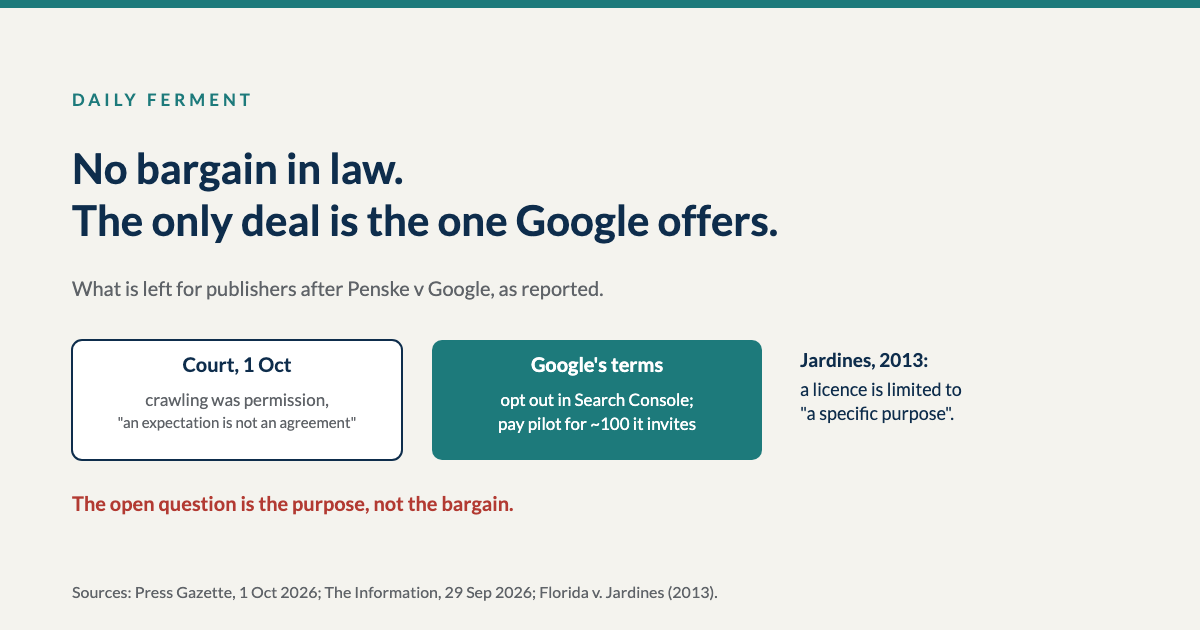
The judge's answer, as Press Gazette quotes it: "Plaintiffs have pleaded only that they have an 'expectation' that Google will send them search traffic if they make their content available for free. But an expectation is not an agreement. It is simply how a general search engine works." Publishers were "voluntarily acceding to cost-free crawling", and accepting the theory "would mean that Google contracts with every website that it indexes."
He wasn't dismissive of the harm. Search Engine Journal quotes him as "not unsympathetic to the situation publishers now find themselves in". But, per Forbes, "the court is bound to apply the law only as it is written."
Isn't that the end of the argument?
That was my first reaction. If there was never a deal, there's nothing to break.
Then I read what the judge said about tying, the other theory. He found "the more plausible inference is that Google Search and AI Overviews have the same use case: providing answers to users' search queries." That's a finding about purpose, and purpose is where I think the real argument sits.
Where have we seen this before?
On a front porch. In Florida v. Jardines in 2013, the Supreme Court described the implied licence anyone has to walk up to a house: it "typically permits the visitor to approach the home by the front path, knock promptly, wait briefly to be received, and then (absent invitation to linger longer) leave." And then the key line: the scope of a licence, express or implied, "is limited not only to a particular area but also to a specific purpose." Police could knock. They couldn't bring a drug dog onto the porch under the same licence.
That's the shape of what publishers are really saying. Leaving the site open to Google's crawler was a licence, not a contract; the judge is right about that. The question is what the licence was for. If it was for being listed in search, AI answers might be a different purpose. The court's finding that Search and AI Overviews share "the same use case" is a finding that the visitor never left the path.
This isn't the court's comparison, and it isn't legal advice. It's the frame that made the ruling make sense to me.
What's left for a publisher, then?
Two things, both on Google's terms. Press Gazette reports Google is rolling out a Search Console setting to opt out of AI Overviews and other AI features, after the UK's competition regulator ordered it. And there's the pilot: payment for "significant" contributions, to publishers Google picks, at rates it sets.
With no bargain in law, the pilot isn't a settlement of the dispute. It's the deal, and Google is the only party writing it. That's the same conclusion the AEO piece reached from the traffic side.
What I'm confident of, and what I'm not
The ruling's quotes come from Press Gazette, Search Engine Journal, Search Engine Roundtable and Forbes; I haven't read the opinion myself, and outlets disagree on whether the dismissal is with or without prejudice. The Jardines comparison is mine, not the court's. That the pilot becomes the terms is inference.
The claim, in one sentence: once a court says crawling was a permission and not a bargain, the only deal on offer is the one the crawler chooses to make, so the payment pilot isn't a settlement of the argument, it's the terms.
Sources
Press Gazette, "Penske AI Overviews lawsuit dismissed because 'no formal bargain' struck with Google", 1 October 2026. https://pressgazette.co.uk/news/penske-ai-overviews-lawsuit-dismissed-because-no-formal-bargain-struck-with-google/
Search Engine Journal, judge acknowledges publisher harm. https://www.searchenginejournal.com/judge-acknowledges-publisher-harm-but-dismisses-google-antitrust-claims/591748/
Search Engine Roundtable. https://www.seroundtable.com/google-ai-overview-lawsuit-dismissed-42211.html
Rick Ellis, Forbes, 1 October 2026. https://www.forbes.com/sites/rickellis/2026/10/01/google-wins-dismissal-of-penske-media-chegg-ai-lawsuits/
Engadget, 1 October 2026. https://www.engadget.com/2275023/judge-dismisses-lawsuits-claiming-googles-ai-overviews-siphon-web-traffic/
ppc.land. https://ppc.land/judge-mehta-dismisses-penskes-google-ai-overviews-antitrust-suit/
Florida v. Jardines, 569 U.S. 1 (2013), Cornell LII. https://www.law.cornell.edu/supremecourt/text/11-564