Stripe made OUSD the default. Who pays you to hold it?
OUSD is Stripe's new default stablecoin, issued by Stripe's own Bridge. The reserve yield goes to partners, so the question is who earns on your float.

On Wednesday, 30 September, Open USD went live, and on the same day Stripe made it the default stablecoin across its products. Since Thursday, 1 October, businesses can build with it through Coinbase too. I read the fine print, because a default is the setting most people never change, and I wanted to know who chose this one and what they get from it.
What is OUSD?
OUSD is a dollar stablecoin. Open Standard, the company that governs it, says "OUSD is issued by Bridge, a Stripe company", with "reserves held at BlackRock, Lead Bank and BNY". Its founding partners are Coinbase, Mastercard, Shopify, Stripe and Visa, and it runs on Base, Ethereum, Solana and Tempo. Bridge's reserve page showed about 470.8 million OUSD in circulation on 30 September, backed 55.1% by cash and 44.9% by Treasury money market funds, "100.00% collateralized". It doesn't name the attestation firm yet.
The difference from USDC and USDT is where the interest on the reserves goes. Open Standard's site says "nearly all reserve revenues" are "shared with companies that grow adoption". Partners "earn rewards proportional to the supply and activity they drive on their platforms" and can earn equity in Open Standard. Open Standard keeps a management fee; nobody has published the figure.
What does "default on Stripe" actually change?
Less than the headline, on day one. Stripe's post says "OUSD on Tempo is now Stripe's default stablecoin configuration", and that Stripe "won't require Stripe users to convert their existing stablecoin balances to OUSD". You can still pick another coin and chain.
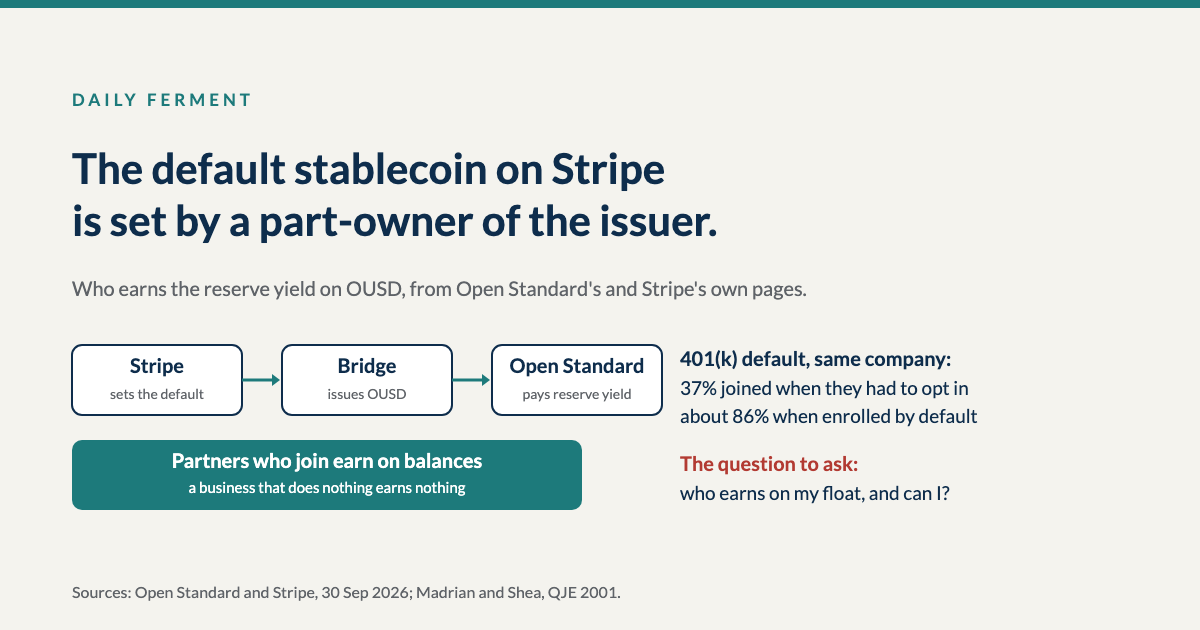
The rewards are not automatic either. Stripe says businesses "that join Open Standard as a partner can earn rewards based on OUSD activity", and that includes their OUSD balances on Stripe. So a business that does nothing gets OUSD as its new default and earns nothing on the float. A business that signs up as a partner can earn on it.
Isn't this just a better deal for businesses?
That was my first reaction. For years the complaint about stablecoins has been that the issuer keeps the yield on your money. Here is one that hands it back.
Then I looked at who sets the default. Stripe owns Bridge, Bridge issues OUSD, and Stripe is one of five founders with equity in Open Standard. The yield is shared with "companies that grow adoption", and the cheapest way to grow adoption is to make yours the coin nobody has to choose.
Why do defaults matter so much?
The clearest evidence I know is from pensions. Brigitte Madrian and Dennis Shea studied a US company that switched its 401(k) plan to automatic enrolment. At three to fifteen months of tenure, 37% of employees hired before the change had joined the plan. Among those hired under automatic enrolment, "approximately 86% of employees" participated. Same company, same plan, same match. The only change was which box was ticked before anyone looked.
What I take from that for OUSD: the default will probably move more balances than the rewards will, because most businesses won't read far enough to find the partner programme. That's an inference from pension behaviour, not something I've measured in payments. The difference with pensions is that the employer setting the 401(k) default wasn't paid by the fund. Here the party setting the default owns part of the issuer.
What should a business on Stripe check?
Three things.
First, whether you're holding stablecoin balances on Stripe at all, and which coin new money now lands in. Second, whether joining Open Standard as a partner is worth it at your balance, which you can't work out until the management fee is published. Third, whether the rest of your stack can tell OUSD apart from a different token with the same ticker.
That last one is real. Origin Dollar, a DeFi token from Origin Protocol, has traded as OUSD for years. Solana Compass warns that it is "unrelated" and readers should "check that address". Bitcoin.com opens with "OUSD can refer to two different assets". Anything that keys on the ticker will mix them up.
What I'm confident of, and what I'm not
The launch facts, reserve figures, Stripe's wording and the pension figures are established from the pages below. That the default will move more money than the rewards is my inference from the pension evidence. I don't know the management fee, and nobody outside Open Standard does yet.
The claim, in one sentence: when the platform that sets your default also owns the issuer, the default is its distribution plan, so before you accept it ask who earns the reserve yield on your balance and whether you can.
It sits next to the piece on stablecoin volume, which argued the headline number isn't the one to watch, and the FX routing piece, which was about what switching providers really costs. OUSD is the case where the provider pays you not to switch.
Sources
Open Standard, "OUSD is live", 30 September 2026. https://joinopenstandard.com/blog/ousd-is-live
Open Standard homepage. https://joinopenstandard.com/
Stripe, "OUSD now live on Stripe", 30 September 2026. https://stripe.com/blog/ousd-now-live-on-stripe
Stripe newsroom, "OUSD is now available on Stripe". https://stripe.com/newsroom/news/ousd-is-now-available-on-stripe
Bridge, OUSD reserves. https://reserves.bridge.xyz/ousd
Kyle Baird, The Block, 30 June 2026. https://www.theblock.co/post/406736/visa-stripe-coinbase-join-open-usd-stablecoin-shares-reserve-revenue
CoinShares, "What is Open USD and what does it mean for stablecoins?" https://coinshares.com/us/insights/research-data/what-is-open-usd-and-what-does-it-mean-for-stablecoins/
Bitcoin.com, "What is OUSD?" https://www.bitcoin.com/get-started/altcoins-and-tokens/stablecoins/what-is-ousd-open-usd-stablecoin/
Solana Compass, OUSD live on Solana. https://solanacompass.com/news/open-standards-ousd-stablecoin-goes-live-on-solana-with-free-11-minting-for-businesses
CoinGecko, Origin Dollar. https://www.coingecko.com/en/coins/origin-dollar
Brigitte C. Madrian and Dennis F. Shea, "The Power of Suggestion: Inertia in 401(k) Participation and Savings Behavior", Quarterly Journal of Economics 116(4), 2001. NBER working paper 7682. https://www.nber.org/system/files/working_papers/w7682/w7682.pdf