TikTok gave a placebo to people who pressed the safety button. Medicine has a rule for that.
New York says TikTok gave some users a reset button that did nothing. Holdout tests are normal. Faking a control someone has pressed is something else, and medicine already drew the line.

On Wednesday, 7 October, a judge's order unsealed part of New York Attorney General Letitia James's amended complaint against TikTok, and Reuters reported what was in it. The complaint says that in 2023 TikTok repeatedly tested Algo Refresh, the tool that's meant to reset your recommendations when your feed has gone somewhere you don't want it to go. Some of the people who switched it on got a version that did nothing. Their feeds stayed the same. A control group got the real thing. According to the complaint, the tests looked at how long people stayed in the app and at the effect on ad revenue. Thousands of users were in them, teens and children among them.
TikTok's spokesperson told Reuters that, like most companies, it regularly tests new features "to validate the experience and understand how they work in the real world", and said the lawsuit mischaracterises how Algo Refresh works. These are allegations in a lawsuit, not findings, and I'm treating them that way.
The question I want to work out is narrower than whether TikTok is bad. Is this just A/B testing, which nearly every product team runs every week? And if it isn't, where exactly is the line?
My first reaction was that this is an ordinary holdout
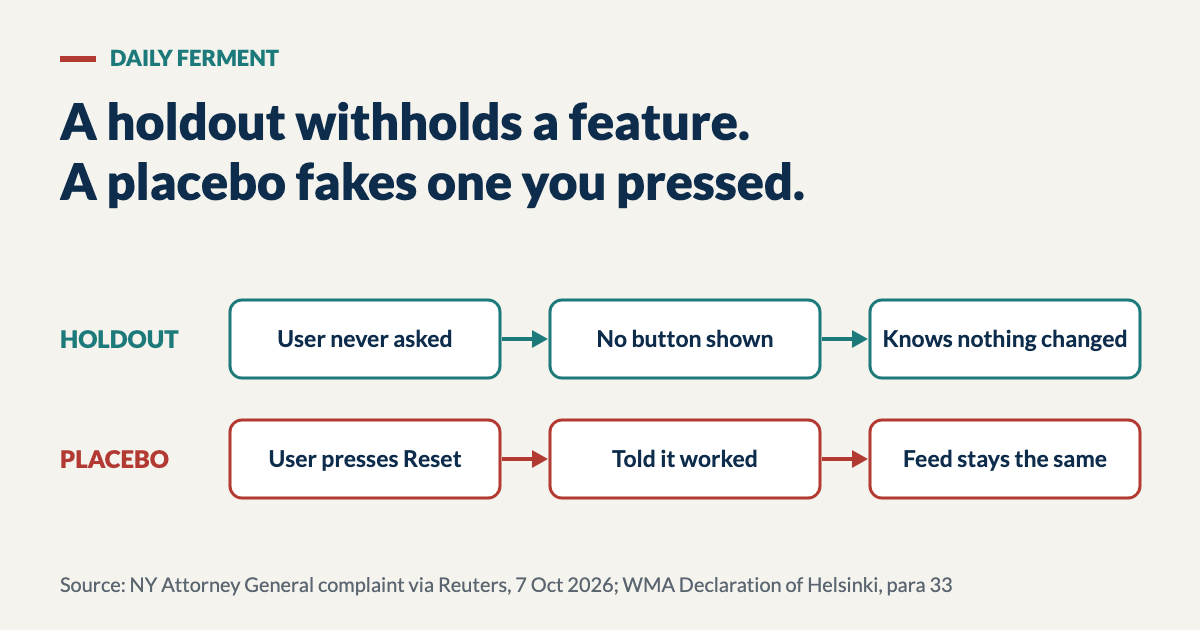
Holdouts are standard. You ship a feature to most users and keep a slice without it, so you can measure whether the feature did anything. Without that, you're guessing. If you banned holdouts on safety features, you'd also lose the ability to find out which safety features work. That argument is real and I don't want to wave it away.
Then I looked at what the holdout here actually was. In a normal holdout, the people in the control group never asked for anything. They just don't see the new button. Here, the complaint says, people found the button, pressed it, and were left believing it had worked. That isn't withholding a feature. It's answering a request with a fake.
A product manager on TikTok's Digital Well Being team seems to have seen it the same way. In an internal chat quoted in the complaint: "A placebo group completely conflicts with that." The "that" was algorithm transparency and control, which is what the feature was for.
The cross: medicine already drew this line
Medicine has been arguing about placebo groups for a long time, and the World Medical Association's Declaration of Helsinki, last revised in October 2024, is where the argument landed. Paragraph 33 says a new intervention "must be tested against those of the best proven intervention(s)". Placebo or no treatment is acceptable where no proven intervention exists, or where there are compelling methodological reasons and the people in the placebo arm won't face extra risk of serious or irreversible harm. Then: "Extreme care must be taken to avoid abuse of this option." Paragraph 31 adds that people must be told which aspects of their care are related to the research.
Hold TikTok's test against that. The company had already put Algo Refresh in front of users as the thing to use when your feed goes wrong. On its own description, this was the remedy, not an open question. In Helsinki's terms it was being presented as the proven intervention, and the placebo went to people who had come asking for it. And nobody in the placebo group was told that this part of their experience was an experiment.
The methodological exception is the honest counterargument. TikTok could say it genuinely didn't know whether the reset helped, and a placebo was the clean way to find out. Helsinki's answer to that is not "never". It's "with consent, and not where the people in the placebo arm carry real risk". Someone pressing a reset button because their feed has filled with content they want to escape is close to the definition of the person who carries the risk.
Ed Felten made the general version of this argument at Princeton in 2014, after Facebook's emotional contagion study. Consent, he wrote, should scale with risk: "Higher-risk cases would merit explicit, no-strings-attached consent for a particular test." Low-risk interface tweaks don't need it. A safety control does.
Where the comparison breaks
A drug trial measures what happens to the patient. By the complaint's account, this test measured time in app and ad revenue, which is what happens to the company. Medicine doesn't have a clean analogue for running a placebo arm to see whether the treatment costs the hospital money. If the complaint is right on that point, it's the part I find hardest to defend, and it's the part where the medical comparison is too kind.
The comparison also breaks on scale and speed. A clinical trial goes through an ethics board before anyone is enrolled. A product experiment can go from idea to thousands of users in an afternoon, and the only review is whoever is in the chat. The Digital Well Being product manager was, in effect, the ethics board, and lost.
What I'd take from it
A rule I'd put in any experiment policy: a holdout can withhold a feature, but it can never fake a control that a user has invoked. If you need to measure whether a user-triggered control works, test real versions of it against each other, or ask people to opt in. "This is a test version of refresh, want to try it?" costs you some statistical purity and buys you not having this paragraph quoted back to you in a complaint.
This is a cousin of something I wrote about Meta's Muse agent: asking for permission doesn't settle much if what happens behind the button isn't what the person thinks it is. There, the button was honest and the action went further than expected. Here, the action allegedly didn't happen at all.
What I'm confident of, and what I'm not
What the complaint alleges, the internal chat line and TikTok's reply are established from Reuters' report. The Helsinki wording is established from the WMA's current text, and Felten's argument from his post. Reading TikTok's own description of the feature as Helsinki's "proven intervention" is my inference; it isn't a legal standard and a court won't use it. Whether cases like this push platforms to separate holdouts from placebos in their written experiment policies is a guess.
The claim, in one sentence: once you've told people a control works, giving some of them a version that does nothing isn't a test of the feature, it's a test of whether they'll notice.
Sources
Reuters (Diana Novak Jones), "TikTok gave teens, children placebo safety feature in experiment, New York alleges", 7 October 2026, as republished by The Manila Times, 9 October 2026. https://www.manilatimes.net/2026/10/09/world/americas-emea/tiktok-gave-teens-children-placebo-safety-feature-in-experiment-new-york-alleges/2442277 (original: https://www.reuters.com/world/china/tiktok-gave-teens-children-placebo-safety-feature-experiment-new-york-alleges-2026-10-07/)
The Next Web, "TikTok gave young users a placebo safety tool, New York lawsuit alleges", 8 October 2026. https://thenextweb.com/news/tiktok-placebo-safety-tool
World Medical Association, Declaration of Helsinki, revised October 2024, paragraphs 31 and 33. https://www.wma.net/policies-post/wma-declaration-of-helsinki/
Ed Felten, "On the Ethics of A/B Testing", Freedom to Tinker (Princeton CITP), 8 July 2014. https://blog.citp.princeton.edu/2014/07/08/on-the-ethics-of-ab-testing/