ChatGPT is signing real cartoonists' names. In 1858 that was called a false mark.
ChatGPT has been signing AI cartoons with the names of more than 15 New Yorker cartoonists. Copyright looks at the drawing. An 1858 court looked at the name, and that's what the fix should check.
On Monday, 5 October, Nieman Lab published Andrew Deck's report that ChatGPT has been putting real New Yorker cartoonists' signatures on cartoons it generates. He documented "more than 15 New Yorker cartoonists" whose signatures turned up, from working contributors like Emily Flake, Joe Dator and Pat Byrnes to Saul Steinberg and George Booth.
The example that went furthest was a cartoon of Dolly Parton arriving at heaven's reception desk with Tim Curry. One tweet of it got 25,000 likes. In the corner is "BLOPER", the signature of cartoonist Brendan Loper. He didn't draw it. A Dolly Parton fan had asked ChatGPT for "a New Yorker-style cartoon", and it signed the result with his name.
The question I want to figure out: is the signature just one more part of the style being copied, or a different thing altogether?
What Nieman Lab found
The detail that stopped me is Pat Byrnes. He has signed his cartoons with a period at the end since he was a teenager. "It was like signing a letter," he told Deck. Across the more than a dozen ChatGPT cartoons Deck found with Byrnes' name, "every one ended with a period."
So the model hasn't just learned what a New Yorker cartoon looks like. It has learned who signs them, and how.
Condé Nast signed a multi-year licensing deal with OpenAI in 2024. A New Yorker spokesperson told Deck that Condé Nast "has never granted an LLM developer permission to train models on its cartoons." OpenAI didn't answer how its models picked up the signatures. Its statement said: "We believe the future of creativity is one that is fundamentally human, and our focus is on building tools that empower human creativity and creators."
After Deck contacted OpenAI, ChatGPT started answering some requests with: "This prompt may violate our guardrails concerning similarity to third-party content." As of publication, it was still signing some cartoons with real names.
My first reaction, and where it went wrong
My first reaction was that this is the copyright fight again, with a signature as the most visible proof of copying. If the model learned the name, it learned from the work.
But the cartoonists themselves kept pulling those apart. Deck writes that the fakes signed with Emily Flake's name looked more like a blend of several cartoonists' styles. "Each signature, though, was undeniably hers." Flake's line: "It's like somebody attributed a quote to me that I didn't say." Dator went further: "I've had people hack my credit card. That feels like less of a violation than this. When they hacked my credit card, they didn't dress up like me."
And the lawyer in the piece agrees, from the other side. James Grimmelmann of Cornell told Deck: "[The signature] is an indication of authenticity, but attribution is a very small part of the fair use inquiry." A copyright claim would turn on the drawing style, and the model isn't reproducing any one cartoon. So the thing that hurts the cartoonists most is the thing copyright cares about least.
The 1858 case about a painted name
In R v Closs, decided in 1858, a picture dealer named Thomas Closs had a copy of a painting by John Linnell and painted Linnell's name on it, to pass it off as an original. He was charged with forgery. The court said no: "a forgery must be of some document or writing", so painting an artist's name in the corner of a picture isn't forgery.
But the court didn't stop there. It said that someone who, in the course of trade, "puts a false mark or token upon a spurious article so as to pass it off as a genuine one", and gets money by it, is "guilty of a cheat at common law."
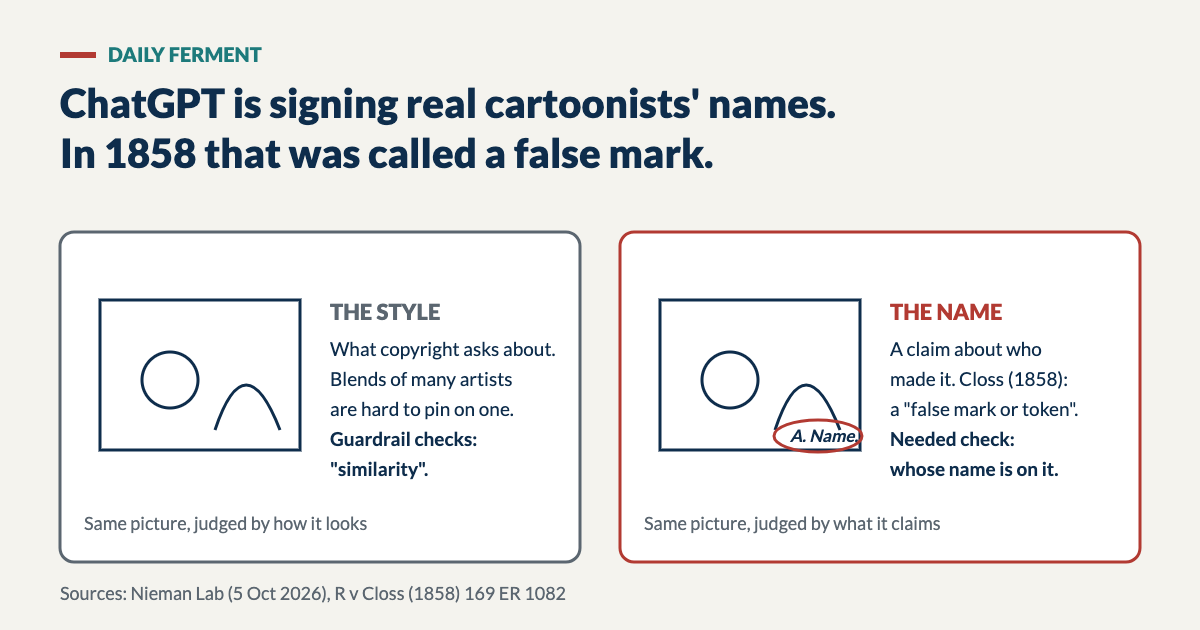
That's the separation the cartoonists were making by instinct. The copy is one thing. The name on the copy is a false mark, and it's wrong for a different reason: not because it looks like Linnell's work, but because it says it is.
The fit isn't clean. Closs was a dealer selling a picture for money. Nobody sold the Dolly Parton cartoon; it went viral for free. So the 1858 rule, read literally, wouldn't catch ChatGPT either. What carries over is the category. A name isn't part of the picture's style. It's a claim about who made it.
Why this matters for the fix
Look at the guardrail OpenAI added: "similarity to third-party content". That's a likeness test. It asks how close the picture is to someone else's work. But Flake's fakes weren't close to her work. They were a blend with her name on top. A likeness check could pass that picture and still let the false mark through.
The cheaper fix, it seems to me, is the 1858 one: treat names as marks, not pixels. Check generated images for real people's signatures and strip or refuse them, whatever the drawing looks like. That doesn't settle the training question, which is still open. It only stops the model telling people that a real cartoonist made something they didn't.
There's a cost the cartoonists named that no filter fixes. Jason Chatfield wrote this week that when people search their names, "viral slop now comes up, not the body of actual artwork we've painstakingly produced over decades." That's the same problem I keep running into with Google's AI answers and who gets credit for the work underneath. The name is how readers find the person. Once a machine can attach it to anything, the name stops pointing back.
What I'm confident of, and what I'm not
The signatures, the quotes and OpenAI's response are established from Nieman Lab's report. R v Closs is established from the reported case. That OpenAI's new guardrail checks likeness and so can miss a bare signature is my inference from its wording; I haven't tested it. Whether a name check would be enough is a guess, because models may keep learning signatures as part of the style.
The claim, in one sentence: copying a style and putting a real person's name on the copy are different wrongs, so an AI guardrail that checks how similar a picture looks will keep missing the one that checks whose name is on it.
Sources
Andrew Deck, "ChatGPT is adding real cartoonists' signatures to fake New Yorker cartoons", Nieman Lab, 5 October 2026. https://www.niemanlab.org/2026/10/chatgpt-is-adding-real-cartoonists-signatures-to-fake-new-yorker-cartoons/
Jason Chatfield, "The Robots Are Forging Our Signatures.", New York Cartoons, October 2026. https://www.newyorkcartoons.com/p/aaaaand-now-the-robots-are-forging
R v Thomas Closs (1858) 169 ER 1082; 27 LJ MC 54. https://vlex.co.uk/vid/r-v-thomas-closs-802284133