Two customers are a quarter of Anthropic. Two clouds are half.
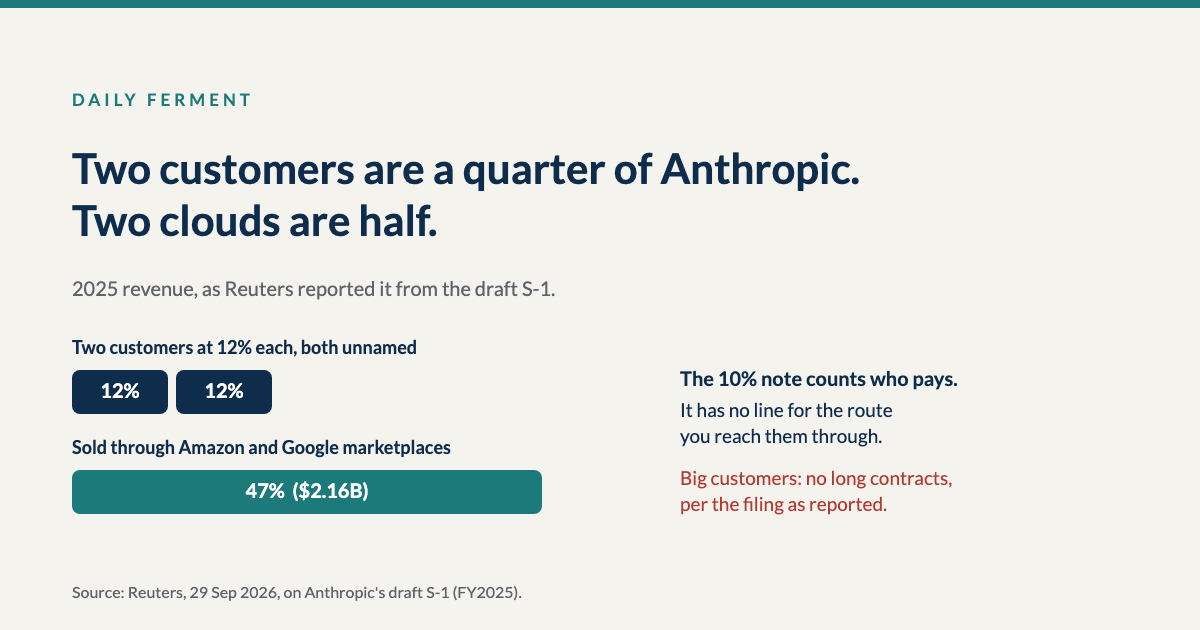
Anthropic's draft S-1 shows two unnamed customers at 12% of revenue each. The bigger dependence is the 47% sold through Amazon and Google, which that note doesn't count.

On Tuesday, 29 September, Reuters reported what is in Anthropic's draft IPO prospectus. The line that travelled was that "two unnamed customers each generated 12% of revenue last year." A quarter of a company priced at about $2 trillion, from two buyers.
The line that travelled less was in the same story. Sales through Amazon's and Google's cloud platforms were "$2.16 billion, or 47% of Anthropic's annual revenue in 2025."
I wanted to know whether those are the same two, and which number is the real dependence.
Who are Anthropic's two biggest customers?
Nobody outside the company knows. The Ringer's Katie Baker put it plainly: "The S-1 doesn't name them, so we're left to guess." Her guesses run from Cursor and GitHub to Meta, AWS, the US government and Jane Street. OfficeChai guesses Cursor and GitHub Copilot. One crypto site reported that Amazon and Google were the two 12% customers; Reuters treats the two figures separately, and I think that site misread it.
The filing isn't required to name them. The US accounting rule, ASC 280-10-50-42, says that if a single customer brings in "10 percent or more" of revenue, the company must disclose that fact and the amount. It also says the company "need not disclose the identity of a major customer." That's why we get two anonymous 12s and nothing below 10%.
Aren't the two customers just Amazon and Google?
That was my first reaction too. Two big numbers, two big clouds, and nearly half of revenue going through them.
The accounting points the other way. Reuters reports that Anthropic books marketplace sales gross "because it is the 'principal' in the transaction", and paid "roughly $351 million back to the platforms in distribution fees." PwC's guide to the revenue standard explains that when the reseller is the principal, the vendor's customer is the reseller. When the vendor is the principal, as Anthropic says it is, the customer is the business at the other end. So, as I read it, a company buying Claude through AWS counts as Anthropic's customer, and AWS counts as a channel.
That's my inference from the rules, not a line from the filing. If it's right, the 10% note and the 47% figure measure two different things, and the second one has no 10% note of its own.
Which concentration should worry an investor more?
Reuters says sales through the two clouds went from 11% of revenue in 2023 to 32% in 2024 to 47% in 2025. Inc. reports the filing warns that "many of the biggest clients are not locked into long-term contracts and can cut or stop spending."
CoreWeave is the useful comparison. Its 2025 S-1 said its largest customer was 62% of 2024 revenue, Microsoft according to Fortune, and its top two were about 77%. That looks far worse. But the same filing said "the vast majority of our revenue today is from multi-year committed contracts." CoreWeave's concentration was in buyers who had signed for years. Anthropic's, as reported, is in buyers who can leave, reached through two partners that also build their own models.
A big customer can leave. A channel can do something quieter: change its fees, change what it shows first, or favour its own model. None of that has to happen for the dependence to be real.
What I'm confident of, and what I'm not
The figures are established, but from reporting on a draft the SEC hasn't published; Anthropic confirmed on 1 June that it had confidentially submitted a draft S-1. Who the two customers are is unknown, and every name in circulation is a guess. That marketplace sales count against end customers rather than Amazon and Google is my inference from the accounting.
The claim, in one sentence: the 10% customer note in a filing tells you who pays; it doesn't tell you who you depend on to reach them, and for Anthropic the second number is the bigger one.
This picks up a thread from the Microsoft billing piece, where the platform's terms mattered more than the price on the page. If the public S-1 lands in October, as The Ringer expects, I'll come back to this and say what changed.
Sources
Echo Wang and Krystal Hu, Reuters, "Anthropic IPO prospectus lays bare deep dependence on big tech partners", 29 September 2026, via Investing.com. https://investing.com/news/stock-market-news/exclusiveanthropic-ipo-prospectus-lays-bare-deep-dependence-on-big-tech-partners-4923585
Jim Edwards, Fortune, 29 September 2026. https://fortune.com/2026/09/29/anthropic-ipo-s-1-prospectus-income-statement/
Moses Jeanfrancois, Inc., 29 September 2026. https://www.inc.com/moses-jeanfrancois/quarter-of-anthropic-revenue-come-from-2-customers-experts-say-real-test-comes-next/91411817
Katie Baker, The Ringer, "The Numbers Behind Anthropic: An FAQ", 30 September 2026. https://www.theringer.com/2026/09/30/tech/anthropic-ipo-numbers-leak-dario-amodei
Anthropic, confidential draft S-1 submission, 1 June 2026. https://www.anthropic.com/news/confidential-draft-s1-sec
Deloitte DART, ASC 280, information about major customers. https://dart.deloitte.com/USDART/home/codification/presentation/asc280-10/roadmap-segment-reporting/chapter-5-entity-wide-disclosures/5-7-information-about-major-customers
PwC Viewpoint, Revenue guide 10.3, determining whether a vendor is principal or agent. https://viewpoint.pwc.com/dt/us/en/pwc/accounting_guides/revenue_from_contrac/revenue_from_contrac_US/chapter_10_principa_US/10_3_determining_a_vendor.html
CoreWeave, Form S-1, March 2025. https://www.sec.gov/Archives/edgar/data/1769628/000119312525044231/d899798ds1.htm
Fortune, CoreWeave IPO filing, 3 March 2025. https://fortune.com/2025/03/03/coreweave-ipo-s1-filing-nasdaq-ai-cloud-nvidia-microsoft/