Google will pay for AI answers. It won't show the meter.
Google pays about 100 publishers when their content shapes AI Overviews. The payout shows in Search Console; the usage behind it doesn't.

On Tuesday, 29 September, The Information reported that Google "has been paying roughly 100 digital publishers for how much their content contributes to AI-powered answers to search and other products." Digiday broke the outline two weeks earlier. One early participant is reported at more than $1 million a year. A later one made $50,000 to $60,000 in a few months. Some sites got under $1,000 over several months.
Daily Ferment is a site a few weeks old, so this isn't money I'm about to see. I read it because it's the first time Google has put a price on the thing every small publisher has been asking about since AI Overviews arrived: what is my writing worth to the answer that replaced my click?
How does Google's AI contribution pilot work?
It's invitation only. Publishers who accept the terms see a panel in Search Console with "monthly earnings and some historical data", according to Search Engine Journal. Payment covers the Gemini app, AI Overviews and AI Mode.
The rule turns on one phrase from Google's help text, as SEJ quotes it: content that "contributes significantly" to an answer. And one exclusion: "Web content may also confirm facts or be linked to within Google's AI after a response is generated, but those instances don't qualify for AI contribution." Being the cited link under an answer isn't enough. Your page has to have shaped the answer before it was written.
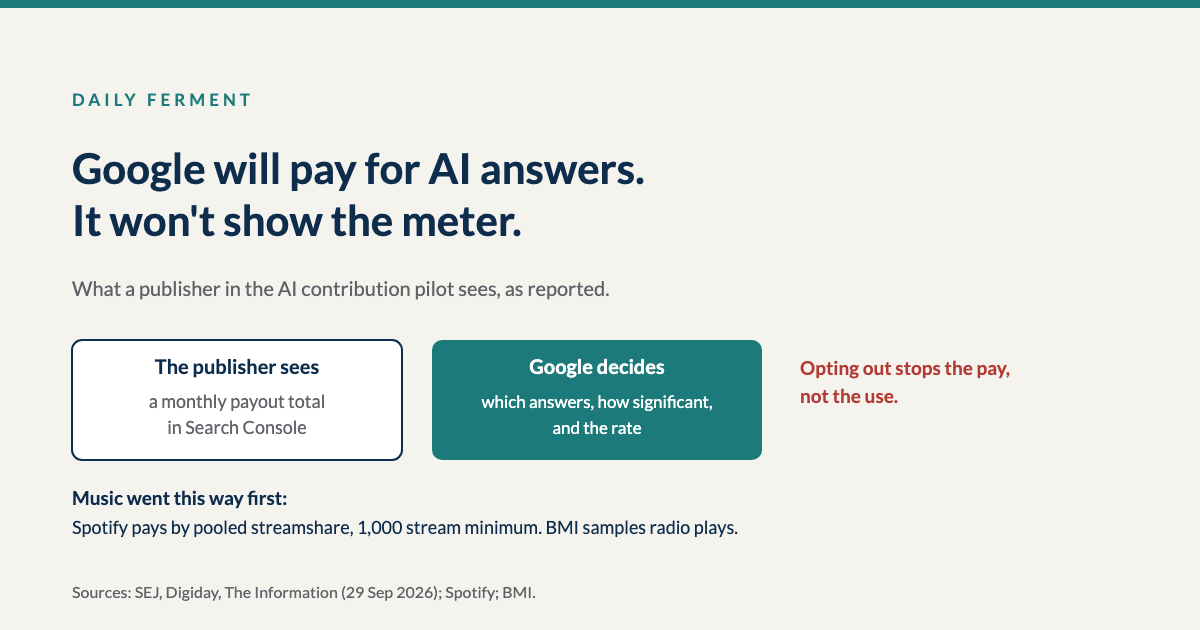
You can leave at any time. Leaving stops the payment, not the use: aiweekly notes that opting out "doesn't prevent Google from using content in AI Overviews, AI Mode, or Gemini."
Can publishers see what they're being paid for?
No. SEJ says the panel "doesn't show how the number was worked out." An executive familiar with the programme told Digiday, "It's quite black box." Per ppc.land's account of The Information's story, recipients "have no idea how the amounts are calculated."
My first reaction was that this is a starting point, and the reporting will get better. Then I looked at who has the usage data. Google decides which answers your page contributed to, decides whether it counted as significant, and decides the rate. The publisher sees a total.
Where have we seen this before?
In music. Spotify says it "does not pay artist royalties according to a per-play or per-stream rate". It pools subscription and ad revenue and pays each rightsholder by "streamshare", their share of all streams in the month. Since early 2024 a track needs "at least 1,000 streams in the previous 12 months" to earn anything. Radio royalties work on a sample: BMI uses monitoring data from "a large percentage" of stations and factors it up to represent the rest.
Each of these has a reason. Each also means the small earner can't check the number. NPR's 2019 piece quoted this complaint: "You cannot get at actual data, especially financial data... they do not tell you exactly what you're making."
The transfer I'd make: once payment depends on a measurement only the buyer can see, the buyer is setting the price. That's not a claim that Google's numbers are wrong. It's that nobody outside Google can tell.
What should a small publisher do with this?
Keep measuring what you can count yourself. Search Console already shows clicks and impressions. Those numbers are also Google's, but they're per page and per query, so you can line them up with your own analytics and see whether they hold up. A payout total can't be lined up with anything.
What I'm confident of, and what I'm not
How the pilot works and the reported payouts are established from the trade press, though Google's help page can only be read by participants, so its wording comes through SEJ. That the payouts will stay unauditable is my inference from how the pilot is built. The royalty comparison is established for Spotify and BMI; whether it predicts where Google goes is a guess.
The claim, in one sentence: a payment you can't reconcile to usage is a price the buyer sets, so for a small publisher the number worth managing is still the traffic you can count, not the payout you're shown.
It follows the AEO piece, which argued that most "AI search wins" were the platform growing, not the publisher. This one is about the same platform deciding what the publisher is owed.
Sources
Jessica Davies and Sara Guaglione, Digiday, 14 September 2026. https://digiday.com/media/google-rolls-out-pay-value-ai-licensing-program-to-publishers/
Matt G. Southern, Search Engine Journal. https://www.searchenginejournal.com/google-tests-paying-publishers-for-ai-answers-via-search-console/589414/
Barry Schwartz, Search Engine Roundtable. https://www.seroundtable.com/google-al-contribution-pilot-42076.html
Ben Schoon, 9to5Google, 17 September 2026. https://9to5google.com/2026/09/17/google-ai-contribution-pilot-tests-paying-websites-when-theyre-used-in-ai-results/
Alix Coutures and Catherine Perloff, The Information, 29 September 2026 (paywalled). https://www.theinformation.com/articles/google-paying-100-digital-publishers-ai-overviews
ppc.land, on The Information's report. https://ppc.land/google-pays-about-100-publishers-for-ai-answers-some-under-1-000/
aiweekly, 30 September 2026. https://aiweekly.co/alerts/googles-ai-overviews-pilot-pays-100-publishers-one-over-1m
Spotify, "Royalties". https://support.spotify.com/us/artists/article/royalties/
Spotify for Artists, "Modernizing our royalty system", 21 November 2023. https://artists.spotify.com/en/blog/modernizing-our-royalty-system
Paula Mejía, NPR, 20 July 2019. https://www.npr.org/2019/07/20/743775196/the-success-of-streaming-has-been-great-for-some-but-is-there-a-better-way
BMI, "How we pay royalties". https://www.bmi.com/creators/royalty/how_we_pay_royalties