Korean banks had permission to test with AI. The attacker just had the tool.
Seven Korean financial firms were breached through side systems, with traces of a free AI pen-testing tool. Regulators then paused the scheme that lets banks use AI on themselves. The exempt banks mostly hadn't used it.
On Tuesday, 6 October, South Korea's Financial Services Commission put on hold an announcement it had planned for the next day. It was going to name the second group of financial companies allowed to step outside the country's strict network separation rules, so they could use outside AI services to hunt for holes in their own systems.
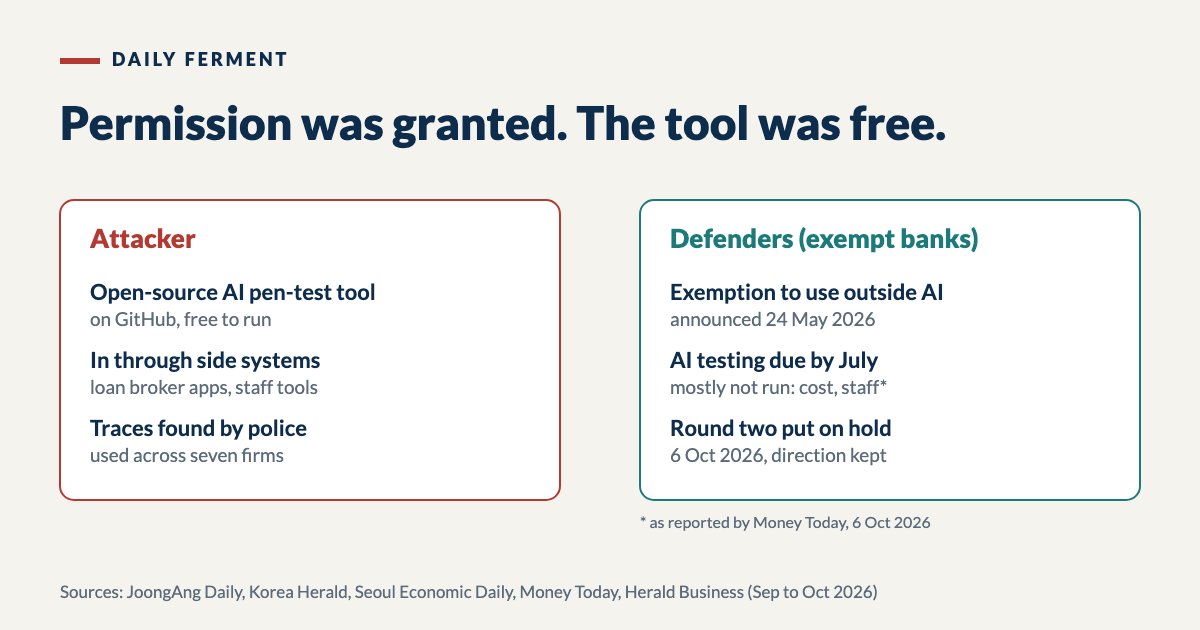
The reason was the week before. Between late September and early October, seven financial firms reported breaches: Shinhan Bank, KB Kookmin, Hana, BNK Busan, Yegaram Savings Bank, Welcome Savings Bank and Hyundai Capital. Shinhan put its count at about 25,700 customers and Yegaram at about 40,000. Woori and NH NongHyup saw attempts that were blocked. Police found traces of Artex, which JoongAng Daily describes as a Chinese-language open-source penetration testing tool on GitHub that uses AI to probe for weaknesses. Shinhan and Hana were both in the first group that got the exemption.
So the question I wanted to answer: if the attackers used AI, does it make sense to slow down the scheme that lets the defenders use it too?
What actually happened in the Korean bank hacks?
Nobody went through the core banking systems. The attackers came in through the side: loan broker apps, employee support tools, sales support systems. The Financial Security Institute grouped the weak points into three kinds, according to the Seoul Economic Daily: lookup services with no authentication, staff systems with weak access controls, and websites with known, unpatched holes. The leaked data was names, phone numbers, annual income and loan limits from loan applications. The regulator's chair, Lee Eok-won, said the leaked data couldn't be used directly for payments, and warned about phishing built on it.
Some caution is due on the AI part. Kim Seung-joo of Korea University's information security school told JoongAng Daily, "It has not been confirmed whether Artex was the only tool used in the attacks." What's established is the traces, the shared attacker IP across the banks, and the side doors.
Why pause the AI exemption?
My first reaction was that the pause is reasonable. You're mid-incident. You don't widen access to outside AI services at the exact moment you're counting what leaked. And part of the stated reason, as Herald Business reported it, is just that: the regulators are busy with incident response, and the agenda needs another security review. A delay for bandwidth isn't a policy.
Then I checked what the exemption was for, and whether it had been used.
It was announced on 24 May, as a response to AI attacks. Vice Chairman Kwon Dae-young said "Advanced AI security threats are like a cold virus", something you can't fully block and have to manage while living with it. The second round would have widened the eligible pool from 49 firms to 75 and picked up to 15, each getting a one year letter of non-enforcement.
And on Tuesday, Money Today reported that most of the ten exempt firms hadn't done the AI vulnerability testing that was due by July. The reasons it gives are ordinary: the token bills for running models through a cloud service, and not enough security staff to fix what the testing found. It also reported that iM Bank was hit by a suspected AI attack a month earlier, in late August.
Put those side by side. The attacker's tool is open source and free to run. The defenders had written permission and a deadline, and stalled on cost and headcount. The regulators themselves say the breaches came from weak basic controls, not from the exemption, and that the overall direction stays. So the pause removes something that, on this reporting, mostly wasn't happening, and doesn't touch the side doors at all.
Using the regulator's own metaphor
Kwon called AI threats a cold virus, so I went to the place where that metaphor has been tested hardest: outbreak vaccination.
During Ebola, the response wasn't to pause vaccines while cases rose. It was ring vaccination, giving the vaccine to the contacts of a confirmed case and to their contacts, as fast as possible. The outbreak is when you deploy. But the trial reports also show the catch. In the PREVAIL I cluster study in Liberia, published in 2018, about 650 close contacts and contacts of contacts were eligible, and 210, or 32%, were vaccinated. The median time from the index case's lab confirmation to vaccinating his contacts was 15 days. The vaccine was available. The ring still had gaps, and they were about consent, logistics and time, not permission.
That's the shape I see in Seoul. Permission to use AI defensively is the vaccine being licensed. It isn't the vaccine being given. If the exempt banks didn't run the testing because of token costs and staff, then what's scarce is money and people, and pausing round two doesn't create either. Ring vaccination works because someone is funded to go door to door within days. The bank version is someone funded to run the scans and fix the loan broker app.
The comparison has limits. A virus doesn't adapt to your vaccination plan the way an attacker adapts to your patching. And I don't know that AI testing would have found these particular doors; an unauthenticated lookup page is the kind of thing a plain scanner finds too. Which, if anything, makes the point sharper: the basics were missing, and AI was the headline.
It also connects to what I wrote last week about the HFS bug that was public for 11 weeks and exploited a day after the write-up. Attackers moving fast with good tools isn't new. What's new is how cheap the good tools are, and how expensive the defender's equivalent still looks on a budget line. And like Nvidia's sandboxes, where the breach went between them, the damage here came through the connecting pieces nobody thought of as core.
What I'm confident of, and what I'm not
The breaches, the side-door entry points, the Artex traces and the paused second round are established from the Korean reporting below. That most exempt firms hadn't run the AI testing comes from one outlet, Money Today, and I'd treat it as reported, not confirmed. That the pause changes little is my inference. Whether AI testing would have stopped these attacks is a guess.
The claim, in one sentence: when the attacker's tool is free and the defender's version needs a budget and staff, permission was never the bottleneck, so pausing permission after a breach changes the paperwork more than the odds.
Sources
Korea JoongAng Daily, "AI-driven hacks on banks leave customers fearing their data is fair game", 5 October 2026. https://www.koreajoongangdaily.com/korea/aidriven-hacks-on-banks-leave-customers-fearing-their-data-is-fair-game/12905416
The Korea Herald, "Korean banks on high alert after wave of cyberattacks", 5 October 2026. https://www.koreaherald.com/article/10893326
The Korea Times, "AI-powered attacks on banks expose technological lag in Korea's financial cyber defenses", 5 October 2026. https://www.koreatimes.co.kr/business/banking-finance/20261005/ai-powered-attacks-on-banks-expose-technological-lag-in-koreas-financial-cyber-defenses
Seoul Economic Daily, "Same IP Used in Hacks on Multiple Korean Financial Firms", 4 October 2026. https://en.sedaily.com/finance/2026/10/04/same-ip-used-in-hacks-on-multiple-korean-financial-firms
SBS News, "Widespread Hacking Attacks Reach Mutual Finance Using AI", 4 October 2026. https://news.sbs.co.kr/english/article.do?news_id=N1008782472
Herald Business (Korean), on the second-round hold, 6 October 2026. https://biz.heraldcorp.com/article/10894072
Money Today (Korean), on iM Bank and the untested exemption, 6 October 2026. https://www.mt.co.kr/finance/2026/10/06/2026100614393083729
Seoul Economic Daily, "Korea to Ease Network Separation Rules to Counter AI Hacking Threats", 24 May 2026. https://en.sedaily.com/finance/2026/05/24/korea-to-ease-network-separation-rules-to-counter-ai
Digital Today, "FSC to ease network separation rules again", 3 September 2026. https://www.digitaltoday.co.kr/en/view/99966/fsc-second-round-eases-network-separation-rules-expands-to-non-bank-financial-and-e-finance-firms
Bolay FK, Grandits G, Lane HC et al., "PREVAIL I Cluster Vaccination Study With rVSVΔG-ZEBOV-GP as Part of a Public Health Response in Liberia", The Journal of Infectious Diseases, 2018. https://pmc.ncbi.nlm.nih.gov/articles/PMC6562162