When a deadline moves every year, the best-advised stop believing it
A deadline that moves every year stops working on the people who notice. Pakistan moved its tax date twice this year, and company filings fell 22% as firms waited.
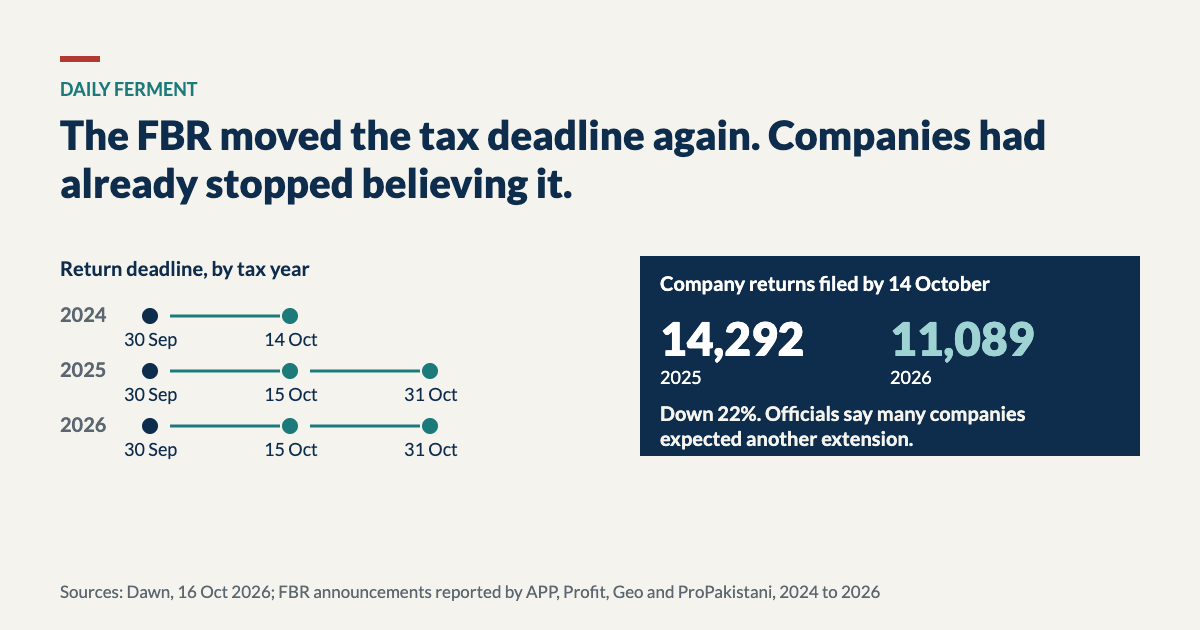
On Thursday 15 October Pakistan's tax authority, the Federal Board of Revenue (FBR), moved the deadline for tax year 2026 income tax returns to 31 October. It was meant to be 30 September. On 30 September it became 15 October. Now it's the end of the month. The FBR's statement, as ProPakistani reported it, gave the same reason as before: "This extension is being granted in view of the requests from various trade bodies and tax bar associations".
The numbers are good. By 14 October the FBR had 6.710 million returns, up from 4.993 million at the same point last year, Dawn reported. Non-salaried filers, the traders, shopkeepers, professionals and self-employed people the FBR most wants in the system, were up 46 percent.
One line in Dawn's report went the other way. Companies filed 11,089 returns by 14 October, against 14,292 a year earlier, a fall of 22.41 percent. FBR officials called it a matter of timing: "Many companies, they say, held back in the expectation that the filing date would be extended further." They were right to expect it.
So the question I'm working on is about the deadline, not the taxpayers. What does a deadline teach people when it moves every year? That isn't only a Pakistani question. Anyone who sets dates for other people, from a regulator to a manager with a release date, is drawing on the same credibility.
My first reaction was that extensions are a kindness
The case for this one is real. ProPakistani reported in late September that the IRIS portal was slow, glitchy and failing to accept many individual returns. Filing is new for a lot of people, and the FBR wants them in the system more than it wants them fined. If the portal fails, the date should move.
Then I looked back. In 2019 the deadline moved to 31 October; tax experts said the law allows 90 days and "only 28 days were given" for online filing. On 21 September 2024 the FBR spokesperson told Geo News: "September 30 will be the last date to file tax returns." It was extended to 14 October. In 2025 the date went from 30 September to 15 October to 31 October, the second move announced on 15 October, under Section 214A, "in response to requests made by various trade bodies and tax bar associations." This year it followed the same steps.
A taxpayer doesn't need to read the notifications to learn that. A company with a tax adviser certainly doesn't. The adviser has seen the pattern for years, and Dawn's numbers suggest companies acted on it.
The cross: the countdown clock that resets
UK consumer law has a name for this, from a case about mattresses.
Emma Sleep ran discount banners with countdown timers on its UK website. When a timer ran out, the same or a very similar offer reappeared and the clock started again. The Competition and Markets Authority took it to court. On 22 May 2026 the High Court confirmed the breaches, and Emma gave undertakings that include not running "limited time" sales where substantially similar deals carry on after the stated deadline. Hayley Fletcher of the CMA put it plainly: "using fake countdown clocks or misleading 'discounts' to push people into spending is illegal." The UK's newer consumer law lists "Falsely stating that a product will only be available for a very limited time" as a banned practice outright.
The logic of the rule isn't only about honesty. A clock that resets works on the shoppers who haven't noticed yet and stops working on the ones who have. Over time it teaches the most attentive customers to ignore every clock, including the real ones.
Put the FBR's date next to that. Each year there's a date, in 2024 called the last one outright, and each year a similar deal continues after it. The people who notice first are the ones with advisers and accountants: companies. And they're the ones whose filings fell.
Where the comparison breaks
The FBR isn't selling anything, and an extension doesn't cost taxpayers money the way a fake discount does. If anything it saves them penalties. The extensions also have a legal basis in Section 214A, and the portal problems this year were reported, not invented.
The company numbers don't prove the point either. The explanation is the officials', and Dawn also notes a surge in tax paid with returns, so the late filers may matter less to revenue than the count suggests. Corporate returns are a small count, about 11,000 against 6.7 million in all, and a lot can move in the last two weeks.
There's a cost the extension does carry, though. It falls on whoever believed the first date, paid for help in a rush or filed in a crowded week, and on the next deadline, which will be believed a little less.
What that suggests
The FBR's own report on why filing rose names three things: matching tax returns against bank, property, vehicle and withholding data, a simpler form for most salaried people and small businesses, and restrictions on non-filers. None of them depends on the date being believed. They work because they're enforced.
The date is the one tool that runs on credibility, and it's being spent every year. My view, and it's only a view: a deadline that can move should say in advance when it will, for example only if the portal is down for a stated number of hours, and publish those hours. Then an extension is a rule being followed, not a clock being reset, and a company that waits is betting against a published rule rather than against a habit.
None of that is special to tax. Any date that moves on request works the same way: the people who have watched it move before plan around the move, not the date.
I looked at a version of this when MongoDB's CEO left for Meta: a reassurance only counts if it would cost the people giving it something. A deadline that moves on request costs the people setting it nothing.
What I'm confident of, and what I'm not
The filing numbers and the officials' explanation for the drop in company returns are established from Dawn's report of FBR data. The extension history is established from news reports in 2019, 2024, 2025 and 2026. The UK rule is established from reports of the Emma Sleep order and the CMA's own statements. That repeated extensions caused companies to wait is the officials' reading, which I find plausible and can't test. That a published extension rule would work better is my view, not something anyone has tried here.
The claim, in one sentence: a deadline that moves every year stops being a deadline for the people best placed to notice, so the extension meant to help filers ends up teaching the biggest ones to wait.
Sources
Mubarak Zeb Khan, Dawn, "Returns filing date extended to 31st", 16 October 2026. https://www.dawn.com/news/2037471/returns-filing-date-extended-to-31st
ProPakistani, "FBR Extends 2026 Tax Return Deadline Again", 15 October 2026. https://propakistani.pk/2026/10/15/fbr-extends-2026-tax-return-deadline-again/
ProPakistani, "FBR Extends 2026 Tax Return Deadline", 30 September 2026. https://propakistani.pk/2026/09/30/fbr-extends-2026-tax-return-deadline/
Associated Press of Pakistan, FBR extends deadline till 31 October 2025, 15 October 2025. https://www.app.com.pk/?p=1086032
Profit, "FBR extends tax return filing deadline to October 14" (tax year 2024). https://profit.pakistantoday.com.pk/?p=173417
Geo News, "No extension in Sept 30 deadline for filing tax returns: FBR", 21 September 2024. https://www.geo.tv/latest/565334-no-extension-in-sept-30-deadline-for-filing-tax-returns-fbr
ProPakistani, "Here is why FBR was legally bound to extend deadline for tax returns", 1 October 2019. https://propakistani.pk/2019/10/01/here-is-why-fbr-was-legally-bound-to-extend-deadline-for-tax-returns/
TLT, "CMA secures High Court order against Emma Sleep over misleading sales promotions", 2026. https://www.tlt.com/insights-and-events/insight/cma-secures-high-court-order-against-emma-sleep-over-misleading-sales-promotions
Furniture News, "Court endorses CMA action as Emma Sleep agrees to change sales practices", 29 May 2026. https://furniturenews.net/news/court-endorses-cma-action-as-emma-sleep-agrees-to-change-sales-practices
CMA, "CMA launches court action against Emma to protect UK consumers", 25 October 2024. https://www.gov.uk/government/news/cma-launches-court-action-against-emma-to-protect-uk-consumers