Google's agents get their own email address. Nothing says when they lose it.
Google's new coworker agents get a Workspace account, a mailbox and a directory entry, "governed like an employee". Employees leave. Agents don't. Banks solved this with dormancy.

On 8 October Google announced what it calls coworker agents. You describe a role, Gemini creates it, and in Thomas Kurian's words "the agent receives its own Workspace account, including an email address, calendar, Drive, and presence in your company directory." Colleagues add it to a Chat space or @mention it. It edits documents under its own name. Every agent gets an identity "governed like an employee, with least-privilege permissions", and every action goes into an audit trail attributed to the agent.
It's in private preview. VentureBeat's Carl Franzen listed what Google hasn't said yet, including licensing and how admins switch individual services on and off.
Reading the announcement, I kept looking for the other end of the story. An employee's access starts with a joiner process and ends with a leaver process. Google describes the joining in detail. I couldn't find a word about the leaving. So that's my question: if an agent is governed like an employee, what ends its access?
My first reaction was that this is just a service account
Companies have run non-human accounts for decades. Service accounts, shared mailboxes, integration users. They get forgotten, and security teams clean them up. Nothing new.
Then I looked at what's different. A service account doesn't sit in the company directory. Nobody @mentions it in a chat or tags it in a comment. A coworker agent is built to be treated as a colleague, with a "persistent, defined role and operational presence across days, sessions, and multiple changing responsibilities." That makes it more like an employee than a service account, and it makes the leaver question harder, not easier.
The event never comes
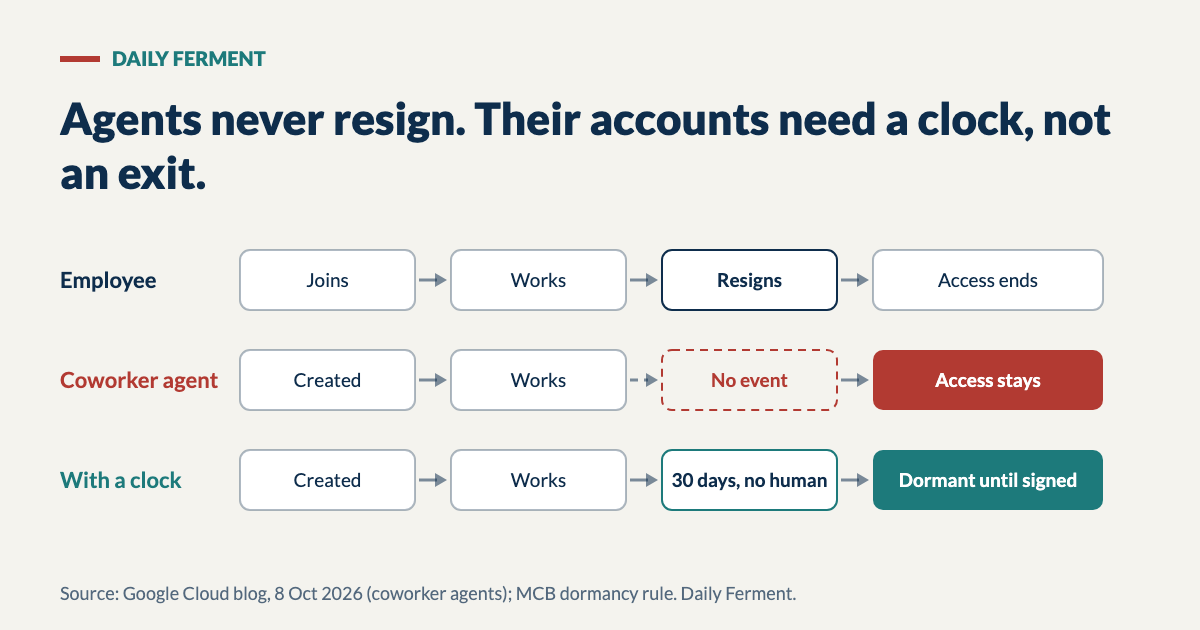
Employee offboarding runs on events. Someone resigns, HR marks the last day, IT shuts the account. The whole process waits for a signal.
An agent never sends one. It doesn't resign. It doesn't retire. It just stops being needed. The launch it was planning ships, the team moves on, and the agent sits there with its mailbox, its Drive, its directory entry and whatever access people shared with it along the way.
Someone has already written about part of this. A piece on beri.net asked what happens to a coworker agent when the person who created it leaves, and pointed to Microsoft's rule that an agent's sponsorship has to pass to someone else. That's a real gap, and it's still an event. Most agents will go stale while their creators are still at the company, sitting two desks away, having forgotten them.
The cross: banks don't wait for you to say goodbye
Pakistani banks deal with forgotten accounts all the time, and they don't wait for the customer to close them. At MCB, the rule is short: "Current or Savings accounts not operated for one year shall be classified as 'Dormant'." To bring a dormant account back, the customer has to come forward with a signed request for reactivation, at the branch, from a registered email, or by post. And if the silence goes on long enough, the money leaves the bank altogether: the State Bank's notice on unclaimed deposits describes banks surrendering balances with ten years of inactivity (its figure for deposits up to the end of 2023), under Section 31 of the Banking Companies Ordinance, 1962. The owner can still claim them back through the branch.
What I like about this is that nobody has to notice anything. The clock does the work. Silence changes the account's state, and the burden moves to the owner to say "this is still mine and I still need it."
Applied to an agent, that would look something like this. If no person has asked the agent for anything in, say, 30 days, it goes dormant. Shares are suspended, the mailbox stops acting on what arrives, the directory marks it inactive. To wake it, a named person signs for it again. After a longer silence it's archived, and its outputs are handed to a human owner.
Where the comparison breaks
Bank dormancy protects the customer's money from someone else. Agent dormancy would protect the company from its own forgotten worker. Different threat, same mechanism.
The bigger problem is what counts as activity. A dormant bank account is one the customer hasn't operated. An agent that runs on a schedule is never idle. It can keep doing its weekly task for a year with nobody reading the output. So the clock has to run on human contact, not on the agent's own activity. Measuring that well is harder than it sounds, and I don't know how Google's audit trail would support it.
I wrote about the same gap from the other side when an agent caused an outage: who was on call for it? And Meta's Muse showed what a permission prompt does and doesn't settle. An agent with its own mailbox is the next step in the same direction: something that acts in the company's name, and that nobody owns once the excitement wears off.
What I'm confident of, and what I'm not
What Google announced is established from its own post and VentureBeat's report. The dormancy rules are established from MCB's published policy and the State Bank's notice. That most agent accounts will outlive their use is my inference, from how service accounts have gone. That dormancy becomes the standard control for agents is a guess.
The claim, in one sentence: an agent governed like an employee never produces the event that ends an employee's access, so its account needs a clock instead of an exit, where silence switches it off until a person asks for it back.
Sources
Thomas Kurian, "Welcome to Gemini at Work 2026: Introducing the Gemini agent", Google Cloud blog, 8 October 2026. https://cloud.google.com/blog/products/ai-machine-learning/welcome-to-gemini-at-work-2026
Carl Franzen, "Google Cloud unveils persistent Gemini Agents for long-running tasks, and they get their own Gmail, Calendar, and Drive storage", VentureBeat, 8 October 2026. https://venturebeat.com/orchestration/google-cloud-unveils-persistent-gemini-agents-for-long-running-tasks-and-they-get-their-own-gmail-calendar-and-drive-storage
"Google's Gemini Agent Gets Its Own Mailbox Before It Gets a Price", beri.net, October 2026. https://www.beri.net/article/google-gemini-agent-coworker-workspace-account-identity-audit-spend-caps-gemini-at-work-2026
MCB Bank, "Reactivation of Dormant Account". https://www.mcb.com.pk/quick-links/reactivation-of-dormant-account
State Bank of Pakistan, public notice on unclaimed deposits. https://www.sbp.org.pk/assets/document/Final-_Draft_Public_Notice_Eng.pdf