AI agents could end the lazy-deposit discount. UK insurance shows who pays.
Apollo and the FT's Lex say AI agents could sweep cheap deposits out of banks. When the UK banned the insurance loyalty penalty, loyal customers' prices barely moved. New customers' deals went instead.

On 27 September Torsten Slok, Apollo's chief economist, asked in a short note whether an "agentic bank run" is coming. His point was simple: the US national average on checking accounts is 0.1%, plenty of accounts pay 3.3% to 5.0%, and an AI assistant with access to your accounts could move the money for you. Banks, he wrote, "could lose a large share of the cheap deposits they rely on to make loans."
On 7 October the FT's Lex column put a number on it. JPMorgan, Bank of America and Wells Fargo hold about $1.6tn in deposits that pay nothing. Lex's own back-of-envelope estimate, which it was careful to call that, puts roughly $500bn of US bank equity value at risk if agents chip away at that cheap money. It also called the bank-run version unlikely, because of trust and liability for misdirected funds.
McKinsey made the underlying point more than a year ago, in a piece called "The end of inertia": deposits and credit cards are the products that rely most on customers not paying attention.
Everyone in that conversation assumes the same thing about where the money goes: out of the banks' margin and into savers' pockets. That's the question I want to check. When you take a loyalty penalty away, who actually ends up with the money?
My first reaction was that savers win
It seemed obvious. Banks pay almost nothing on idle balances because most people don't move them. An agent moves them. The bank either pays up or loses the deposit. Savers get the spread.
Then I remembered that this has been tried, on purpose, in another market.
The cross: the UK banned price walking in insurance
For years UK home and motor insurers charged loyal customers more at renewal than they charged new customers for the same cover. The industry called it price walking. The FCA estimated that in 2018, 6 million loyal policyholders would have saved £1.2 billion had they paid the average price for their risk. From 1 January 2022 the FCA required that a renewal price be "no higher than they would pay as a new customer". It expected the rules to save consumers £4.2 billion over 10 years.
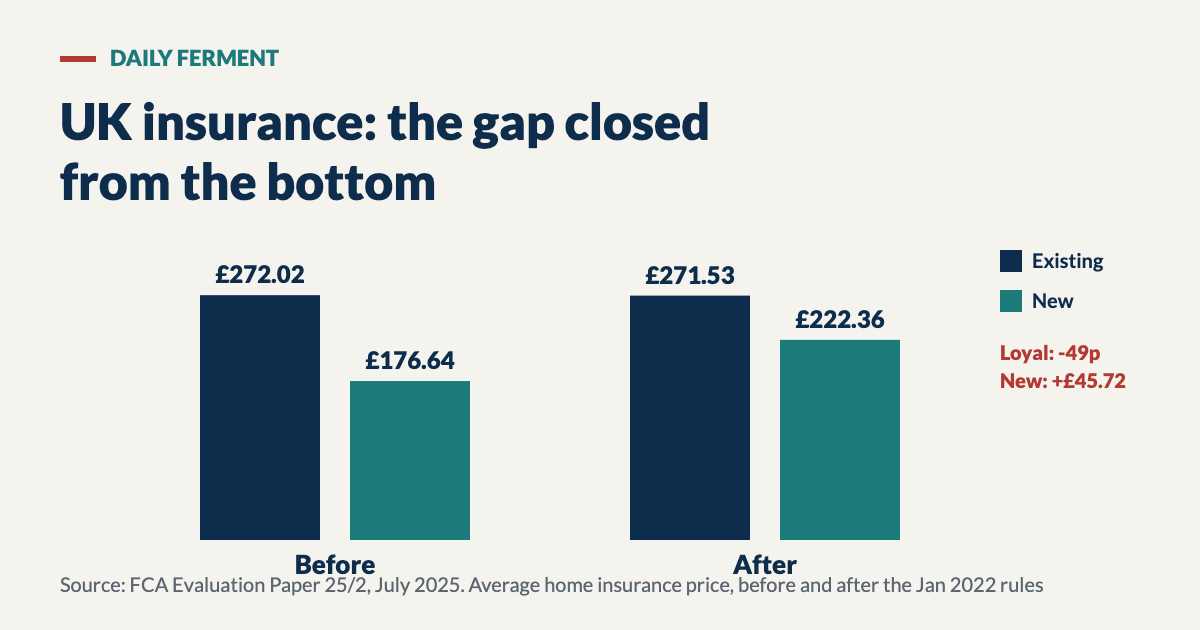
In July 2025 the FCA published its evaluation, EP25/2. In home insurance the gap did close. Before the rules, an existing policyholder paid £272.02 on average and a new customer paid £176.64. After, the existing policyholder paid £271.53 and the new customer paid £222.36. The FCA's summary is that the differential "almost halved".
Look at which number moved. The loyal customer's price fell by 49p. The new customer's price rose by about £46. The gap closed from the bottom. The FCA had expected this: it anticipated that firms "would no longer offer unsustainably low-priced deals to new customers."
Motor tells a messier story. New customers' prices rose there too, and the FCA's central estimate is an average saving of £6.63 per policy, about £1.6bn over ten years against the £2.5bn it originally expected for motor. For home it found no statistically significant saving at all. The evaluation also says 2023's broad premium rises make all of this harder to read, so I'm holding the exact numbers loosely. The direction is what I'm taking.
What that suggests for deposits
In banking, the discount on lazy money isn't just profit. It pays for things. Free checking, branches, sign-up bonuses, the teaser rate that pulls in someone who does shop around. If agents arbitrage the discount away, the insurance result suggests banks won't simply pay everyone 4% and absorb it. They'll take it back from the other side: monthly fees, minimum balances, fewer bonuses, worse deals for the people who were already chasing rates. The money that used to flow from the inattentive to the attentive stops flowing, and some of it doesn't reach anyone.
Where the comparison breaks
The FCA rule applied to every insurer and every customer on the same day. Agents won't. Some customers will have one, most won't for a while. That's a big difference. A ban removes the penalty. An agent lets one person dodge it.
So the sharper risk isn't that the loyalty penalty ends. It's that it survives for the people without agents, and gets heavier, because the bank's cheap money now comes only from them. That would be the price walking problem rebuilt, with "has an agent" in place of "shops around". I can't show that's what will happen. Banks might also just compete harder for everyone; Lex points out that AI cuts their costs too. But it's the version I'd watch for.
I asked the same question about stablecoins when Stripe made OUSD its default: who pays you to hold it? Idle money always earns something for someone. The question is only who.
What I'm confident of, and what I'm not
Apollo's figures are established from its note, Lex's from Dealroom's summary of the column, and the $1.6tn from PYMNTS citing the FT; I couldn't open the FT piece itself. The UK insurance numbers are established from the FCA's evaluation, which itself warns that 2023's price rises cloud them. That banks would respond to agents the way insurers responded to the ban is my inference. That the penalty would concentrate on people without agents is a guess.
The claim, in one sentence: ending a loyalty penalty rarely hands the money back to the loyal; it mostly takes away the deals that paid the people who shopped around, and if only some customers have agents, the penalty can settle on the ones who don't.
Sources
Torsten Slok, "Is an Agentic Bank Run Coming?", Apollo Daily Spark, 27 September 2026. https://www.apollo.com/wealth/insights-news/insights/daily-spark/is-an-agentic-bank-run-coming
Lex, Financial Times, 7 October 2026, as summarised by Dealroom: "AI agents could cost banks $500bn, by winning savers better rates". https://dealroom.co/news/other-jd5dn9-ai-agents-could-cost-banks-500bn-by-winning-savers-better-rates/ (FT: https://www.ft.com/content/a21ec190-edcd-454e-886a-302b0a16ea82)
PYMNTS, "AI Agents Wake Up $1.6 Trillion in Sleepy Bank Deposits", October 2026. https://www.pymnts.com/news/artificial-intelligence/2026/ai-agents-wake-up-1-6-trillion-in-sleepy-bank-deposits/
Ramji Sundararajan, Uzayr Jeenah, Alana Ellis, "The end of inertia: Agentic AI's disruption of retail and SME banking", McKinsey, 15 August 2025. https://www.mckinsey.com/industries/financial-services/our-insights/the-end-of-inertia-agentic-ais-disruption-of-retail-and-sme-banking
Financial Conduct Authority, "FCA confirms measures to protect customers from the loyalty penalty in home and motor insurance markets", 28 May 2021. https://www.fca.org.uk/news/press-releases/fca-confirms-measures-protect-customers-loyalty-penalty-home-motor-insurance-markets
Financial Conduct Authority, "Evaluation Paper 25/2: An evaluation of our General Insurance Pricing Practices (GIPP) remedies", July 2025. https://www.fca.org.uk/publication/corporate/ep25-2.pdf