Google is feeding rank trackers fake results. Volkswagen's emissions cheat shows where to measure instead.
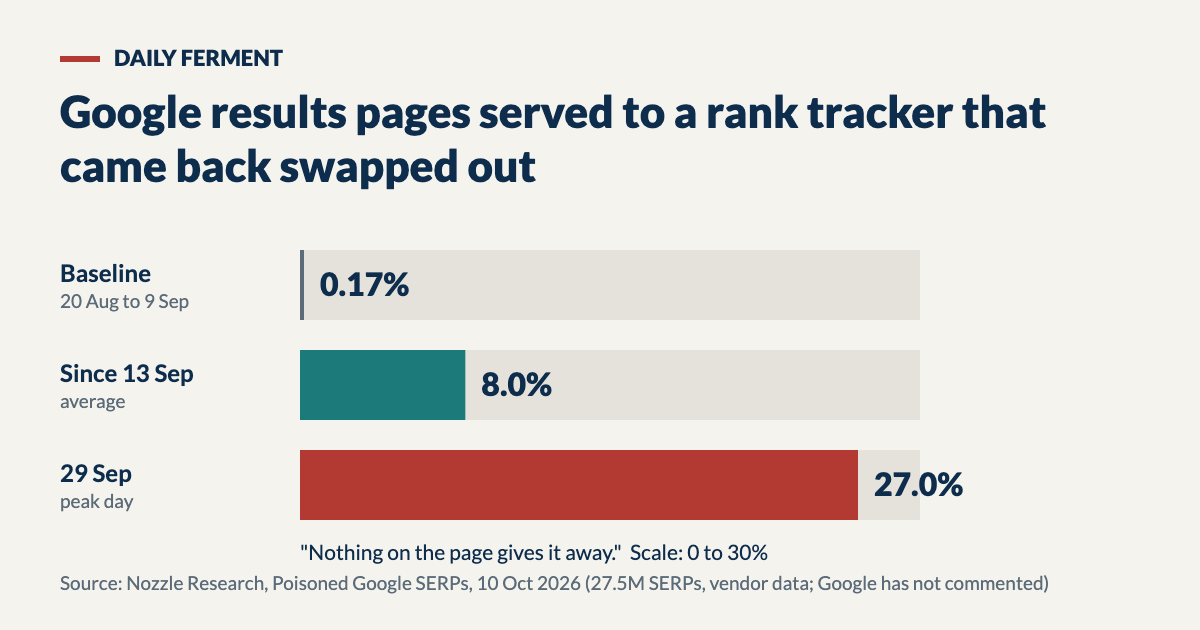
Nozzle says 8% of the Google results its rank tracker collected since mid September were swapped out, with nothing on the page to show it. Volkswagen's emissions cheat was caught by measuring where the car couldn't tell it was being tested.

On 10 October the rank-tracking company Nozzle published a study of 27.5 million Google results pages its systems had collected since August. From 13 September, it says, 8.0% of them came back "poisoned", against 0.17% in the weeks before. On 29 September the figure hit 27.0%. A poisoned page looks completely normal: no error, no captcha, same layout. The results on it are just different. "Nothing on the page gives it away," Nozzle writes. Two days later Barry Schwartz at Search Engine Roundtable rounded up tool after tool reporting broken or missing Google rankings, and said the injected-data tactic "concerns me the most." Another vendor, DemandSphere, puts its own figure at about 11% of daily checks, PPC Land reported on 13 October.
Google hasn't commented on any of this. So the question I want to work out is a practical one for anyone who publishes: if the thing you measure can tell when you're measuring it, what are your numbers measuring?
My first reaction was that Google is sabotaging SEO
That's not quite what the evidence shows. The target looks like scrapers that copy Google's results and resell them, especially to AI companies. Google sued one of them, SerpApi, and the case was dismissed in August before Google refiled, AdExchanger notes. When Google started rolling out google.com/goto redirects on result links in August, it said: "We have a long history of deploying technical measures against evolving forms of abuse," as PPC Land quotes it. Rank trackers collect results the same way scrapers do, with automated searches, so they get caught in it.
And from Google's side, poisoning is smarter than blocking. Nozzle makes the point itself: a refused request tells a scraper to try again, while a poisoned one "gets stored as real." Google doesn't owe scrapers accurate answers.
But the effect on everyone downstream is the same either way. In Nozzle's data, when a project's own site normally ranked for a keyword, it fell out of the top ten on 58.6% of poisoned pages. Someone watching a dashboard would see their site vanish and come back. Nozzle found 77.9% of poisoned pages were back to normal within three days. That's a lot of panicked Mondays.
The cross: the car that knew it was on the test bench
On 18 September 2015 the US EPA said Volkswagen had fitted diesel cars with software that "detects when the car is undergoing official emissions testing" and turned the full emissions controls on only during the test. On the road the cars emitted nitrogen oxides at up to 40 times the standard.
The way it was caught is the part that matters here. The cars passed in the lab. The International Council on Clean Transportation hired West Virginia University to test them a different way: with a portable measurement kit, about the size of a couple of shoe boxes, riding along in the car and reading the exhaust while people drove normal routes around San Diego, Los Angeles and San Francisco. On the road the Jetta came in at 15 to 35 times the US limit and the Passat at 5 to 20 times. In the ICCT's words, "This inconsistency was a major factor in ICCT's decision to contact CARB and EPA about our test results."
The lesson people took from it wasn't "build a better lab." It was that a system which can recognise the test will pass the test, so you measure at the tailpipe, under conditions it can't tell apart from ordinary use.
What that means for a publisher
I want to be careful with the comparison. Volkswagen was lying to a regulator about a legal limit. Google is refusing to give free, accurate data to bots it never agreed to serve. The ethics don't line up at all. What lines up is the measurement problem. A rank tracker is a lab test: a robot runs a search and records what it sees. Once Google can spot the robot, the reading tells you how Google treats robots, not how it treats your readers.
So where's the tailpipe for a website? It's the visits that actually arrive from Google, in your own analytics or server logs. Google can't tailor those to fool a tracker, because they're people. Nozzle's own checklist ends in the same place from the other direction: if Search Console still shows impressions and clicks, your site hasn't disappeared. That's Google's own report of what real searchers saw, which is a strange thing to fall back on when Google is the party you can't fully read. But it beats a scraped ranking that may have been invented for the scraper.
I made a similar point about answer engine optimization numbers with no control group: the headline figure often measures the platform, not your work. And when Google started its payments pilot for AI answers I wrote that it wouldn't show the meter. This is the meter getting harder to read from outside. There's an even closer case in the piece on an AI agent that could change what its reviewer saw: the check is only as good as the system's indifference to being checked.
Where the comparison breaks
The poisoning numbers come from companies that sell ranking data and have a stake in the story. Nozzle's "poisoned" label is its own rule, built from each keyword's history, and DemandSphere hasn't said how it got 11%. Google's September spam update ran from 24 September to 8 October, PPC Land notes, so some of the swings may be real ranking changes. And unlike the WVU kit, your analytics can't tell you where you ranked, only that people came. For a new site with little traffic, that's a thin signal.
What I'm confident of, and what I'm not
The poisoning figures are established only as vendor measurements, Nozzle's 8.0% and DemandSphere's roughly 11%, with methods they describe themselves. That Google is doing it on purpose, aimed at scrapers, is inferred; Google hasn't said so. The Volkswagen facts are established from the EPA, the ICCT and WVU. That rank tracking stays unreliable for long is a guess.
The claim, in one sentence: once the system you're measuring can tell it's being measured, a scraped reading only tells you how it treats the instrument; the numbers worth trusting are the ones taken where it can't tell, which for a publisher means the visits that actually arrive from search.
Sources
Nozzle Research, "Poisoned Google SERPs", 10 October 2026. https://nozzle.io/research/poisoned-google-serps/
Barry Schwartz, Search Engine Roundtable, "Third-Party Google Rank Tracking Not Fully Working Now", 12 October 2026. https://www.seroundtable.com/third-party-google-rank-tracking-broken-42272.html
PPC Land, "Google returns wrong results on 11% of DemandSphere's daily rank checks", 13 October 2026. https://ppc.land/google-returns-wrong-results-on-11-of-demandspheres-daily-rank-checks/
AdExchanger, Daily News Roundup, 13 October 2026. https://www.adexchanger.com/daily-news-roundup/tuesday-13102026/
US EPA, "EPA, California notify Volkswagen of Clean Air Act violations", 18 September 2015. https://www.epa.gov/archive/epa/newsreleases/epa-california-notify-volkswagen-clean-air-act-violations-carmaker-allegedly-used.html
ICCT, press statement on EPA's notice of violation to Volkswagen. https://theicct.org/epas-notice-of-violation-of-the-clean-air-act-to-volkswagen-press-statement
WVU Today, "WVU study found elevated levels of emissions from Volkswagen vehicles", 24 September 2015. https://wvutoday.wvu.edu/n/2015/09/24/wvu-study-found-elevated-levels-of-emissions-from-volkswagen-vehicles