Xbox now sells cloud gaming by the hour. Is that fair?
Game Pass cloud play gets a 15 hour monthly cap and paid hours at 24 to 40 cents. AT&T's unlimited data case shows when a cap is fair and when it isn't.

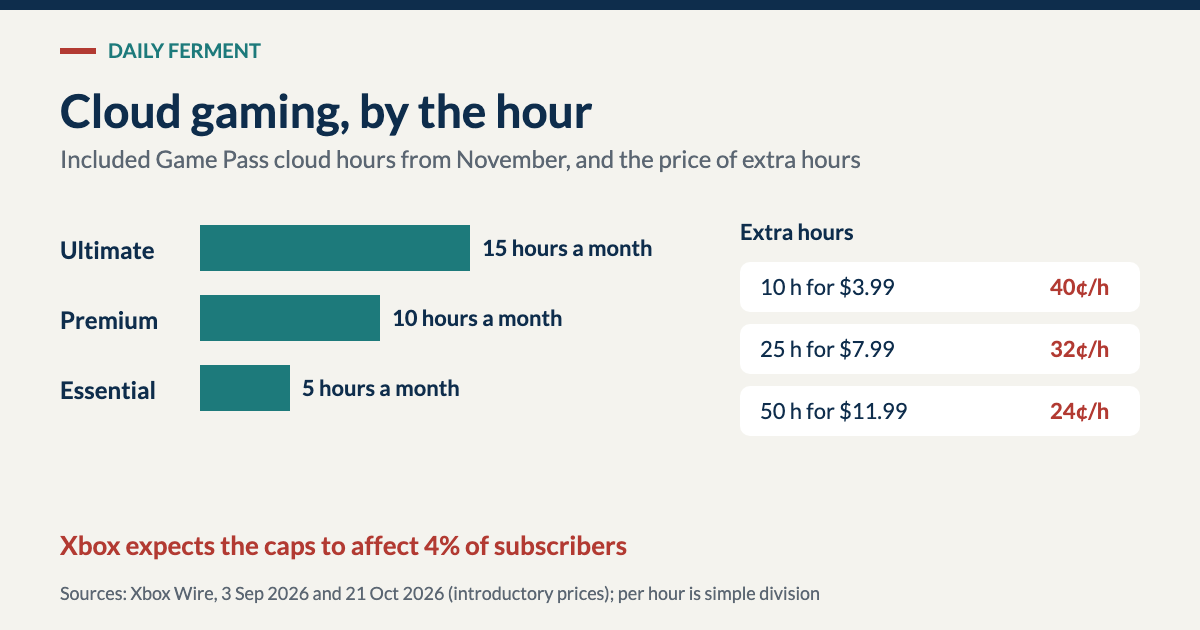
On 21 October Xbox started letting some testers buy cloud gaming by the hour: 10 hours for $3.99, 25 for $7.99, 50 for $11.99. That works out to between 24 and 40 cents an hour. To use it without Game Pass you need to own a game that can be streamed, or play one of a few free ones. Testers can also stream free with ads.
This comes on top of an announcement from 3 September. From November, Game Pass includes a monthly allowance of cloud play: 15 hours on Ultimate, 10 on Premium, 5 on Essential. After that, you buy more hours. Xbox's reason: "the cost of providing cloud gaming grows as more people use it and play for longer." Its estimate of who notices: "4% of Game Pass subscribers."
Sources: Xbox Wire, 3 Sep 2026 and 21 Oct 2026. Per-hour figures are simple division.
Fifteen hours is about half an hour a day. For someone who games only on a phone or a TV with no console, that's not much.
So: is capping something that used to come with the subscription a fair move, or the start of paying twice?
Isn't this the "unlimited" data fight again?
That was my first reaction. It looked like a familiar trick: sell a plan as including something, then meter it once people depend on it.
Guess first: in AT&T's "unlimited" data case, how much data could a customer use before AT&T slowed them down?
As little as 2 gigabytes in a billing period, from 2011. More than 3.5 million customers were affected by October 2014. Source: FTC, November 2019.
The cleanest version of that trick ended up in court. In 2014 the US Federal Trade Commission sued AT&T, alleging it had sold "unlimited" mobile data and then, from 2011, slowed customers down after as little as 2 gigabytes in a billing period. The FTC counted more than 3.5 million customers affected by October 2014. AT&T settled in 2019 for $60 million, paid back to those customers without them having to claim.
The settlement said what the problem was. AT&T may not describe a plan's speed or amount of data, including calling it "unlimited", without disclosing material restrictions, and the disclosure has to be prominent, "not buried in fine print or hidden behind hyperlinks."
AT&T "unlimited" data (2011 to 2019)
- What was sold "unlimited" data
- The line slowed after as little as 2 GB
- When buyers learned after the fact; FTC sued in 2014
- Outcome $60 million refunds; prominent disclosure required
Xbox Game Pass cloud play (2026)
- What was sold cloud gaming in the subscription
- The line 15, 10 or 5 hours a month
- When buyers learned announced 3 Sep, two months ahead
- Open question whether owned games count against the hours
Sources: FTC, November 2019; Xbox Wire, 3 Sep and 21 Oct 2026.
Hold Xbox up against that and most of my first reaction falls away. The cap was announced two months before it starts. The numbers are in the announcement, not a footnote. The company says how many people it expects to hit the line. And Game Pass didn't promise unlimited cloud play in the first place, as far as anything I opened shows. AT&T hid a line under a word that said there was none. Xbox drew a line in public.
Then who is actually losing something?
The 4%. Under a flat subscription, the people who stream the most get the most, and everyone else's fee carries part of their server time. That's my inference, but it's what Xbox's own reason implies: costs grow with how long people play. A cap with paid hours moves that cost onto the people creating it. For 96% of subscribers nothing changes. For the heaviest players it's a price rise, and it lands on a group that is likely to include people with no console at all, for whom cloud is the only way in.
There's a case for that being fair: the people using the expensive part pay for it, and everyone else's fee stops carrying them. There's also a case against: people who bought an annual subscription before 3 September bought it on terms that didn't include a cap. The AT&T refunds went to exactly that group: people who signed up for unlimited plans before 2011 and were slowed down afterwards.
And one question is still open. Xbox's September post doesn't say whether streaming games you already own counts against your Game Pass hours. If it does, a subscriber who bought a game outright could hit the cap on something that's theirs. If it doesn't, most of the "paying twice" worry goes away. That's the detail I'd wait for before deciding.
I've written about this kind of gap twice before: Tesla Roadster deposits, where buyers paid years before getting anything, and Accenture's $29 cap on Claude, where a monthly cap decided who carries the cost of heavy use. Both times the money was less interesting than the timing: when the buyer learned the terms. Xbox told people in September. Whether that was early enough depends on when you bought your subscription.
A usage cap is fair when the buyer can see the line before paying and most people never reach it; it turns into a broken promise when the box said there was no line, or when the line moves under people who already paid.
- Established
- The hour limits, the 4% estimate, the introductory prices and the FTC case facts.
- Inferred
- That heavy streamers were carried by the flat fee and now pay for their own hours.
- Guess
- That whether owned games count against the 15 hours is the detail that decides how most people feel about it.
More on Daily Ferment: Microsoft's 5% monthly billing fee is a loan at about 11% and Airbnb banned checkout chores. Who pays for the dishes now?.
Sources
- Xbox Wire, "Cloud playtime now available to test with Xbox Insiders", 21 October 2026: https://news.xbox.com/en-us/2026/10/21/cloud-playtime-now-available-to-test-with-xbox-insiders/
- Xbox Wire, Xbox Cloud Gaming changes, 3 September 2026: https://news.xbox.com/en-us/2026/09/03/xbox-cloud-gaming-changes/
- Game Informer, "Xbox announces monthly hour limits to cloud gaming are coming in November", 3 September 2026: https://gameinformer.com/2026/09/03/xbox-announces-monthly-hour-limits-to-cloud-gaming-are-coming-in-november
- Pure Xbox, cloud playtime price tiers, 21 October 2026: https://www.purexbox.com/news/2026/10/three-price-tiers-revealed-as-xbox-rolls-out-cloud-playtime-to-insiders
- FTC, "AT&T to Pay $60 Million to Resolve FTC Allegations It Misled Consumers with 'Unlimited Data' Promises", November 2019: https://www.ftc.gov/news-events/news/press-releases/2019/11/att-pay-60-million-resolve-ftc-allegations-it-misled-consumers-unlimited-data-promises