The Roadster is back. Its 2017 deposits are still waiting.
Tesla showed the new Roadster on 15 October, nine years after it took $50,000 deposits for a car promised in 2020. The interesting part isn't the thrusters. It's who carries the cost of a date that keeps moving.
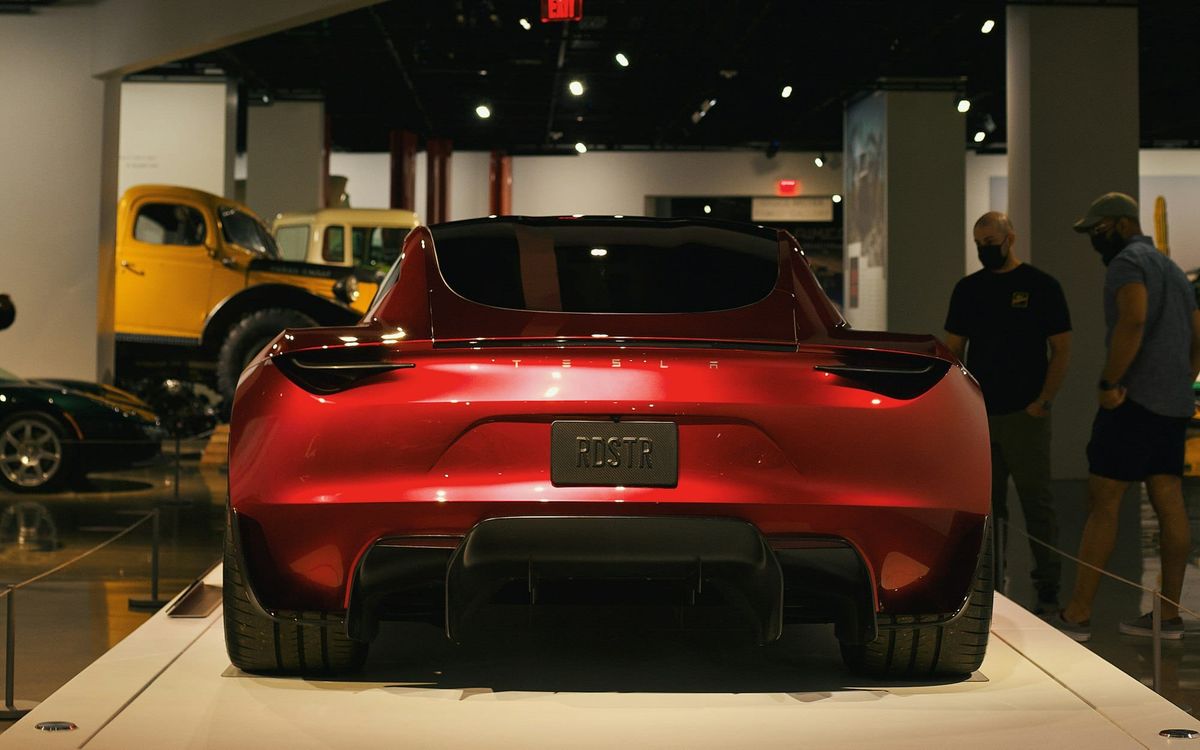
On 15 October, outside Waco, Texas, Tesla showed the new Roadster. In the demonstration TechCrunch described, the car used fans and cold-gas thrusters to drive up an inverted ramp, spin and land, and to lift itself over a row of other Teslas. Tesla showed 0 to 60 mph in one second. Elon Musk said Tesla will build it in 2028, and that "safety is not the main goal."
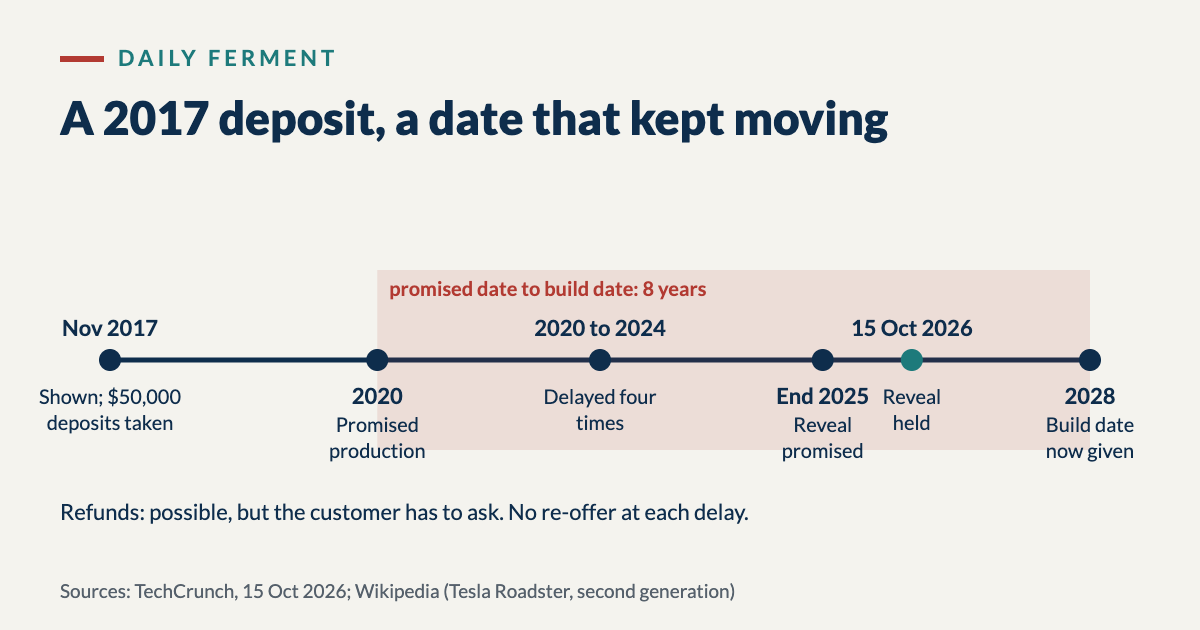
What caught me is the other date. The Roadster was first shown in November 2017, with production set for 2020. People paid $50,000 deposits then. Some paid $250,000 in full for one of 1,000 Founders Series cars. By TechCrunch's count, Musk delayed it in 2020, 2021, 2023 and 2024, promised a reveal by the end of 2025, moved it to 1 April 2026, and postponed an attempt on 1 October for the weather.
So the question: when a company takes your money against a date and the date keeps moving, what does it owe you each time?
Sources: TechCrunch, 15 Oct 2026; Wikipedia, Tesla Roadster (second generation).
Didn't Tesla just deliver on the promise?
My first reaction watching the clips was that the critics had been answered. A car that flies, roughly, on stage.
Then I read what was actually shown. TechCrunch doesn't say whether the runs were live or recorded, and the one-second figure is Tesla's own. There's still no retail price. The build date is 2028, which means a deposit placed in late 2017 would wait about ten years for a car. What happened on 15 October was a reveal, which is the thing that was promised for 2025.
The strongest case for Tesla is fair, and I want to put it plainly. The deposits are refundable. When Tesla reopened reservations in September, Not a Tesla App reported the whole $50,000 as "fully refundable." Nobody was forced to stay. Anyone who reserved a car from Musk knew his dates run long.
What does getting your money back actually look like?

Marques Brownlee, the tech reviewer, cancelled his Roadster reservation in September 2025 after about eight years. He said on his podcast "there is no cancel button next to the Roadster." The phone line went to voicemail for days. He was told at first: "I'll get 45 grand back. The first 5K I don't get back." He did get the last $5,000 in the end, Electrek reported, and Jalopnik wondered whether that was the normal process or because he's famous. His summary of the eight years: "Tesla has been sitting with my 50 grand for eight years and hasn't done anything with it, obviously."
So the money was refundable. But every step of getting it back started with the customer.
Guess first: under US rules for goods ordered by mail, phone or online, what happens to your order if the seller misses its date by more than 30 days and you say nothing?
It counts as cancelled, and you get your money back, unless you have said yes to waiting. The seller has to offer the choice without being asked. (16 CFR 435.2)
Who has already written down what a delay owes?
The US Federal Trade Commission has, for ordinary goods bought by mail, phone or online. The rule is short. A seller may not take your order unless it reasonably expects to ship by the time it states, or within 30 days if it says nothing. If it can't, it has to offer you, "without prior demand," the choice "either to consent to a delay in shipping or to cancel the buyer's order and receive a prompt refund." If the new date is more than 30 days out, or there isn't one, the order counts as cancelled and refunded unless you say yes to waiting. A prompt refund means within seven working days for most payments.
I'm not saying this rule covers a car reservation. I don't know that it does, and the Roadster deposit isn't a mail order. I'm using it because it shows a standard a regulator already considers fair for an ordinary parcel: each slip resets the question, and the default is your money back.
Now run the Roadster through it. Every one of those delays, 2020, 2021, 2023, 2024, would have been a moment when Tesla had to ask each depositor, out loud, "wait or refund?" Silence past a long delay would have meant a refund. Instead, silence meant the money stayed, for years, at no interest to the buyer. I wrote on 28 September about Microsoft's monthly billing fee working out at about 11% a year; money held before delivery is a loan whichever way it flows. And on 17 October about how deadlines that move every year teach people to stop believing them. A re-offer at each slip is how you keep a date believable, because the person who stays has chosen to.
FTC mail order rule
- Who asksThe seller, "without prior demand"
- Choice offeredWait, or cancel and get a prompt refund
- If you say nothingLong delay: order cancelled, money back
- Refund timeWithin seven working days for most payments
Roadster deposit, as reported
- Who asksThe customer
- Choice offeredNone at each delay
- If you say nothingThe deposit stays with Tesla
- Refund timeBrownlee: no cancel button, days of voicemail, then checks and wires
Sources: 16 CFR Part 435; Electrek and Jalopnik, Sep 2025. The rule may not cover car reservations; it is shown here as a standard.
Does this apply beyond one car?
Anywhere money moves before the product does: pre-orders for games and phones, crowdfunding, off-plan flats, deposits on anything built to order. The pattern is the same. The seller sets the date, the buyer carries the delay, and the burden of asking sits with whoever has less information.
How sure am I?
- Established
- The 2017 deposits and 2020 target, the delays TechCrunch lists, the 2028 build date, Brownlee's account as Electrek and Jalopnik reported it, and the text of the FTC rule.
- Inferred
- That a re-offer at each delay would have changed how many depositors stayed.
- Guess
- That 2028 slips at least once more.
A deposit taken against a promised date should come with a refund offer every time the date slips, so the buyer is asked again instead of having to ask, and the Roadster shows what a wait looks like without that, nine years in which getting the money back was the customer's job.
What I don't know is how many 2017 deposits are still sitting there. Tesla has never said, and that number is the real verdict on the wait.
Sources
- TechCrunch, Tesla reveals SpaceX-powered Roadster that flies and falls with style, 15 October 2026.
- Wikipedia, Tesla Roadster (second generation).
- Electrek, Tesla makes it hard to get $50,000 Roadster deposit refunded after 8 years, 29 September 2025.
- Jalopnik, MKBHD tries getting his $50,000 Tesla Roadster reservation refunded, 30 September 2025.
- Not a Tesla App, Tesla reopens Roadster reservations ahead of public reveal, 19 September 2026.
- US Federal Trade Commission, 16 CFR Part 435, Mail, Internet, or Telephone Order Merchandise Rule.