Acquitted nine years ago, still on the police certificate. A court says stop.
Pakistan's Islamabad High Court says an acquitted case must not appear on a police certificate. Where should a record forget: in the archive or at the printer?
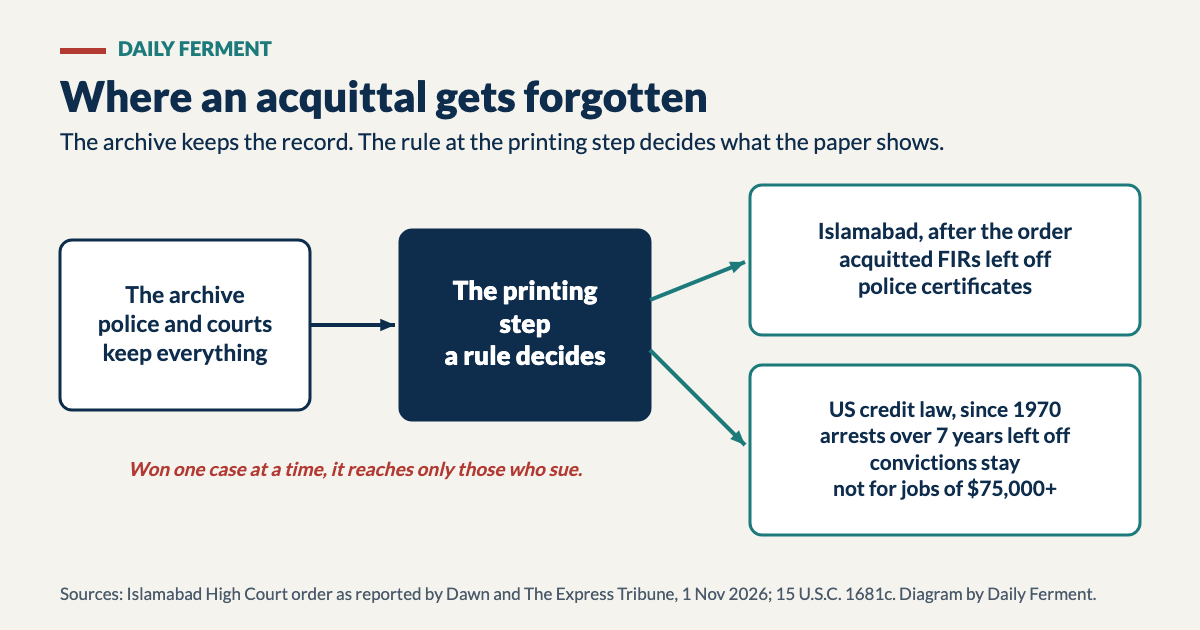
Should a case you were acquitted of show up when someone checks your record? In Pakistan, the Islamabad High Court has now said no. In an eight-page order reported on 31 October and 1 November 2026, Justice Ayyaz Shaukat ruled that an FIR, the first police report in a case, "shall not be reflected in the police character certificate" once the person named in it has been finally acquitted. The petitioner needed the certificate to travel to the United Kingdom. Police had listed a case she was acquitted of nine years earlier. Whether an acquittal shows up anywhere depends less on the archive than on the rule at the moment the document is printed.
What did the Islamabad High Court order?
According to Dawn and The Express Tribune, the court did three things. It declared the petitioner's certificate unlawful and ordered the reference removed. Police had also described her as "discharged" during the investigation, and the court rejected that wording as undercutting the acquittal. It told the Inspector General of Police in Islamabad to set up a formal mechanism so that cases ending in final acquittal are left off certificates. And it said, in the line I find most important: "Citizens so situated ought not to be driven to this court individually in order to secure what the law already confers upon them."
The order does not tell the police to forget. Dawn reports that police may keep their internal criminal records. What they may not do is disclose an acquitted case on a certificate, especially one people need to go abroad. The court tied this to Articles 4, 9, 14 and 15 of the Constitution, which cover, in Dawn's summary, rights, liberty, dignity and freedom of movement. Keeping the old FIR on the certificate, it said, "keeps the suspicion alive after the law has laid it to rest."
- About 2017 The petitioner is acquitted in the case (The Express Tribune: "nine years ago").
- 8 Aug 2025 Lahore High Court tells the Punjab Home Department to leave an acquitted FIR off one man's certificate.
- 31 Oct 2026 ARY News reports the Islamabad High Court order by Justice Ayyaz Shaukat.
- 1 Nov 2026 Dawn and The Express Tribune report the eight-page order: certificate declared unlawful, IGP Islamabad told to build a mechanism.
My first reaction: haven't the courts already settled this?
I assumed this was old law. In a way it is. In August 2025 the Lahore High Court ruled almost the same thing for one man acquitted under the Kite Flying Act, who needed a certificate to travel to England. Justice Abhar Gul Khan wrote: "After acquittal, it is unnecessary to mention this FIR in any official documents."
That ruling is exactly what made me look twice. It helped one petitioner. At the hearing, the Home Secretary said records are kept for 60 years under the Police Rules, and the FIR would not be deleted, only its status updated. Fourteen months later another citizen had to go to another High Court for the same correction, nine years after her own acquittal. The rule existed in judgments. It did not exist in the system that prints the certificate. The Islamabad order is different because it is aimed at that system.
The other side: why police keep these records
There is a real case for disclosure, and I want to put it fairly. Those who want disclosure would say an acquittal means the prosecution did not prove guilt, which is not a finding of innocence, and that it can follow a weak investigation or a witness who changed their story. Embassies, employers and licensing bodies would say they want to judge the full picture themselves, and that the police are the only ones who hold it. The public prosecutor argued in Lahore that an acquittal does not entitle anyone to have records expunged.
The courts' answer, in both cases, is to separate keeping from telling. The police can keep the file for whatever legitimate use the law allows. The certificate, which is a public statement about a person's character, cannot carry a case the law has closed in that person's favour. My own view, and it is only that, is that this is the right line: a certificate that repeats an accusation the courts rejected tells the reader something false about the person holding it.
Where American credit law put the same line in 1970
The United States drew a version of this line half a century ago, in a law about credit, not crime. The Fair Credit Reporting Act, added on 26 October 1970, tells consumer reporting agencies what they may not put in a report. Among the items: "records of arrest" older than seven years, and any other adverse item older than seven years "other than records of convictions of crimes." The courthouse keeps everything. The agency that prints the report has to leave the old items out, for everyone, without anyone filing a petition.
Two things in that law surprised me. First, it is weaker than the Islamabad order on acquittals. Under federal law an arrest that ended in acquittal can still be reported for seven years; only some states go further. Second, the protection has a price tag. The limits do not apply when the report is for a job paying $75,000 a year or more, or credit or life insurance of $150,000 or more. The salary line started at $20,000 and was raised to $75,000 in 1996. So even a rule built into the printing step can quietly stop applying to some people.
Islamabad High Court order, 2026
- Who keeps the record: police, in internal records
- What the document leaves out: an FIR ending in final acquittal
- How long: for good, once the acquittal is final
- Exceptions: none reported
- How it applies: a police mechanism ordered; not yet built
US Fair Credit Reporting Act, 1970
- Who keeps the record: courts and agencies keep everything
- What the report leaves out: arrest records and most adverse items older than seven years
- How long: convictions: no federal limit
- Exceptions: jobs paying $75,000 a year or more; credit or life insurance of $150,000 or more
- How it applies: by statute, to every consumer report
Sources: The Express Tribune and Dawn, 1 Nov 2026; 15 U.S.C. 1681c (Legal Information Institute).
Guess first: in the US credit law, above what annual salary may an arrest older than seven years still be reported to an employer?
$75,000. The line was $20,000 until a 1996 amendment raised it. (15 U.S.C. 1681c(b).)
What this means if you're the one asking
If you were acquitted and a certificate or check still shows the case, the useful question is where the document is produced and what rule binds that step. In Islamabad, after this order, the answer should be a police procedure, not a lawsuit, once the IGP builds it. In the United States, it depends on the type of check, the salary and the state.
I've written before about the difference between what a company keeps and what it shows, with the Gyazo breach that leaked descriptions of screenshots and with Character.AI's chats being sold when a therapist's notes couldn't be. The same shape keeps coming back. Deleting a record is rarely what people need. They need the point of disclosure to know which parts it may repeat.
- Established
- What the reports quote from the Islamabad order (the written order itself was not available to me), the 2025 Lahore ruling as Dunya News reported it, and the text of the US Fair Credit Reporting Act.
- Inferred
- That the step where a certificate or report is printed, not the archive, is where an acquittal is kept off. That is my reading of both systems, not something either says in those words.
- Still a guess
- How quickly and how well Islamabad's police build the mechanism, and whether other provinces follow without more petitions.
An acquittal stays off a certificate only when the rule lives where the certificate is printed; a right that has to be won in court one person at a time is a right most people never collect.
More on Daily Ferment: The Gyazo breach leaked the description of your screenshots, not the screenshots and Should camera locations be public? Ask what the camera is for
Sources
- Fiaz Mahmood, The Express Tribune, No need to mention FIR in character certificate: IHC, 1 November 2026.
- Malik Asad, Dawn, Islamabad High Court bars FIR mention in character certificates after acquittal, 1 November 2026.
- ARY News, IHC orders major change in police character certificates, 31 October 2026.
- Dunya News, FIR record on character certificate, other documents unnecessary after acquittal, LHC rules, 8 August 2025.
- Legal Information Institute, 15 U.S. Code § 1681c, Requirements relating to information contained in consumer reports (Fair Credit Reporting Act).