Should camera locations be public? Ask what the camera is for
MapQuest now shows license plate readers on its map, and Flock has fought maps of its cameras before. Britain settled a version of this argument in 2001, when it painted its speed cameras yellow.
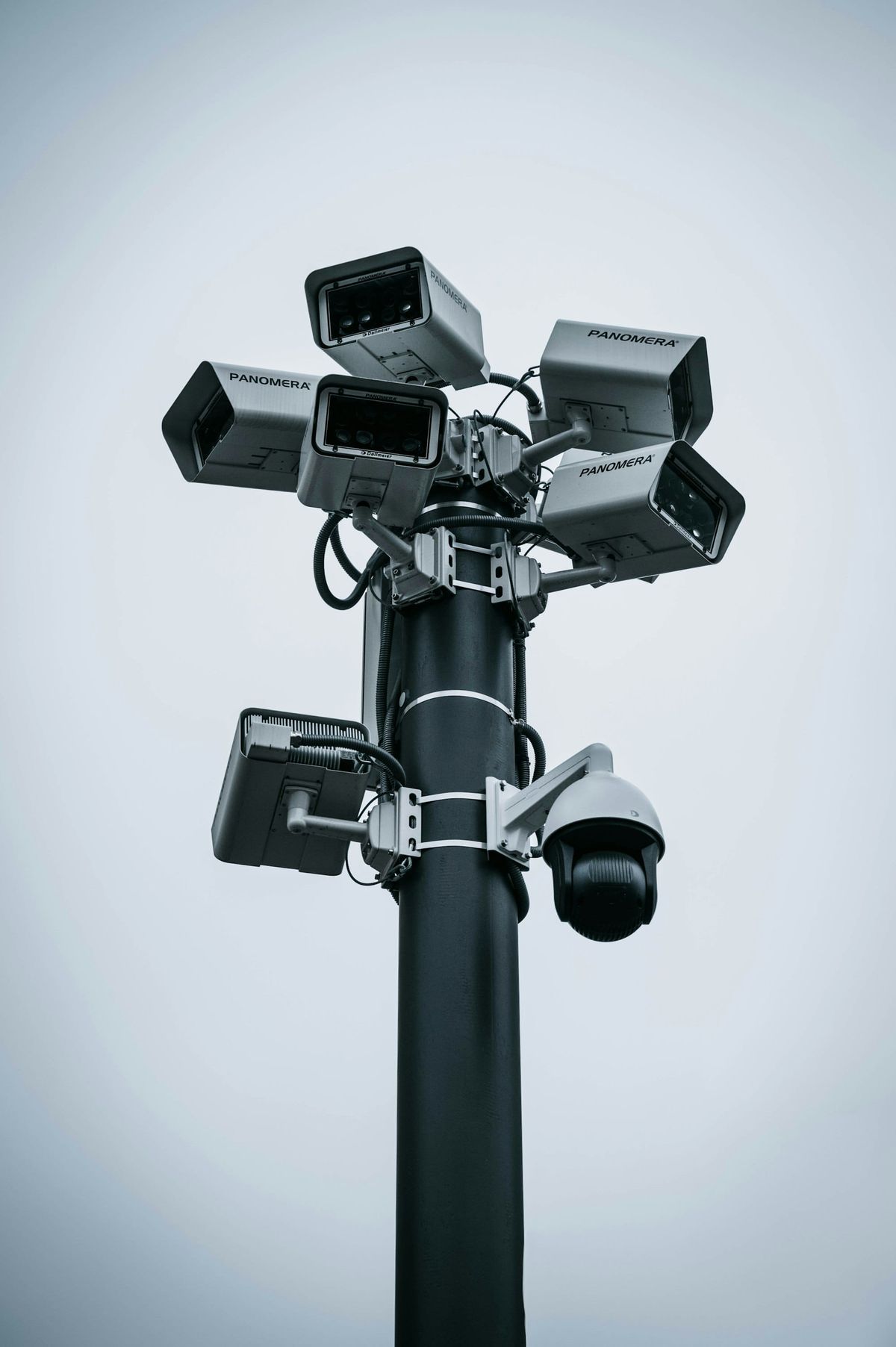
"The Roads Have Eyes!" That was MapQuest's line on Bluesky on 15 October, over a short video telling people to switch on a new Surveillance Layer in Map Options "to see known license plate readers from Flock Safety," along with cameras from Motorola Solutions, Axon, Genetec, Verkada and a list of others. Engadget wrote it up the next morning. MapQuest hasn't said where the locations come from. Gizmodo guessed DeFlock, a volunteer map, and OpenStreetMap.
Three weeks earlier a different map went dark. On 24 September a brand-protection firm acting for Flock filed a trademark complaint against FlockSurveillance.org, a site built from camera coordinates that had leaked from Flock's own website, according to Cybernews and Jalopnik. In early 2025 Flock's lawyers had sent DeFlock a cease-and-desist; the EFF answered that the mapmaker wouldn't comply. Flock's press page says the company "does not share specifics regarding individual agency contracts, camera counts, locations or deployments."
So the question: should the public know where surveillance cameras are?
Sources: Fleet News, Aug 2001; DfT Circular 01/2007; House of Commons Library SN00350; LSE, 2017.
Isn't the answer obviously yes?
That was my first reaction. These cameras sit on public roads, many of them bought by police departments, and people should know what's pointed at them.
Then I read what police departments have said when asked. In 2023 FOX6 in Milwaukee asked local forces for their Flock locations. Milwaukee police said disclosure could "seriously impair" their work. Brookfield said it would give criminals "a strategic advantage." A deputy chief in West Allis shrugged the other way: "They're not hidden cameras." Same product, opposite answers, and neither side said what the cameras were actually meant to do. That's the gap in "obviously yes." It skips the question of what the camera is for.
Who already answered this, and how?
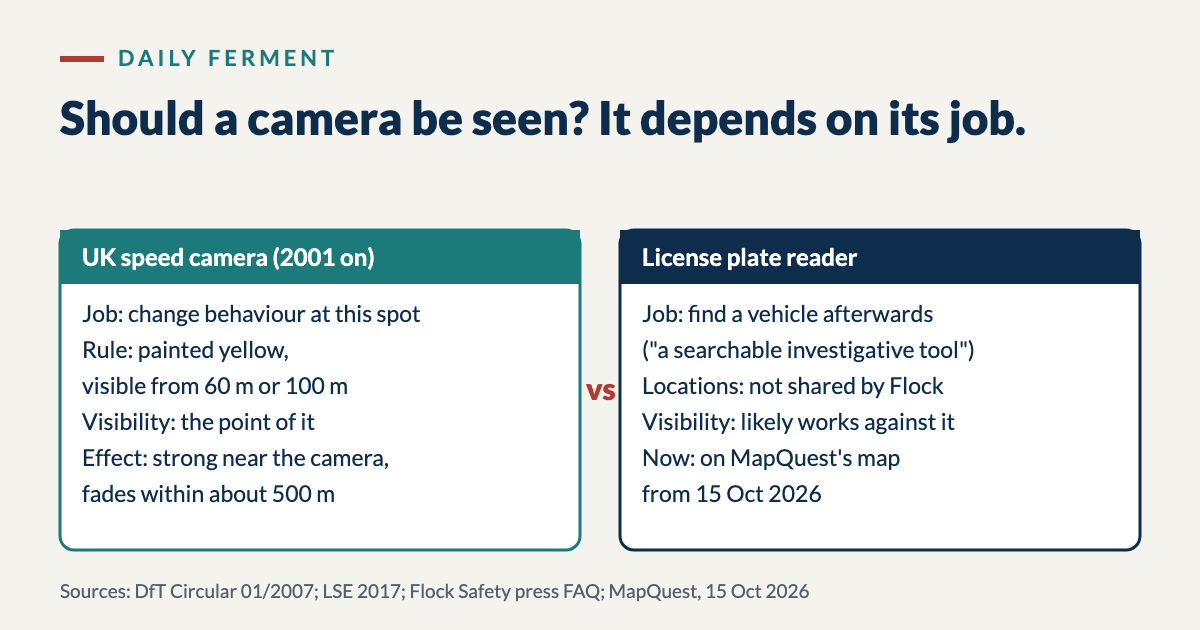
Britain argued about this for speed cameras and settled it in 2001. Announcing that camera partnerships could keep fine income to pay for enforcement, Transport Minister John Spellar said fixed cameras would have to be "well signed and highly visible." His reason was one sentence: "They are there to change driver behaviour, not to catch motorists and raise revenue."
"They are there to change driver behaviour, not to catch motorists and raise revenue."
John Spellar, UK transport minister, August 2001The rules that followed were specific. Cameras went yellow. The Department for Transport's 2007 circular still names the paint, "No. 363 Bold Yellow of BS381C:1996," and says housings must be visible from 60 metres where the limit is 40 mph or less and from 100 metres everywhere else. It also says this high-visibility approach "should be retained."
The detail I liked most is an exception in the same circular. The visibility rules cover speed cameras but not red-light cameras, because a red signal already tells drivers to stop. The goal was never the camera being seen. It was the rule being seen at the spot where breaking it hurts people.
Guess first: did Britain's visible speed cameras cut crashes on the roads around them, or only at the camera?
Mostly only at the camera. An LSE study of about 2,500 sites found the effects "highly localised within 500 metres", with a slight rise in collisions beyond 1.5 km.
Did making them visible work?
At the spot, yes, though less than the first numbers said. The government's four-year evaluation in 2005 reported 22% fewer injury collisions at camera sites. The House of Commons Library notes that headline was disputed because it ignored regression to the mean, the tendency of a bad stretch of road to look better next year anyway. Allowing for that, the figure was 19%.
Away from the spot is another story. A 2017 study from the LSE of about 2,500 British sites found the effects "highly localised within 500 metres," with a slight rise in collisions beyond 1.5 km. A driving simulator study in Israel in 2015 found both median speed and speed variance "were higher with overt than with covert cameras," and that drivers facing visible cameras showed a "kangaroo effect": brake for the camera, speed up after it. I wrote on 15 October about Google feeding rank trackers fake results, where a system behaved one way when it knew it was being measured. A yellow camera is that same effect, chosen on purpose.
So Britain knowingly bought a trade. Visible cameras give you reliable behaviour at a few known dangerous places, and lose the wider uncertainty that hidden ones create. For a camera whose job is to make one bend safer, that's the right purchase.
So which job does a license plate reader do?
Flock describes its readers as "a searchable investigative tool for specific public safety purposes, not a live-tracking system." That is a find-it-afterwards job. A camera like that works best when the people it's looking for don't know where it is, which is presumably why police in Milwaukee didn't want a map.
But Flock also says, in its own marketing, that the technology "has shown to both deter crime" and help solve it. Deterrence is the speed camera's job, and by Britain's logic a camera meant to deter works through being known. You can argue for secrecy, or you can argue for deterrence at a place. Arguing for both at once is where the case gets muddy.
How sure am I?
- Established
- What MapQuest launched, Flock's takedown request and the wording on its press page, Britain's rules and the evaluation figures as reported.
- Inferred
- That the camera's job is the useful test for whether its location should be public.
- Guess
- That maps like MapQuest's will push the agencies that buy these readers to say plainly which job they're paying for, because the public will now see the answer whether they say it or not.
Whether a camera's location should be public depends on what it is for, since a camera meant to change behaviour at a spot works better seen and one meant to find people afterwards works better unseen, and the fight over maps of license plate readers is really a fight over which kind they are.
What I still don't know is whether a public map makes these readers less useful for finding stolen cars. Nobody I read has measured it.
Sources
- MapQuest, Bluesky post announcing the Surveillance Layer, 15 October 2026.
- Engadget, MapQuest will now show you where Flock cameras are in your neighborhood, 16 October 2026.
- Gizmodo, MapQuest adds Flock camera locations, 16 October 2026.
- Cybernews, Flock tries to take down map built from its own leaked camera data, 28 September 2026.
- EFF, Anti-surveillance mapmaker refuses Flock Safety's cease and desist demand, 26 February 2025.
- Flock Safety, Press center FAQ and Don't just watch crime. Solve it.
- FOX6 Milwaukee, Mapping Flock cameras: police secrecy by department, 24 October 2023.
- Fleet News, Police forces get green light to introduce more speed cameras nationwide, August 2001.
- Department for Transport, Circular 01/2007: Use of speed and red-light cameras for traffic enforcement, 31 January 2007.
- House of Commons Library, Road safety: speed cameras (SN00350), 2013.
- LSE, Speed cameras reduce road accidents and traffic deaths, 25 October 2017.
- Marciano, Setter and Norman, Overt vs. covert speed cameras, Accident Analysis and Prevention, 2015.