Google Search fell below half of Alphabet's revenue. It still grew 12%.
Google search revenue is 49.7% of Alphabet now, the first time under half. It still grew 12%. The share fell because Cloud doubled, and US farming shows why that matters.
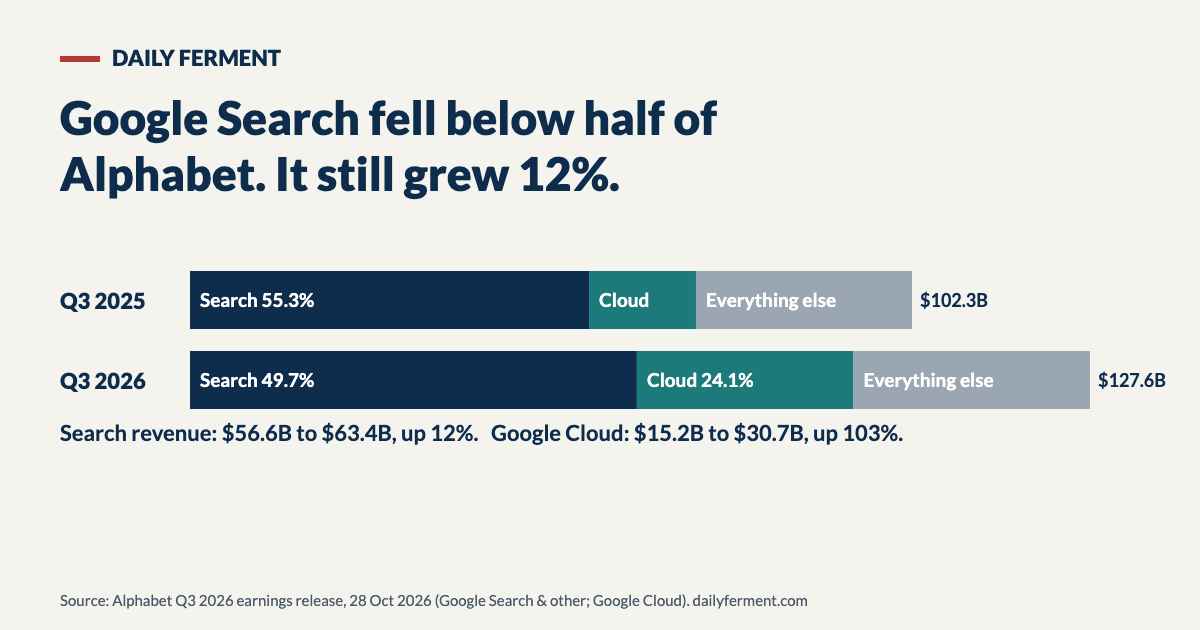
On 28 October Alphabet reported its third quarter. Google Search & other brought in $63.35 billion of Alphabet's $127.58 billion in revenue. That's 49.7%, and Kadoa, which tracked every quarter since Alphabet started reporting the line, says it's the first time search has been below half. So how much of Google's revenue comes from search now? Just under half. Is Google search shrinking? No. The search line grew 12% from a year earlier. It fell below half because Google Cloud doubled. Those are two different stories, and the headline mixes them up.
How much of Google's revenue is from search now?
The numbers come straight from Alphabet's earnings release. A year ago, in the third quarter of 2025, search made $56.57 billion of $102.35 billion, or 55.3%. This quarter it made $63.35 billion of $127.58 billion. Kadoa counts 31 quarters before this one in which search sat between 52.8% and 62.0% of revenue. Google Cloud went from $15.16 billion to $30.71 billion, up 103%, and is now 24.1% of the company.
Source: Alphabet Q3 2026 earnings release, 28 Oct 2026. Shares computed from the reported lines.
Guess first: Alphabet added $25.2 billion of revenue in a year. How much of it came from search?
$6.8 billion, about 27%. Google Cloud added $15.6 billion, about 62%.
My first reaction: AI is finally eating search
That was my first read, and I suspect it was most people's. Answer engines take queries, the share drops, there's the proof. Then I looked at the search line on its own. It went up 12%. Alphabet's release says search query growth this year is "the highest it has been in the last five years", and Sundar Pichai, chief executive of Google and Alphabet, credits AI for driving "overall Search query growth, including commercial queries". You can doubt the framing, but the revenue figure isn't framing. A business that grew $6.8 billion in a year isn't being eaten.
What changed is the denominator. Alphabet added $25.2 billion of revenue year on year. About 27% of that came from search and about 62% came from Cloud. The release credits enterprise AI infrastructure and AI solutions for the Cloud jump, with sales of Google's TPU systems a meaningful contributor.
I also checked profit, because revenue share can flatter a low margin business. Here it doesn't. Google Services, which includes search, YouTube and subscriptions, made $39.16 billion of operating income. Google Cloud made $11.12 billion, more than three times its $3.59 billion a year ago. So Services still earns about 78% of what the two segments make. Alphabet doesn't report search's own profit, so I can't split that further, and I won't pretend to.
Where else did a shrinking share hide a growing business?
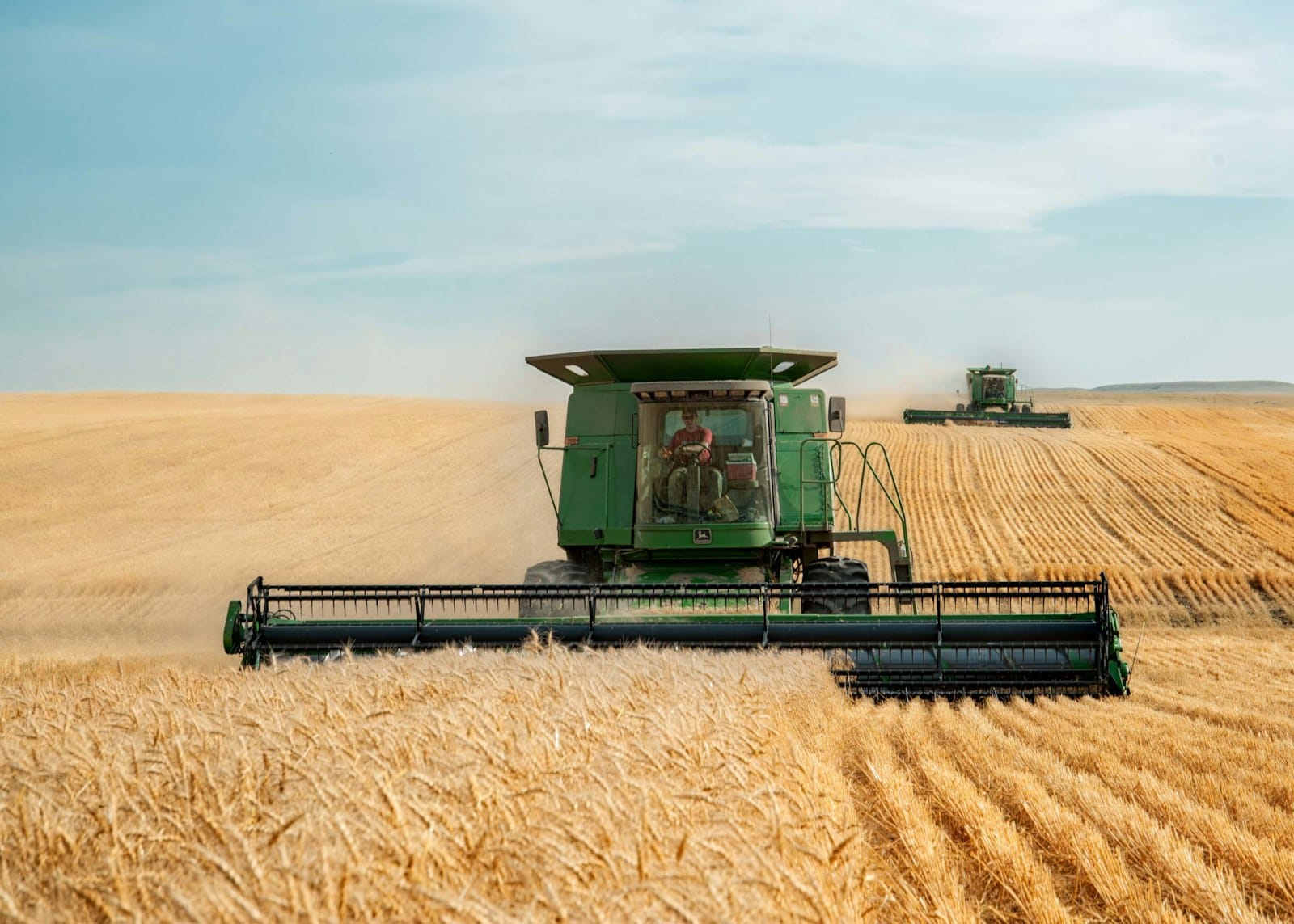
The comparison that helped me is American farming. In 1900, 41% of the US workforce worked in agriculture. By 2000 it was 1.9%. Farming's share of GDP went from 7.7% in 1930 to 0.7% in 2002. Read those numbers alone and you'd think American farming collapsed. It didn't. The USDA's Economic Research Service says farm output in 2023 was nearly three times its 1948 level, growing about 1.5% a year while the inputs used grew only 0.12% a year.
The share fell because everything around farming grew faster: factories, then services, then software. The ERS report on the 20th century puts both facts side by side: "Output from U.S. farms has grown dramatically", while "production agriculture has become a smaller player in the national and rural economies". Both true at once. That's the shape of the Alphabet number.
US farming, 20th century
- Share of workforce: 41% in 1900, 1.9% in 2000
- Share of GDP: 7.7% in 1930, 0.7% in 2002
- Output: nearly three times its 1948 level by 2023
- Why the share fell: everything around it grew faster
Google Search, 2025 to 2026
- Share of Alphabet revenue: 55.3% to 49.7%
- Revenue: $56.57 billion to $63.35 billion, up 12%
- What grew faster: Google Cloud, up 103%
- Profit: not reported for search alone
Sources: USDA ERS, EIB-3 (2005) and productivity summary (updated 25 Aug 2026); Alphabet Q3 2026 release.
The farming story also hints at what does change when a share falls. Being "a smaller player" is a real change even while output keeps growing: the old business stops setting the priorities. I think something like that is starting inside Alphabet. Alphabet-level costs, which the release says are "primarily" shared AI research and development, came to $7.66 billion this quarter. Somebody's profits pay for that, and for most of Google's history it was search's. I wrote about the same question for petrol cars once they become the minority: when the old thing stops being the majority, who carries the fixed costs? At Alphabet, for now, the answer still looks like Services, which means mostly search.
So is Google search declining?
Not on this evidence. Its revenue grew 12% in a year, and the company says queries are growing too. What's declining is search's weight inside Alphabet, which is a fact about Cloud and AI chips, not about search. If you want the signal that AI answers are hurting search, watch the search line itself, not its share. A slowdown from 12% to low single digits while Cloud keeps doubling would be a very different story.
I'd also be careful about the opposite mistake. A fast growing Cloud business built on AI demand is exactly the kind of growth that can reverse. I made a version of that point about AI's payoff outside tech: spending on AI shows up long before the gains do. Cloud revenue is someone else's AI spending.
What would change my mind: Alphabet disclosing search's own margin and it turning out much lower than I assume, or search revenue growth falling sharply over the next two quarters.
How sure am I?
- Established
- Search made $63.35 billion of Alphabet's $127.58 billion in Q3 2026 (49.7%), up 12% on a year earlier, while Google Cloud doubled. All from Alphabet's release.
- Inferred
- That most of Alphabet's profit still comes from search. Google Services earns about 78% of the two segments' operating income, but Alphabet doesn't split out search.
- Still a guess
- That search's share keeps falling for a while without search itself shrinking. Two quarters of slow search growth would change that.
A falling share tells you the rest of the company grew; whether the old business is shrinking is a different number, and for Google Search in Q3 2026 that number was up 12%.
More on Daily Ferment: A judge says Google never made publishers a deal. Now it picks who gets one. and Stack Overflow got 969 questions in September. Who writes the next answers?
Sources
- Alphabet Inc., "Alphabet Announces Third Quarter 2026 Results", Exhibit 99.1 to Form 8-K, 28 October 2026. sec.gov
- Kadoa Company Atlas, "Google Search is now less than half of Alphabet's revenue", 29 October 2026. kadoa.com
- Carolyn Dimitri, Anne Effland and Neilson Conklin, "The 20th Century Transformation of U.S. Agriculture and Farm Policy", USDA Economic Research Service, EIB-3, June 2005. ers.usda.gov
- USDA Economic Research Service, "Agricultural Productivity in the United States: Summary of Recent Findings", updated 25 August 2026. ers.usda.gov