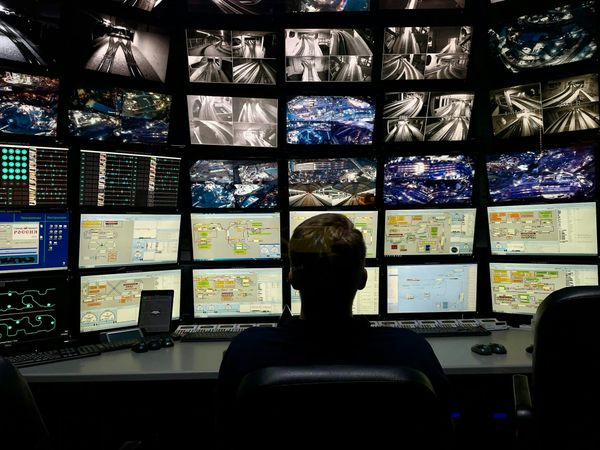
AI hasn't paid off outside tech. Electricity took four decades.
Apollo's chief economist says AI has paid off for the Mag 7 and not for the S&P 493. Factories in the 1890s had the same problem with electricity, and the fix wasn't patience.

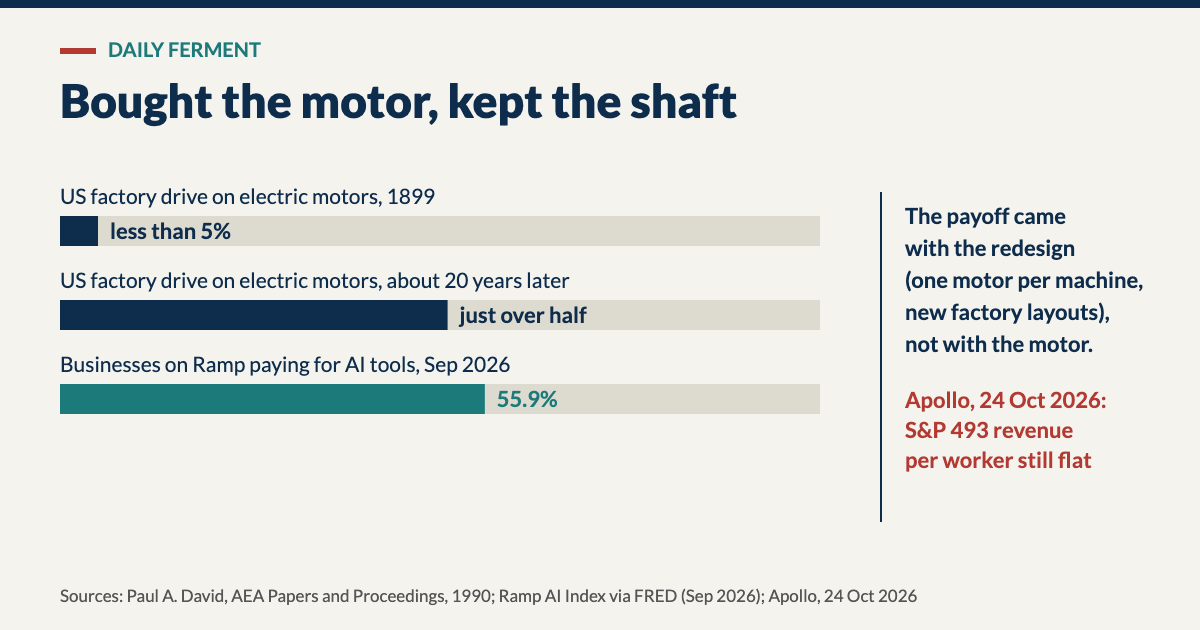
On 24 October 2026, Torsten Slok, the chief economist at Apollo, published a short note with a blunt title: No Signs of AI Payoff Outside the Tech Sector. Revenue per worker is rising for the Magnificent Seven and flat for the other 493 companies in the S&P 500. Profit margins look the same. He sees no sign of AI in productivity growth at all.
So is AI failing outside tech? Not yet, is my answer, but not for the comforting reason. The payoff hasn't shown up, which is what people now call the AI productivity paradox, and history says it won't until companies rebuild how the work is done, the way factories had to be rebuilt around the electric motor before electricity paid.
What did Apollo actually find?
Slok's note is five charts and four paragraphs. The charts compare the Mag 7 with the S&P 493 on revenue per worker (adjusted for inflation to late 2019) and on margins, then show the San Francisco Fed's utilization-adjusted productivity series, which has not bent upward. The words that matter most are about behaviour: mainstream corporate America is "starting to view token spending not as a source of growth but as a cost center that weighs on margins."
His line on where this gets settled is worth keeping:
"the AI story will be decided in the S&P 493, not the Mag 7"
Torsten Slok, chief economist, Apollo, 24 Oct 2026Meanwhile adoption is not the problem. Ramp's AI Index, published on FRED, shows 55.9% of businesses on Ramp paying for AI tools in September 2026, up from 47.7% in February. That's a sample of US companies that use Ramp cards, not all firms, but the direction is plain. More than half are buying. Almost none of it shows up in the numbers Slok tracks.
My first reaction, and why it was too easy
My first reaction was: this is the Solow paradox again, so wait. In 1987 Robert Solow said you could see the computer age everywhere but in the productivity statistics, and Jack Triplett at Brookings was still taking that line apart in 1999. The gains came later. Give AI time.
When I looked at why the gains came later, that answer fell apart. Waiting was never the mechanism. Something specific had to change first, and it doesn't change on its own.
How long did electricity take to pay off?
The best account is Paul David's 1990 paper, The Dynamo and the Computer, in the AEA Papers and Proceedings. In 1899, electric motors were less than 5% of the mechanical drive in American factories. About two decades later, only slightly more than half of factory drive had been electrified, and that was four decades after the first central power station opened.
In 1899, what share of the mechanical drive in US factories ran on electric motors?
Less than 5%, according to Paul David (1990). Getting to slightly more than half took roughly another two decades.
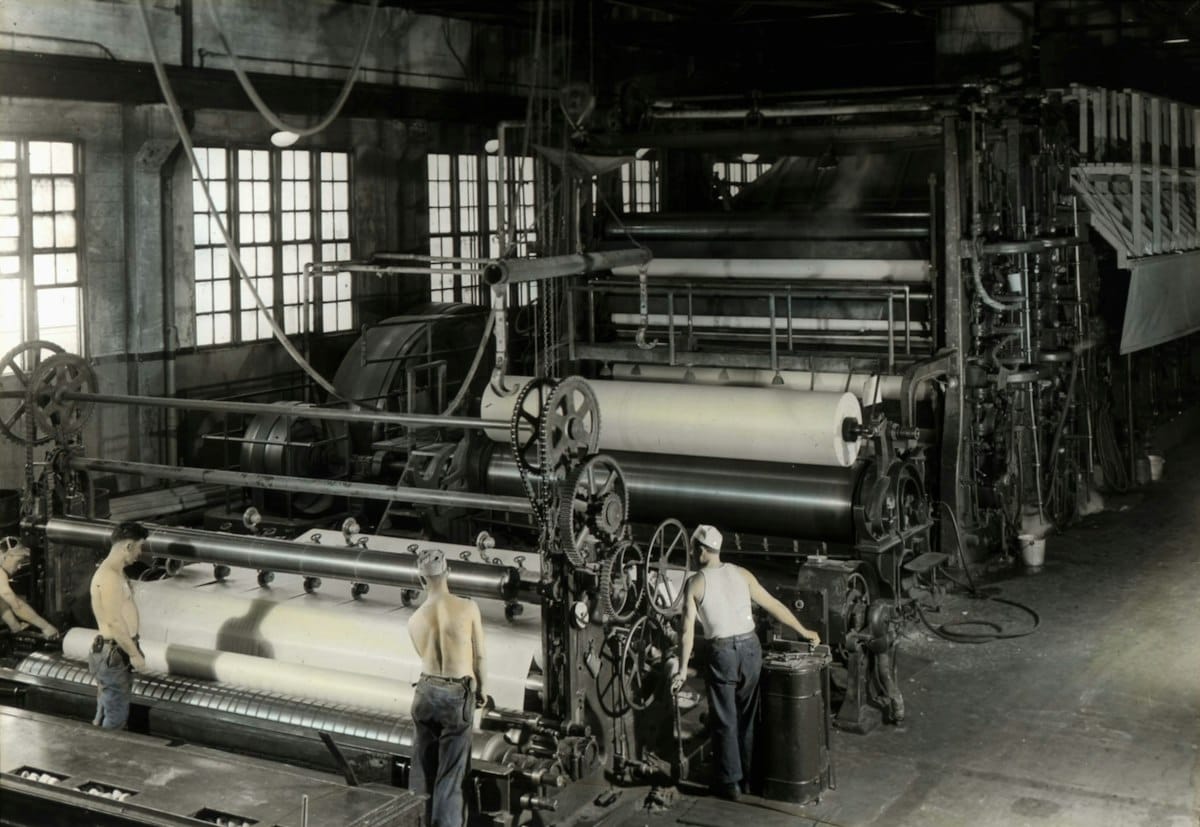
The detail that matters is how factories used the motors at first. Retrofitting usually meant adding electric motors to the plant that was already there. In what David calls group drive, each motor turned a section of the old overhead shafting for a group of machines, and the original belts, shafts and even the steam engines stayed in place as spare capacity. More capital, the same layout, and measured productivity held down.
The payoff came with what David calls unit drive, a separate motor on each machine. Then the shafts could go, the buildings could be redesigned without the bracing, machines could be placed in the order the work flowed, and one department could be changed without shutting down power to the whole mill. The productivity came from the new layout, not from the new motor.
US factories and electricity, 1880s to 1920s
- What firms bought electric motors, added to the existing plant
- What stayed the same line shafts, belts, braced buildings, the old engines kept as spare capacity
- What it showed more capital, little change in output
- What paid one motor per machine and factories laid out around the flow of work
Companies outside tech and AI, 2026
- What firms bought AI tools; 55.9% of businesses on Ramp pay for them
- What stayed the same the same process steps, often bought per seat
- What it showed flat revenue per worker and margins for the S&P 493
- What would pay the open question: work redrawn around the tool, if AI is general enough
Sources: Paul A. David, AEA Papers and Proceedings, May 1990; Ramp AI Index via FRED; Apollo, 24 Oct 2026.
Is there a modern version of the same dip?
Yes, and it has data. Erik Brynjolfsson, Daniel Rock and Chad Syverson called it the productivity J-curve (American Economic Journal: Macroeconomics, 2021): general purpose technologies such as AI "enable and require significant complementary investments", in training, process redesign and new ways of organizing, and those investments don't get counted as output. So measured productivity looks flat or worse at first, then rises.
A later study tested this on factories directly. Kristina McElheran, Mu-Jeung Yang, Zachary Kroff and Brynjolfsson used two US Census Bureau surveys of tens of thousands of manufacturers, from 2017 and 2021. As MIT Sloan reported on 9 July 2025, firms that adopted AI saw productivity drop 1.33 percentage points at first after controls, and over time tended to outperform non-adopters on productivity and market share. The gains went mostly to firms that were already digitally mature.
Sources: Ramp AI Index via FRED; Apollo, 24 Oct 2026; McElheran, Yang, Kroff and Brynjolfsson via MIT Sloan, 9 Jul 2025; Paul A. David, 1990.
Where Slok's reading is stronger than mine
Two things in his note push back on the comfortable version of this, and I think he's right on both.
First, he says mainstream companies "do not need the latest model" and won't pay for it. If firms are cutting token budgets to protect margins, they're cutting the experiments that a redesign would need. The 1890s mills that kept the line shaft at least kept the motor.
Second, he says "in business, intelligence is mostly judgment," and that AI doesn't understand accountability, trust or unwritten rules. Electricity didn't need to understand anything. A motor turns or it doesn't. If the work AI is meant to change is mostly judgment, the redesign is harder to see and harder to copy than moving machines around a floor. I wrote about a version of this with two AI medical scribes: one saved time and clinicians couldn't tell them apart, because the time saved didn't turn into anything the system measured.
What I'd add is that a lot of the S&P 493's AI spend looks like seats, not layouts. When Accenture capped Claude at $29 a month, the spend started billing like photocopying, an overhead line rather than part of how a project runs. That is a motor bolted onto the old shaft.
So what should anyone look at instead?
Revenue per worker in year three is the wrong test, in 1905 as in 2026. The better question for any company outside tech is whether a single process has been redrawn around the tool: fewer handoffs, a step removed, a role changed, work moved to a different place in the flow. If the answer is no and the spend is still per seat, flat margins are exactly what the history predicts. If the answer is yes somewhere, that's where to look for the first turn of the J.
That's also the honest weakness in my comparison. It assumes AI is a general purpose technology like electricity. If it turns out to be narrower, closer to a very good calculator, as Slok puts it, there's no rebuilt factory waiting at the end, and the S&P 493 is right to treat it as a cost.
Outside tech, most AI spending is still a motor bolted onto the old line shaft, and until companies redraw the work around it, flat margins are what the history predicts.
- Established
- Apollo's charts show flat revenue per worker and margins for the S&P 493 against rising figures for the Mag 7 (24 Oct 2026); more than half of businesses on Ramp pay for AI tools; electricity paid off in US factories only after they were redesigned around unit drive (David, 1990); AI-adopting manufacturers saw an initial productivity drop, then outperformed (Census study via MIT Sloan).
- Inferred
- That today's flat line outside tech is mostly the old-layout phase, with AI spend going to seats rather than redesigned processes. Slok's note does not separate adopters from non-adopters, so this is my reading, not his finding.
- Guess
- When it turns, or whether it turns at all. If AI is narrower than electricity, there is no rebuilt factory at the end and treating it as a cost is right.
More on Daily Ferment: AI benchmarks miss most work. Drug trials once missed women. and Accenture capped Claude at $29 a month. The rest now bills like photocopying.
Sources
- Torsten Slok, No Signs of AI Payoff Outside the Tech Sector, Apollo, 24 Oct 2026
- Ramp, Artificial Intelligence Adoption by Ramp Businesses: Overall, FRED series RAMPAIALL
- Paul A. David, The Dynamo and the Computer, AEA Papers and Proceedings 80(2), May 1990
- Brynjolfsson, Rock and Syverson, The Productivity J-Curve, NBER w25148 (AEJ: Macroeconomics, 2021)
- MIT Sloan, The productivity paradox of AI adoption in manufacturing firms, 9 Jul 2025
- Jack E. Triplett, The Solow Productivity Paradox, Brookings