Japan's throne has one young heir. Software has a name for that.
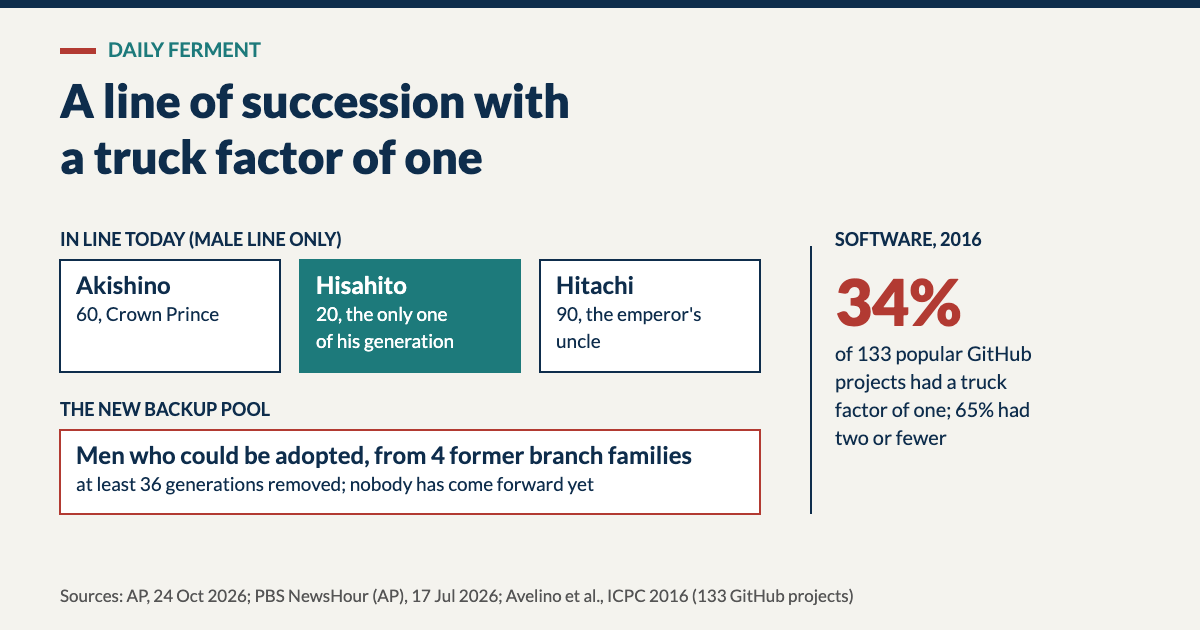
Japan's revised succession law keeps the male-line rule and plans to adopt distant relatives if Prince Hisahito has no son. Software engineers call a pool of one a truck factor of one.

Japan's revised Imperial House Law took effect on Saturday, 24 October 2026, AP reported. It keeps the rule that only a man descended through the male line can become emperor. That leaves three people in line: Crown Prince Akishino, 60, his son Prince Hisahito, 20, and the emperor's uncle, Prince Hitachi, who is 90.
So what happens if Prince Hisahito has no son? The new law's answer is adoption: unmarried men aged 15 or older, descended in the male line from branch families that left the imperial family in 1947, can be brought back in. So far, AP says, nobody has come forward.
What exactly changed on 24 October?
Two things, both passed by parliament on 17 July (PBS NewsHour, from AP).
First, princesses who marry commoners can now keep their royal status instead of leaving the family, as Princess Mako did in 2021. Five unmarried princesses, including the emperor's daughter Princess Aiko, 24, can choose. Their husbands and children still don't become royals, so this keeps people available for official duties without adding anyone to the line.
Second, the adoption route. The candidates would come from the 11 branch families that gave up their status in 1947 to ease the monarchy's postwar costs. Four of those families remain. Officials told AP that they are at least 36 generations removed from Emperor Naruhito, splitting from a common male-line ancestor 600 years ago. The English text of the law on the Imperial Household Agency's site, which predates the revision, still shows how big a change this is: Article 9 says the emperor and members of the family "may not adopt children."
Sources: AP, 24 Oct 2026; PBS NewsHour (AP), 17 Jul 2026.
Why do supporters want it this way?
The case for the law deserves to be stated in its own terms. For Prime Minister Sanae Takaichi and other conservatives, PBS reported, the male bloodline is "the only source of the emperor's authority and legitimacy." On that view, letting Aiko reign wouldn't widen the pool. It would change what the throne is. Adoption from old branch families is the only way to add heirs without breaking the thing the rule protects.
The case against is just as plain. Critics told AP the law discriminates by family background and gender and puts pressure on the youngest royals to have sons. Polls run against it: in late July, Yomiuri found 85% support allowing a female emperor, and more people disapproved of adopting men from former branches (45%) than approved (40%). Kyodo had support for a female emperor at 81.0% (both reported by FN News).
I don't have a stake in which side is right about legitimacy. What caught my attention is the structure of the fix.
What does software call a pool of one?
Programmers have a blunt name for this: the truck factor, "the number of people on your team that have to be hit by a truck (or quit) before the project is in serious trouble." When Guilherme Avelino and colleagues measured it for 133 popular projects on GitHub in 2016, 34% had a truck factor of one and 65% had two or fewer (arXiv).
In a 2016 study of 133 popular projects on GitHub, what share depended on a single person, a truck factor of one?
34% (45 projects), and 65% had a truck factor of two or less. Avelino, Passos, Hora and Valente, 2016.
Look at the next generation of Japan's imperial family that way and the truck factor is one. Hisahito is the only eligible man of his generation. Everyone else in the line is his father's age or 90.

A project in that position has two usual moves. It can change who is allowed to maintain the code, giving commit rights to the people who already do the work. Or it can keep the rule and look further out for people who meet it. The first changes the criterion. The second keeps the criterion and widens the search.
Japan has chosen the second, and chosen it in an extreme form. The people already doing the work, the princesses who carry out official duties, are kept in the family but kept out of the line. The pool is widened instead with men who meet the rule exactly and whom nobody inside has worked with, from families that left nearly 80 years ago.
My first reaction, and where it was wrong
My first reaction was that the adoption route simply doesn't work, since nobody has volunteered. That was too quick. AP quotes conservative scholars saying there are a number of candidates, and the law has been in force for a day. Software projects also bring in maintainers from outside, and some of them become the best people a project has.
What does hold up is narrower. Once the pool is widened with strangers, the risk doesn't disappear; it moves. It used to sit in one number, how many eligible men there are. Now it sits in a process: who volunteers, who chooses among them, and whether anyone outside can see how. AP reports experts already questioning "the lack of transparency in the selection process." In a software project, the moment a newcomer gets commit rights to a project with a truck factor of one is exactly the moment everyone should be watching.
A software project with a truck factor of one
- Change the criterion give commit rights to people already doing the work
- Keep it, search wider bring in a maintainer from outside the project
- Where the risk moves to how the newcomer is chosen and who can see it
- If it fails the project can be forked or abandoned
Japan's imperial line, from 24 Oct 2026
- Change the criterion rejected: women and the female line stay out of the line
- Keep it, search wider adopt unmarried men, 15 or older, from four former branch families
- Where the risk moves to who volunteers and how they are selected, which experts already call opaque
- If it fails no fork; the line depends on Hisahito having a son
Sources: AP, 24 Oct 2026; Avelino et al., 2016. The comparison is mine.
I'd also be careful with the comparison where it bends. A software project can fork, or be abandoned with little cost. A 1,500-year-old monarchy can't, and a person adopted into it gives up an ordinary life in a way no new maintainer does. That cost, carried by real people, is part of why nobody has stepped forward, and the truck factor doesn't measure it. I wrote about a smaller version of the trust problem when MongoDB's chief executive left for Meta and the reassurances didn't land. It left me thinking that a successor is judged as much on how they were chosen as on who they are.
When a succession rule leaves a pool of one, widening it only with people the rule allows but nobody has met moves the risk from how many heirs there are to who volunteers and who chooses them.
- Established
- The revised Imperial House Law took effect on 24 Oct 2026 and keeps male-line succession; three people are in line (60, 20 and 90); adoption is allowed from former branch families at least 36 generations removed and nobody has come forward (AP); late-July polls show most respondents favour allowing a female emperor; 34% of 133 popular GitHub projects had a truck factor of one (Avelino et al., 2016).
- Inferred
- That the adoption route makes the selection process, not the number of heirs, the new single point of failure. That is my reading of the structure, not something the law or AP says.
- Guess
- Whether anyone volunteers, and whether the law is changed again before it is tested. The software comparison bends here: a person adopted into the family gives up far more than a new maintainer does.
More on Daily Ferment: MongoDB's CEO left for Meta. Why didn't the reassurance work? and PHP shipped a critical fix. Old versions got none. Now what?
Sources
- AP, Japan's revised Imperial law enshrining male-only succession takes effect, 24 Oct 2026
- PBS NewsHour (AP), Japan enshrines in law male-only succession for its shrinking imperial family, 17 Jul 2026
- Imperial Household Agency, The Imperial House Law (English text)
- FN News, poll round-up on the Takaichi cabinet and the Imperial House Law, 27 Jul 2026
- Avelino, Passos, Hora and Valente, A Novel Approach for Estimating Truck Factors, ICPC 2016 (full text)
- Avelino et al., arXiv:1604.06766