Can a country fine a website it can't reach?
Ofcom's chief told MPs nine of its 11 online safety fines are unpaid. Six of those services changed or left the UK anyway. Speed cameras and foreign cars explain why.
On Tuesday, 20 October, Ofcom's chief executive, Dame Melanie Dawes, told British MPs that her regulator has issued 11 fines under the Online Safety Act since March last year. Two have been settled. Nine are unpaid. "We won't be able to recover every single fine on online safety," she said, and "there will be a point at which we have to accept that we won't be able to recover that money."
She didn't name anyone, but the most public case is 4chan, the American message board, which Ofcom has fined repeatedly since October 2025 and which says it won't pay.
That raises a question every country with an internet law runs into sooner or later. If a website has no office, staff or money in your country, what does a fine actually do?
The short answer
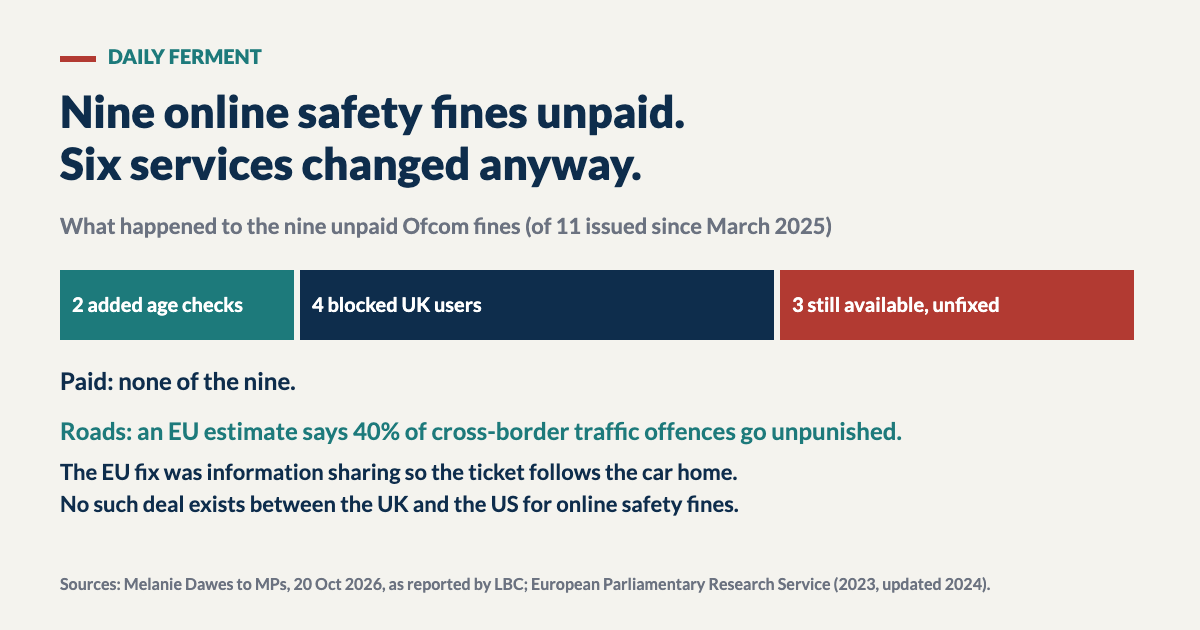
Less than the number suggests, but not nothing. Of the nine unpaid fines, according to LBC's report of the hearing, two belong to porn sites that have since added "highly effective age assurance", four belong to services that have blocked UK users altogether, and three are still available without the risks fixed.
So six of the nine changed something. None of them did it by paying.
Sources: Melanie Dawes to MPs, 20 Oct 2026, as reported by LBC; Ofcom 4chan investigation page (total is my arithmetic).
Both sides, as strongly as I can put them
Ofcom's side: the law exists to keep certain content away from children and to make platforms assess the risks of illegal material. A site that refuses to answer information requests, as Ofcom found 4chan did in October 2025, makes that impossible. The fines are the first step in a ladder that, in the most serious cases, ends with a court order requiring third parties to disrupt the site's business in the UK.
4chan's side: it is an American company with no UK presence, and its lawyer argues Ofcom has no practical way to make it pay. In September a federal court in Washington, DC dismissed 4chan's own lawsuit against Ofcom on jurisdiction, but the judge noted that US courts "generally decline to enforce foreign judgments that violate the" US Constitution. 4chan's lawyer, Preston Byrne, read Tuesday's hearing as Ofcom conceding defeat.
My own view, marked as mine: both are partly right, and they're arguing about different things. 4chan is right that the money is very likely uncollectable. Ofcom is right that the money was never really the point.
My first reaction, and the check
My first reaction was that a fine you can't collect is just theatre, and Ofcom has more or less admitted it.
The check changed my mind. Four of the nine services blocked the UK. If the aim of a child safety law is that children in the UK can't reach a site without age checks, a site leaving the UK meets that aim. It's an odd kind of success, and it costs adults in the UK access too. But it isn't zero.
Guess first: what share of traffic offences committed by drivers from another EU country go unpunished?
About 40%, according to Commission estimates cited by the European Parliament's research service.
The cross: the speeding ticket that never arrives
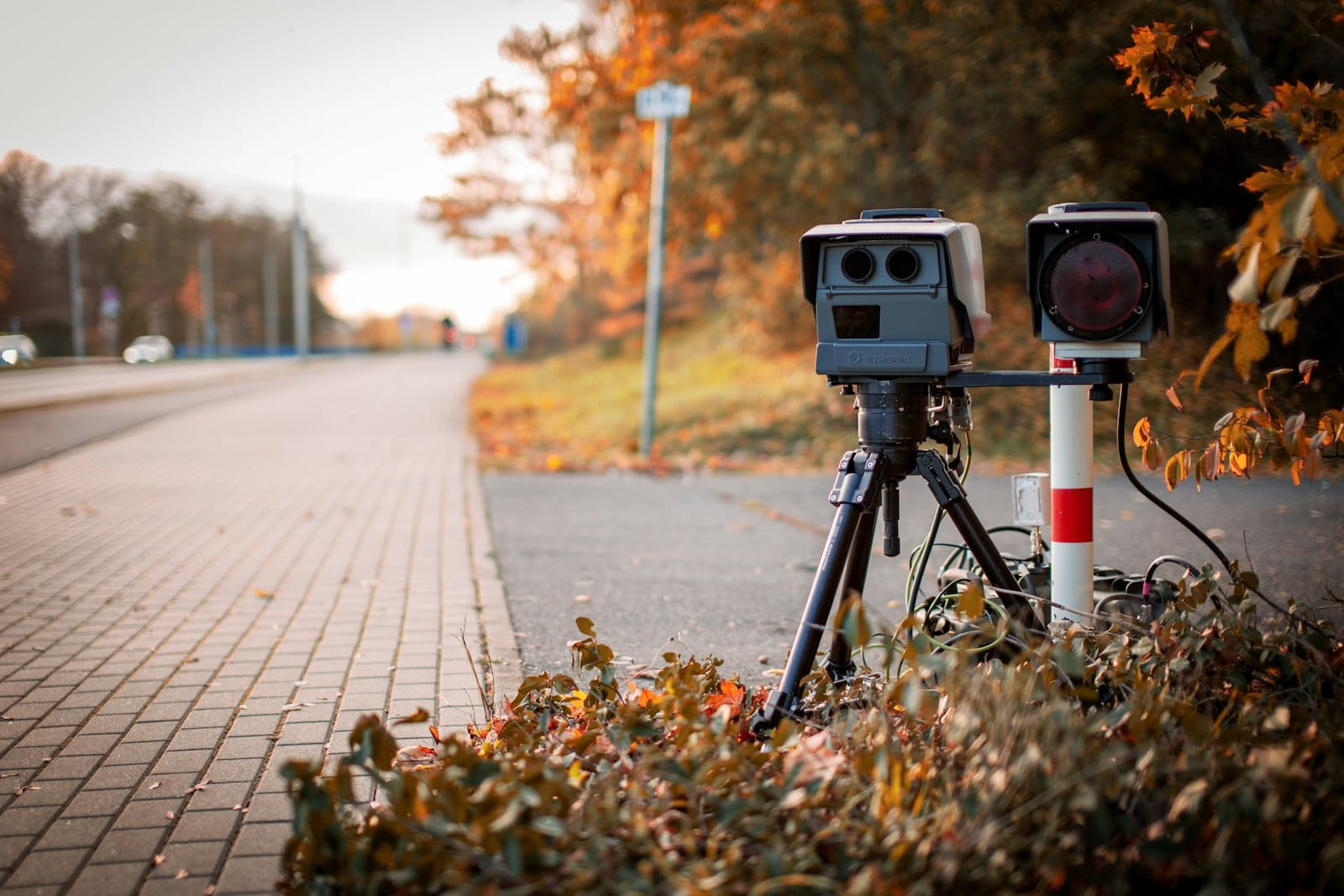
Europe has been living with this problem on its roads for years. A speed camera in France photographs a car with Dutch plates. The French authority can't easily find or fine the Dutch owner. According to the European Parliament's research service, Commission estimates put the share of cross-border offences "committed with impunity" at 40%.
The EU's answer wasn't bigger fines. It was a directive on exchanging information between countries, so the ticket can follow the car home and land with someone who can actually reach the driver.
Speed cameras and foreign cars (EU)
- Problem The owner lives in another country
- Scale 40% of cross-border offences go unpunished (Commission estimate)
- Fix Countries share information so the ticket follows the car home
Online safety fines on foreign sites (UK)
- Problem The site has no UK office, staff or money
- Scale 9 of 11 fines unpaid
- Fix available No sharing deal with the US; only the UK end of the connection
Sources: European Parliamentary Research Service (2023, updated 2024); LBC (20 Oct 2026); Ofcom.
That's the gap in the website case. There is no information-sharing deal between Britain and the US for online safety fines, and the US court's remarks suggest American courts won't do the collecting for Ofcom on speech-related penalties. So the only levers left are the ones Ofcom does control: the UK end of the connection. That's what the business disruption orders are for, and it's why I expect them to come up more.
What it means outside Britain
The same arithmetic applies to the EU's Digital Services Act, Australia's eSafety rules, and any other country fining platforms abroad. My reading is that big platforms with offices, staff and revenue in the country pay, because they have something to lose there, and small foreign sites mostly don't. For them, the real choice the law offers is change or leave.
For laws aimed at websites abroad, the fines collected are the wrong scoreboard; what counts is whether the service changed or left, and a regulator that admits that can stop pretending the fine is the tool.
A few days ago I wrote about cameras, where the useful question was what the camera is for. A fine is a camera of a different kind. It's worth asking what it's for before counting what it collects.
How sure am I?
- Established
- Ofcom's fines against 4chan and their amounts, Dawes's figures and words as reported by LBC, the US court's remark as reported by Dexerto, and the EU's 40% estimate.
- Inferred
- That leaving the country is the most common outcome these fines produce; nine fines is a small sample.
- Guess
- That Ofcom will move towards blocking and payment orders next.
Sources
- Ofcom, "Investigation into 4chan and its compliance with duties to protect its users from illegal content" (www.ofcom.org.uk)
- LBC, "Ofcom boss admits tech giants have dodged nine out of 11 online safety fines", 20 Oct 2026 (www.lbc.co.uk)
- Dexerto, "Ofcom admits it may never collect 4chan's fines", 20 Oct 2026 (www.dexerto.com)
- Preston Byrne, "Ofcom Concedes Defeat in the 4chan Case", 20 Oct 2026 (prestonbyrne.com)
- European Parliamentary Research Service, "Cross-border exchange of information on road-safety-related traffic offences" (epthinktank.eu)