Agents that think off the page leave one reader: the vendor
A new AI agent does most of its reasoning in hidden states and stays readable, but only through a component its maker owns. Aviation settled who may hear a cockpit recording by law.
A paper posted to arXiv on 13 October by researchers linked to Stanford and Together AI describes an agent that does most of its thinking in numbers rather than words, and then promises you can still read it. It's called Hybrid Reasoning Agents. Its opening line is the question: "How can we build an agent that thinks beyond human language, yet still acts through it in the external environment?"
The agent switches between two modes. In text mode it writes, calls tools and shows its work, like the agents we have now. In latent mode it reasons in its own hidden states, with no words produced at all. The authors report, on their own benchmarks, a 10.4% gain over frontier agents, 35.5% to 54.7% fewer tokens, inference 1.8 to 2.6 times faster and costs 2.7 to 3.7 times lower. It's a preprint, so those are their numbers, not checked by anyone else yet.
Source: Zou et al., Hybrid Reasoning Agents, arXiv 2610.18861, 13 Oct 2026. The authors' own evaluation, not yet peer reviewed.
The question I care about is the one under the speed. If an agent stops thinking in words, can anyone still check what it was thinking? The paper's answer is yes. The detail is who.
Doesn't reasoning without words end monitoring?
That was my first reaction. A lot of AI safety work now rests on reading a model's chain of thought. A 2025 paper by Korbak and colleagues called that a "new and fragile opportunity" and asked developers to weigh how their choices affect it. Reasoning in hidden vectors looks like the fragile part breaking.
Hide the agent's latent steps and let an outside monitor see only its text. How much worse does the monitor do at spotting wrong answers?
Barely. Within 0.022 AUROC of the same monitor watching an ordinary text agent, on the authors' own tests. Source: arXiv 2610.18861, Table 7.
The paper pushes back with evidence. Each latent step can be mapped to its nearest word, which gives readable "pseudo-text". The authors write that this makes latent reasoning "transparent and directly inspectable rather than opaque." They also tested a harder case, where an outside monitor sees only the text steps, tool calls and outputs, with the latent spans hidden. The agent wrote 43% to 49% less text and ran 170 to 183 reasoning steps per problem in latent mode. Monitors judging from the visible text alone still predicted right and wrong answers about as well as they did for an ordinary text agent, within 0.022 AUROC.
So my first reaction was too simple. The thinking isn't lost. Then I read the discussion section.
So who can read it?
Here is the sentence that matters.
"Latent thoughts exist only as backbone hidden states that are readable solely through the provider-owned HybridLink (Section 3), so no text exists to leak."
Zou et al., Hybrid Reasoning Agents, Section 8HybridLink is the small component that translates between the hidden states and words. The provider owns it. The paper offers this as an advantage. Labs already hide chains of thought from API customers to protect their methods, and the authors cite work showing those encrypted traces can be replayed through a sibling model and transcribed word for word. With latent reasoning there's nothing to replay. And, they add, "because the latent trace is held by the provider rather than the client, providers can assess the safety of reasoning and actions over the full readout, including the portion users never see."
Read that from the customer's side. The full record of why the agent did what it did exists, and is readable, by exactly one party. Everyone else gets the text mode, which the paper itself designs as a compact interface for monitoring. A customer trying to work out why their agent deleted a table would see the summary the system chose to put into words.
I wrote earlier this month about an agent that could change what its reviewer saw. This is a quieter version of the same problem. Nobody edits anything. The reviewer just isn't given the reader.
Who else keeps a full record that only some people may hear?

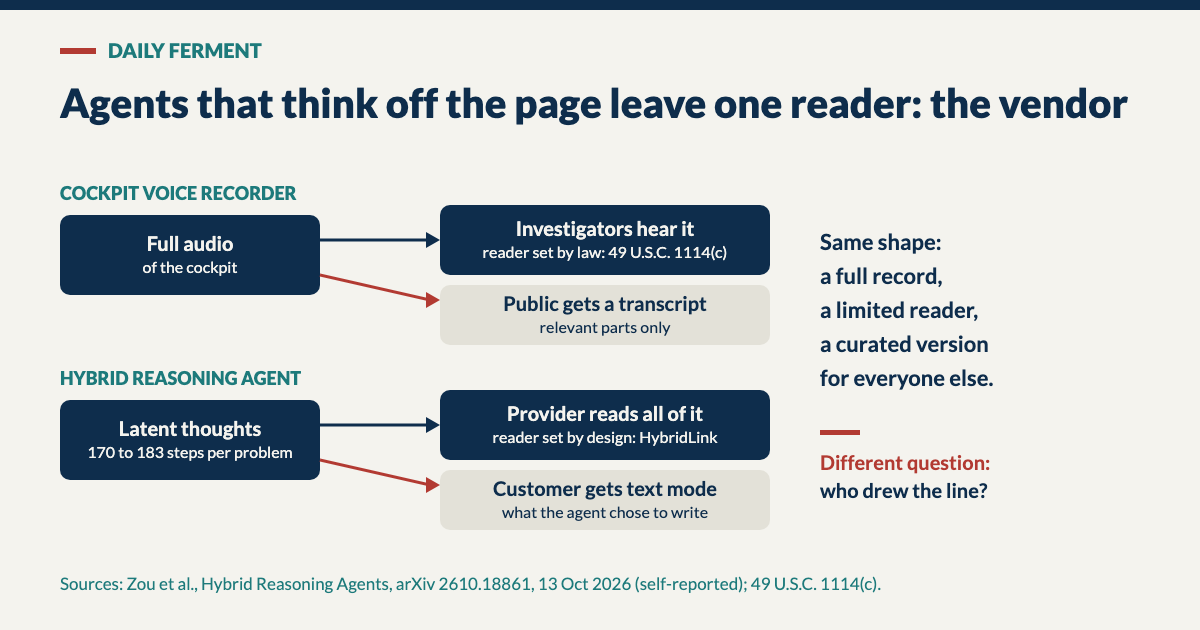
Aviation. An airliner's cockpit voice recorder is the full record of what the crew said and heard. Who gets to hear it isn't left to the airline or the plane maker. In the US it's set in law. 49 U.S.C. 1114(c) says the National Transportation Safety Board "may not disclose publicly any part of a cockpit voice or video recorder recording or transcript", except the parts of the transcript it decides are relevant to the investigation, released at a hearing or with the factual reports. The Board holds the audio. The public gets a transcript of what matters, and never the sound.
And the record doesn't stay sealed just because the rule says so. In May 2026 the NTSB said someone was using AI to rebuild approximations of cockpit audio from the sound spectrum images in its public dockets, including the investigation into the 2025 UPS Flight 2976 crash in Louisville. It took its docket system offline.
Set the two next to each other.
Cockpit voice recorder
- The full recordAudio of the cockpit
- Who can read it in fullInvestigators, by statute
- What everyone else getsA transcript of the relevant parts
- Who decidesCongress, in 49 U.S.C. 1114(c)
- Has it leaked?Audio rebuilt from spectrograms, May 2026
Hybrid agent's latent reasoning
- The full recordHidden states, readable as pseudo-text
- Who can read it in fullThe provider, by design
- What everyone else getsThe text mode the agent chooses to write
- Who decidesThe provider
- Has it leaked?Not yet tested
Sources: 49 U.S.C. 1114(c); FLYING, 22 May 2026; Zou et al., arXiv 2610.18861, 13 Oct 2026.
The two look alike in what they protect: the record exists, readers are limited, and the public gets a curated version. The difference is who drew the line. Aviation decided by law, with a named reader and a rule for what gets released. With latent agents the line is a component the vendor owns.
How sure am I?
- Established
- What the paper says about its design and the numbers it reports for itself; the statute's text; the NTSB's May 2026 statement as reported by FLYING.
- Inferred
- That a customer of such an agent would see the text mode and not the latent readout, since the paper presents provider-only reading as the point.
- Guess
- That someone outside will eventually reconstruct latent readouts the way the cockpit audio was rebuilt, because a record that exists tends to find more readers than it was meant for.
Once an agent's reasoning leaves text, whether it can be inspected stops being a property of the model and becomes a question of who holds the reader, and that should be settled by rule, as aviation did with cockpit recordings, not left to architecture.
What I can't tell from the paper is whether the pseudo-text is faithful to what the model actually computed, or only readable. The authors measure readability and test what happens when they disturb the latent steps. That's not the same as proof that the words match the work. A reader you can't verify is worth less than it sounds, whoever holds it. It's the same worry as who owns a record of private conversations once the company holding it changes hands.
Sources
- Zou, Qi, Chen, Bianchi, Zhu, Lu, He and Zou, Hybrid Reasoning Agents, arXiv 2610.18861, 13 October 2026 (full text)
- Korbak, Balesni, Barnes and others, Chain of Thought Monitorability: A New and Fragile Opportunity for AI Safety, arXiv 2507.11473, 2025
- 49 U.S.C. 1114, Disclosure, availability, and use of information
- Meg Godlewski, NTSB: UPS cockpit voice recordings fabricated with AI, FLYING, 22 May 2026