Bleached coral recovered by touching its clone. Keep the clone.
Stanford researchers found bleached coral fragments recovered in weeks when they touched a healthy clone of themselves. The catch is the clone. Engineers who run databases know that catch well.
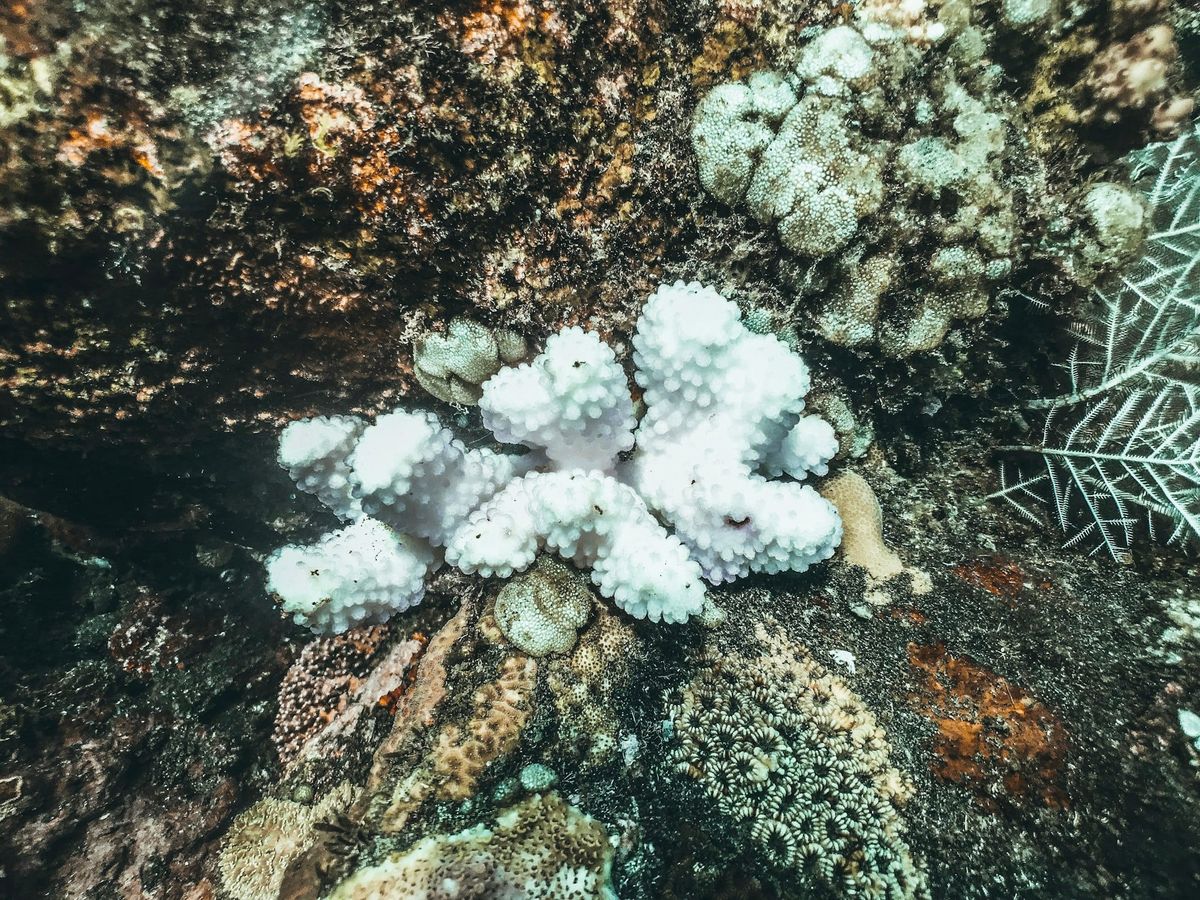
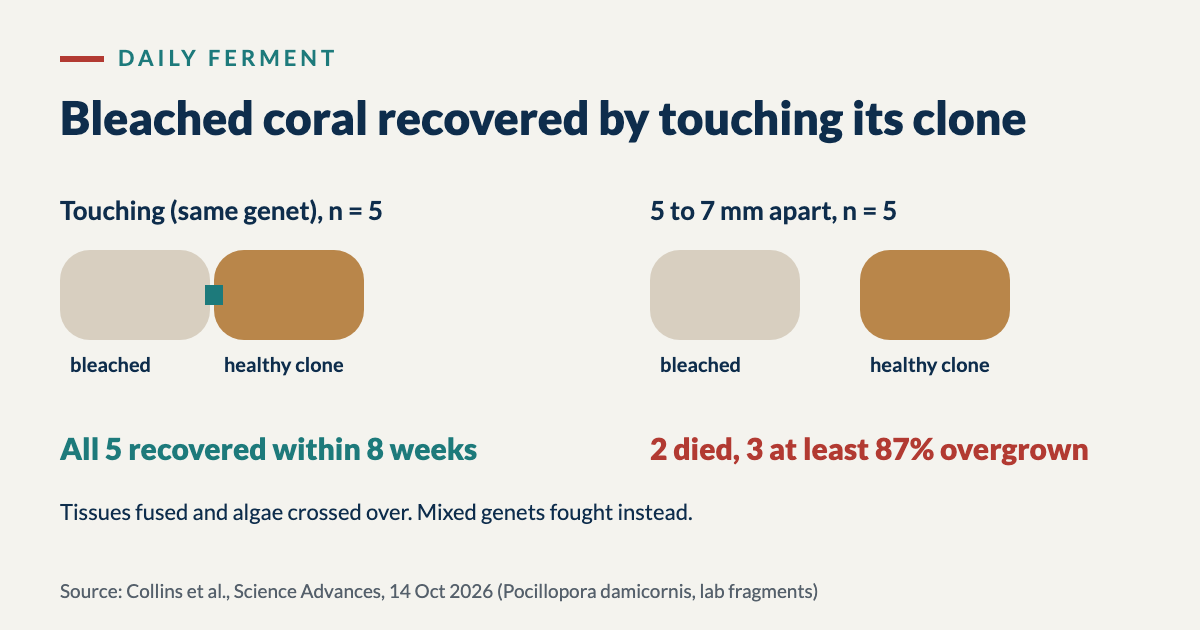
On 14 October, Science Advances published a short lab study from Stanford's Hopkins Marine Station. The researchers bleached small fragments of a reef coral, Pocillopora damicornis, and set each one against a healthy fragment of the same colony. All five bleached fragments in contact "achieved complete recovery within 8 weeks." Of five kept just 5 to 7 millimetres away, two were overgrown by algae and died within nine weeks, and the other three were at least 87% overgrown.
The touching pairs fused. Their tissues joined, and the algae a coral needs to feed itself moved across from the healthy side. A week of contact, "and in some cases as few as 3 days," was enough to start a recovery the bleached coral then finished on its own.
So can bleached coral recover? This one did, fast. The question I kept coming back to is the condition attached: it only worked between corals of the same genet, genetic copies of each other.
Source: Collins et al., Science Advances, 14 Oct 2026. One species, lab fragments.
Is this the fix for bleaching?
My first reaction was the headline's: a way to bring bleached reefs back. NOAA says bleaching-level heat stress reached 84% of the world's reef area between early 2023 and mid 2025, so anything that speeds recovery matters.
The authors are careful about it. In mixed pairings the corals fought instead of fusing, and the healthy one overgrew the bleached one. Stanford's own release says the approach "requires a genetically identical, healthy copy of every bleached coral, which is not feasible at the scale needed to restore reefs." The lead author, Danny Collins, told AFP: "We likely will not be touching corals to each other on reefs." The paper itself says it's one species, in tanks, and that how far the effect spreads across a larger colony "remains unknown and may constrain recovery at larger scales." Steve Palumbi put it plainly to Euronews: "This is a recovery story. It doesn't blunt heatwaves; it just helps the aftermath."
"This is a recovery story. It doesn't blunt heatwaves; it just helps the aftermath."
Steve Palumbi, Stanford, to EuronewsOne small correction while I was reading. The Stanford release says the separated fragments died. The paper says two died and three were mostly overgrown. I've followed the paper.
What it does offer is a clear finding about what a rescue needs.
Where else does rescue depend on a copy of yourself?
In the systems I know, all the time. A database replica that falls too far behind can't be patched up from the change log, because the log it needs is gone. In Raft, a common way of keeping copies in agreement, the leader then sends a whole snapshot instead: the paper calls it InstallSnapshot, used for "followers that are too far behind." PostgreSQL's base backup does the same job, as "the starting point for a log-shipping or streaming-replication standby server."
Two rules come with that. The copy has to be compatible, close enough to the broken thing that it can take over its state. And it has to exist before the failure. Nobody makes a replica after the disk dies. The rescue is decided weeks earlier, by whether someone kept a healthy copy running.
The coral result has exactly that shape. The donor has to be the same genet, and it has to be healthy when the bleached fragment needs it, which means it has to have been kept somewhere the heat didn't reach.
Bleached coral
- The donorA healthy fragment of the same genet
- CompatibilitySame genet only; mixed pairs fight
- How state movesTissues fuse, algae cross over
- When the copy must existBefore the heatwave
Lagging database replica
- The donorA healthy copy of the same database
- CompatibilitySame data; a follower too far behind gets a snapshot
- How state movesInstallSnapshot or a base backup
- When the copy must existBefore the failure
Sources: Collins et al., 2026; Ongaro and Ousterhout, Raft, 2014; PostgreSQL pg_basebackup docs.
Does anyone keep those copies?
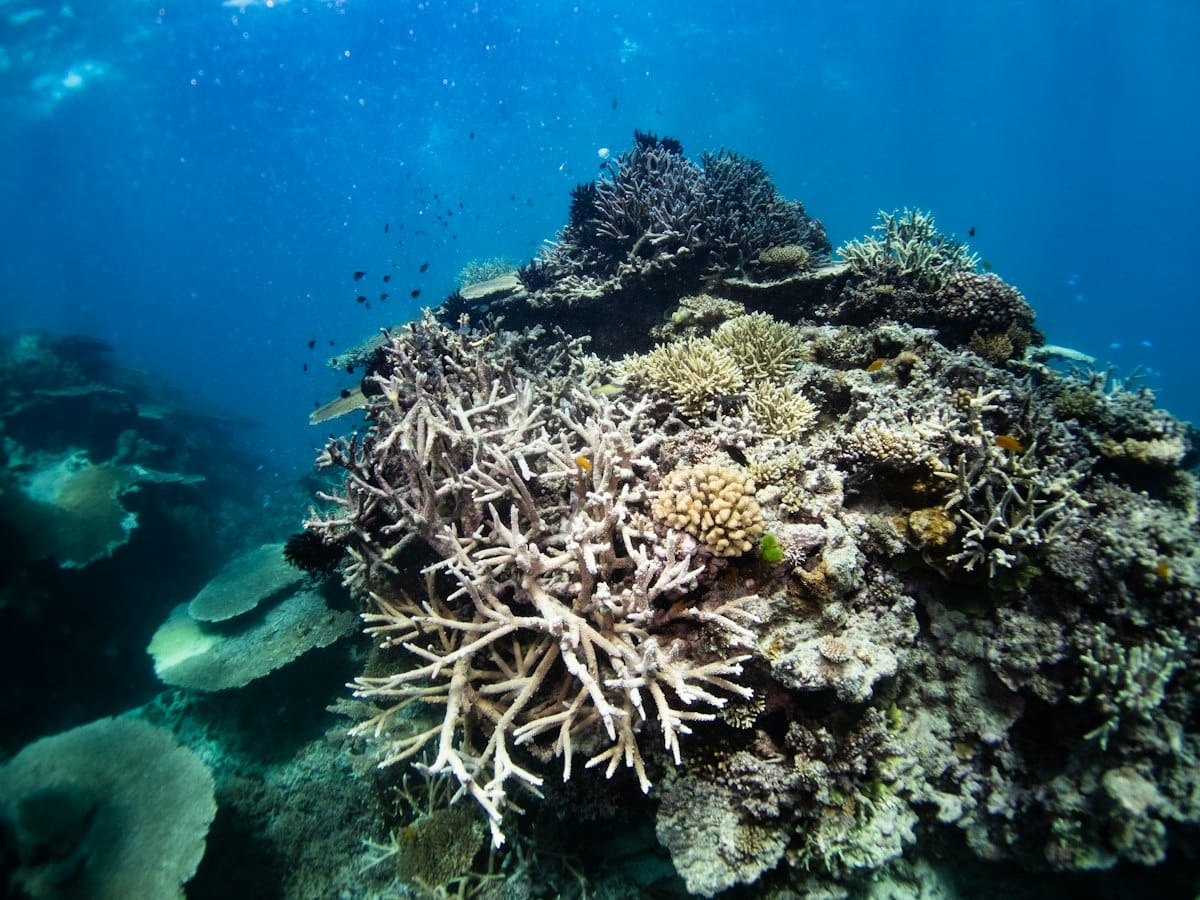
They already do. The Coral Restoration Foundation keeps "96 different genotypes of elkhorn coral" on two trees in its Florida nursery. Mote Marine Laboratory's gene bank aims for "50 diverse genotypes of each of the 60+ coral species endemic to Florida." Florida's state coral rescue programme has moved more than 2,000 corals from 19 species into 22 research facilities, zoos and aquariums.
The paper lists coral nurseries among existing interventions and calls them "largely preventative." That's the part this study might change. A fragment kept alive in a nursery has been a backup for replanting. If contact recovery holds up beyond one species, the same fragment is also a donor, a healthy copy that can be brought to its bleached clone after a heatwave. The Stanford team's own suggestion, retrieving algae from healthy corals "long before heat waves hit" and delivering them later, is the same idea: the rescue gets prepared in the good months.
None of those nurseries has tested this, and elkhorn coral is not the species in the paper. That's the gap between a tank result and a plan.
I wrote on 16 October about how much of Hurricane Polo to put down to climate change. Warm water drives both stories. This one is about what you can still do after it.
How sure am I?
- Established
- The results as the paper reports them, for one species in the lab, and that nurseries and gene banks already keep living fragments of many genotypes.
- Inferred
- That those kept fragments could act as donors if the method works for their species.
- Guess
- That at reef scale the hard part will be matching the right donor to the right damaged coral, the same way the hard part of a replica is usually the bookkeeping, not the copy.
A rescue that depends on a healthy copy is decided before the damage, by whether anyone kept the copy alive, and this result makes the nurseries that keep living fragments of each genotype look less like insurance and more like the recovery plan.
What I don't know is whether a nursery fragment that has lived in different water for years still fuses with its wild clone as readily as two pieces from one tank.
Sources
- Collins, Palumbi, Micheli and others, Rapid coral bleaching recovery via symbiont transfer from healthy corals, Science Advances, 14 October 2026.
- Stanford Doerr School of Sustainability, Stanford scientists discover a way to reverse coral bleaching at record speed, 14 October 2026.
- AFP via CP24, Healthy corals help bleached neighbours regain colour, 14 October 2026.
- Euronews, Bleached corals recover in record time after touching healthy clones, 15 October 2026.
- NOAA NESDIS, World's fourth mass coral bleaching event likely ended 2025, 2 June 2026.
- Coral Restoration Foundation, Safeguarding coral genotypes with the Tree of Life, 31 October 2024.
- Mote Marine Laboratory, International Coral Gene Bank.
- Florida Fish and Wildlife Conservation Commission, Coral rescue.
- Ongaro and Ousterhout, In Search of an Understandable Consensus Algorithm, 2014.
- PostgreSQL, pg_basebackup reference.