Science proved Jodi wasn't a T. rex. Then she sold for $47.3 million.
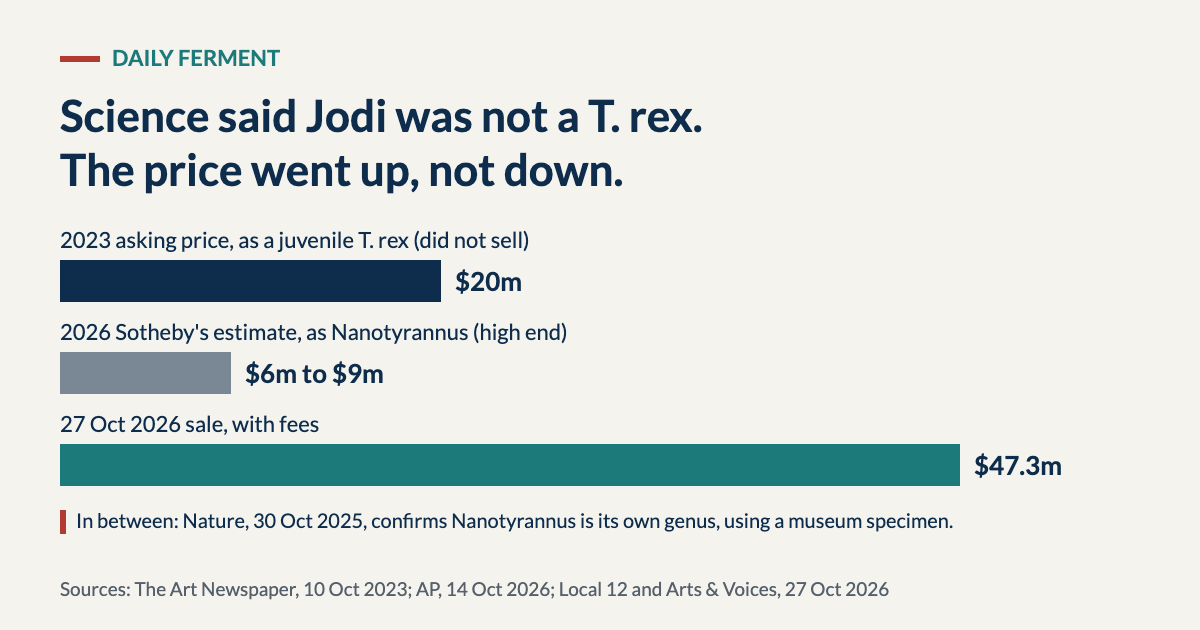
Offered as a T. rex for $20 million in 2023, the skeleton sold as a Nanotyrannus for $47.3 million. The study that made her rare was done on a museum specimen. Her buyer can keep her from science.
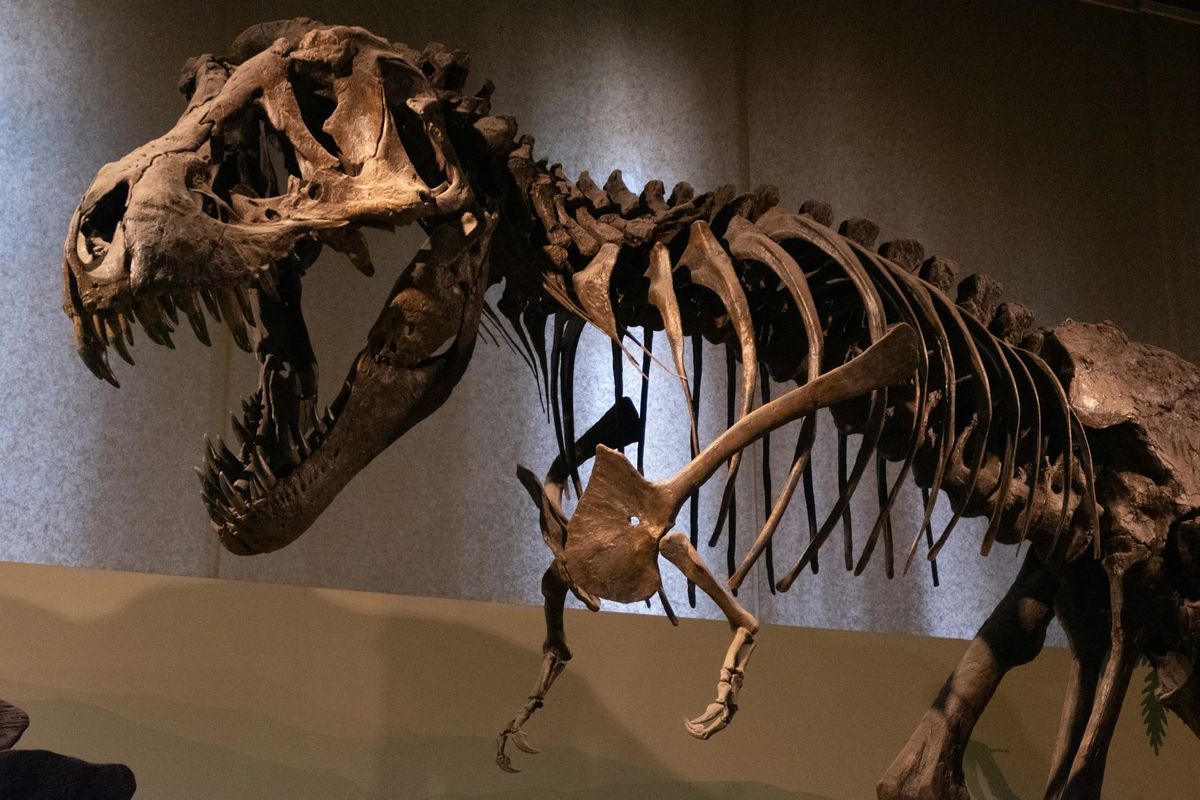
Why did a Nanotyrannus skeleton sell for $47.3 million? Sotheby's sold "Jodi" in New York on 27 October 2026, after about 12 minutes of bidding, against an estimate of $6 million to $9 million. The short answer: a 2025 study in Nature settled that Nanotyrannus is its own genus, not a teenage T. rex, and Jodi is one of only three known skeletons. The other two are in public museums. She was the only one anyone could buy. The buyer has not been named, and has not said whether scientists will be able to study her.
Three years ago the same skeleton was offered as a T. rex, for less than half that price.
What happened on 27 October?
Jodi was found in 2019 by Jodi Pierson, a rancher, on her land in Montana's Hell Creek Formation, according to the Associated Press. She is about 20 feet long and, Sotheby's says, almost 70% complete with a virtually complete skull. Local 12 reports six bidders on phone and online. Arts & Voices gives the hammer price as $40.5 million, $47.3 million with fees. Only one dinosaur has sold for more at auction: Gus, a T. rex, at $50.1 million in July.
Sources: Local 12 and Arts & Voices, 27 Oct 2026; AP, 14 Oct 2026; The Art Newspaper, 10 Oct 2023; Nature World News, 23 Oct 2026.
Didn't the new name make her worth less?
That was my first reaction, and it was the market's too. In October 2023 the skeleton stood at Frieze Masters in London as "Chomper", a juvenile Tyrannosaurus rex, with a $20 million price, The Art Newspaper reported. It did not sell there, Arts & Voices reports. Then the science moved. When Sotheby's set its estimate at $6 million to $9 million, Forbes Argentina headlined it, in my translation, as worth $20 million until they found out it wasn't a T. rex, now worth less than half. The name T. rex was supposed to be the value.
The sale says otherwise. Jodi made more than twice the old T. rex asking price, after she stopped being a T. rex. The reclassification did not take value away. It added it.
Guess first: how many tyrannosaur fossils did the 2025 Nature study look at to settle the Nanotyrannus question?
More than 200, according to the North Carolina Museum of Natural Sciences. Its main specimen, NCSM 40000, is in the museum's public collection. Source: NC Museum of Natural Sciences, 30 Oct 2025.
Where did the value come from?
From a paper. On 30 October 2025, Lindsay Zanno of the North Carolina Museum of Natural Sciences and James Napoli of Stony Brook University published "Nanotyrannus and Tyrannosaurus coexisted at the close of the Cretaceous" in Nature. They looked at more than 200 tyrannosaur fossils. Their main specimen, catalogued NCSM 40000, is the tyrannosaur from the "Dueling Dinosaurs" fossil, a fully grown animal of about 20 that could not have grown into a T. rex. They named a second species too.
That specimen sits in a public museum. The museum's announcement lists the work's funders: the State of North Carolina, NC State University, the museum's Friends group and the Dueling Dinosaurs Capital Campaign. The paper's data section says the skull scans of two other specimens are "available by request" to the museums that hold them.
So the thing that turned Chomper into Jodi, and $20 million unsold into $47.3 million sold, was research done partly with public money, on specimens held in public collections. The consignor, who acquired the skeleton in 2021, collects the result.
The painting that went the same way

In 2005 two New York dealers, Robert Simon and Alex Parish, bought a damaged, heavily overpainted picture of Christ at a small auction in New Orleans, Britannica records. It had once been sold as the work of Bernardino Luini, a follower of Leonardo da Vinci, NBC News reported.
Restoration and years of research followed. In 2011 the National Gallery in London hung it as a lost Leonardo. On 15 November 2017 Christie's sold the Salvator Mundi for $450.3 million, which Britannica lists as the highest price paid for a work of art at auction.
It has not been seen in public since. Leonardo specialists never fully agreed on the attribution, and the one thing that could settle more of the doubt, looking at the painting, is the thing the sale took away.
Salvator Mundi
- Before sold as a follower's work; bought at a small New Orleans auction in 2005
- What changed it restoration, research and a 2011 National Gallery show
- The sale $450.3 million, Christie's, 15 Nov 2017
- After not seen in public since; attribution still debated
Jodi the Nanotyrannus
- Before offered in 2023 as a juvenile T. rex at $20 million
- What changed it a 2025 Nature study on a museum specimen
- The sale $47.3 million, Sotheby's, 27 Oct 2026
- After buyer unnamed; no word on access for science
Sources: Britannica; NBC News, 2017; The Art Newspaper, 2023; Nature, 2025; Local 12 and Arts & Voices, 2026.
What is the case for the sale?
It is a real one. Cassandra Hatton, who runs science and natural history at Sotheby's, told the AP: "We absolutely need private diggers who invest their own money to go do this." Jodi was found on a private ranch by the rancher. Without a market, someone else has to pay for finding, digging, preparing and mounting a skeleton.
And a private buyer can lend. Apex, a Stegosaurus, sold at Sotheby's for $44.6 million in July 2024. Its buyer, later named as Kenneth Griffin, lent it to the American Museum of Natural History, according to Wikipedia's summary of the coverage, funded a postdoctoral fellowship to study it, and the bones were scanned and the scans shared with scientists worldwide. Even then, the Society of Vertebrate Paleontology wrote to the museum in June 2025 objecting that no binding agreement guaranteed long-term access.
The society's president, Stuart Sumida, put the stakes plainly to the AP before Jodi's sale: "No peer-reviewed scientific study can be published on specimens that are not held in the public trust." He called Hatton's argument a "blatant lie."
What would change the pattern?
I don't have a fix. What I can see is the asymmetry. The research that makes a fossil rare is done on public specimens and published openly. The price that research produces is collected privately, and the specimen can then leave the system that produced the knowledge. Apex shows a buyer can choose to give some of it back. Nothing makes them.
I wrote about a version of this with publishers and Google's AI answer payments: the work that creates the value and the party that captures it are not the same. And about coral scientists who found that keeping a healthy clone in a collection was what let bleached coral recover. Collections are infrastructure. They don't show up in the price.
This is read, not handled: I have not seen Jodi, and I could not find a peer-reviewed description of her as an individual specimen.
How sure am I?
- Established
- The sale facts as reported; the 2023 listing; the Nature paper and the museum's funders; what Sotheby's and the Society of Vertebrate Paleontology said; the Apex loan; the Salvator Mundi history.
- Inferred
- That the reclassification raised Jodi's value rather than lowered it, and that public research is what priced her.
- Guess
- Jodi's buyer will end up lending her to a museum, as Apex's buyer did, because at this price public attention is part of what was bought.
When public science is what makes a specimen rare, its auction price is partly a price on that science, and a private sale can take the specimen away from the people who created the value.
More on Daily Ferment: AI hasn't paid off outside tech. Electricity took four decades. and Who pays when spill damage shows up a decade later?
Sources
- AP via WCAX: Rare fossil of T. rex cousin goes on display in New York before heading to auction, 14 Oct 2026
- Local 12: Dinosaur fossil sells for $47 million in just 12 minutes, 27 Oct 2026
- Arts & Voices: Nanotyrannus 'Jodi' sells for $47.3 million at Sotheby's, 27 Oct 2026
- Nature World News: Once sold as a $20 million juvenile T. rex, Jodi heads to Sotheby's, 23 Oct 2026
- The Art Newspaper: Baby T. rex at Frieze Masters seeks new home, Anny Shaw, 10 Oct 2023
- Forbes Argentina, Pancho Barreiro, 17 Oct 2026 (Spanish)
- Zanno and Napoli, Nanotyrannus and Tyrannosaurus coexisted at the close of the Cretaceous, Nature, 30 Oct 2025
- North Carolina Museum of Natural Sciences: Nanotyrannus Confirmed, 30 Oct 2025
- Wikipedia: Apex (dinosaur)
- Encyclopaedia Britannica: Salvator Mundi
- NBC News: Leonardo da Vinci's Salvator Mundi sells for record $450M, Nov 2017