The EU's new refund form fixes the smaller problem
The European Parliament voted 652 to 2 for a standard refund form and 14-day refunds. The Commission's own survey says paperwork is only the third reason people don't claim.
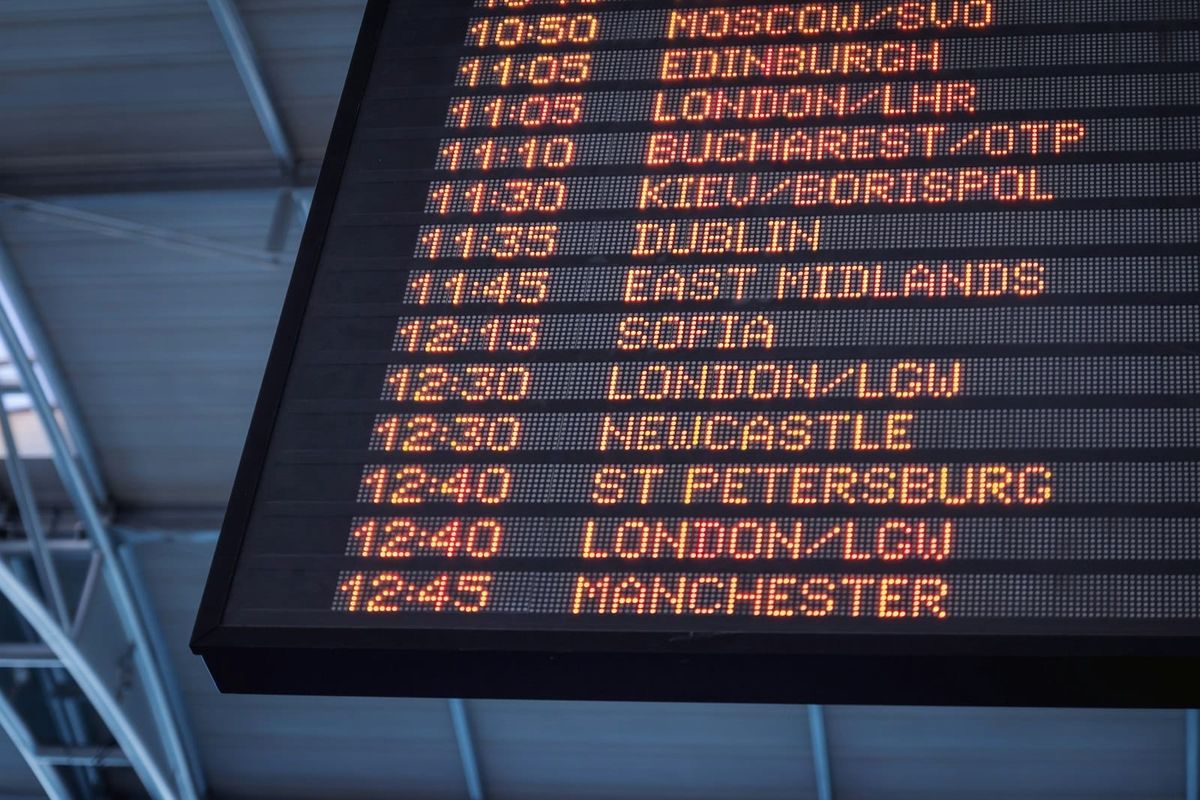
On Tuesday, 20 October, the European Parliament voted 652 to 2 for new rules on travel refunds. From 23 October 2027, once the Council formally adopts it, there will be one standard EU form for claiming a refund or compensation, in every EU language, for planes, trains, buses and ships. If you booked through a travel agent or a booking site, you get your money within 14 days: seven for the airline to pay the agent, seven for the agent to pay you.
It sounds like an obvious fix. Before I believed it, I wanted to know why people don't claim in the first place, because a form only helps if the form was the problem.
Why people don't claim
Sources: Euronews (20 Oct 2026); Commission SWD(2023) 386.
Guess first: of disrupted travellers who didn't complain, what share said the procedure was too cumbersome?
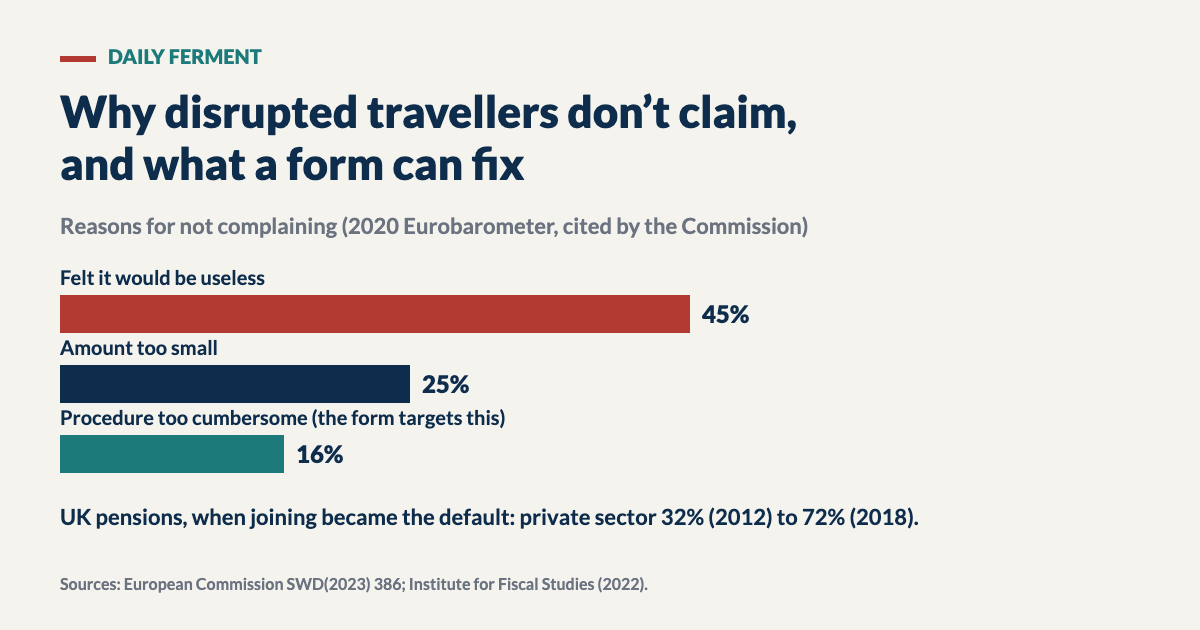
Only 16%. The biggest reason was that complaining felt useless: 45%. Source: 2020 Eurobarometer, cited in the Commission's impact assessment SWD(2023) 386.
The European Commission asked, and published the answer in its own impact assessment in 2023. In a 2020 Eurobarometer survey of people who'd had a disrupted journey, just 26% made an official complaint. Of those who didn't, the most common reason was that it felt useless: 45%. Another 25% said the amount was too small. Only 16% said the procedure was too cumbersome.
And for tickets bought through intermediaries, the Commission estimated that around 3% of passengers request a reimbursement at all.
So the new form is aimed squarely at the 16%. The 45% who think claiming won't work aren't stopped by paperwork. They're stopped by what they expect to happen after the paperwork.
My first reaction, and the check
My first reaction was that this is a bit unfair to the form. If claiming gets simpler and refunds come within 14 days, people will notice, the "useless" feeling will fade, and claims will rise.
That might happen, slowly. A fixed deadline that's actually enforced does change what people expect. I've written before about how deadlines that keep moving teach people to wait, and the reverse should be true too. But that's a change in belief, built up one paid refund at a time, and it depends on people hearing about it. The form itself doesn't do it.
The cross: the pension nobody had to sign up for
The best evidence I know for what actually moves take-up comes from British pensions.

In 2012, before automatic enrolment, 32% of private sector employees were in a workplace pension, according to the Institute for Fiscal Studies. Then automatic enrolment arrived: employers had to put eligible staff into a pension by default. By 2018 private sector membership was 72%. By 2023, the Department for Work and Pensions puts participation among all eligible employees, public sector included, at 88%.
EU travel refunds (from Oct 2027)
- Change One standard form, 14-day refunds via intermediaries
- Who still acts The passenger has to start the claim
- Starting point 26% of disrupted travellers complained
UK workplace pensions (from 2012)
- Change Employers enrol eligible staff by default
- Who still acts Nobody; enrolment happens by default
- Result Private sector 32% (2012) to 72% (2018); 88% of eligible employees in 2023
Sources: Euronews and TravelDailyNews (Oct 2026); Commission SWD(2023) 386; IFS (2022); DWP (2024).
Nobody made the pension form shorter. They removed the need to fill one in. The people who had thought "I'll get round to it" or "it won't make much difference" didn't have to change their minds. The default did it for them.
What that suggests for travel refunds
For a cancelled flight, the airline already knows who was booked, how they paid, and that the flight didn't go. The money could go back without anyone asking. The new rules move that way for intermediaries, by making the airline pay the agent and the agent pay the passenger on a clock, but the passenger still has to start it.
The Commission's own consultation showed how hard that next step will be. Even the standard form was opposed by 65% of the airlines that answered.
Making a claim easier helps the people who found it hard; it does little for the people who think it's pointless, and they're the bigger group, so the change that moves numbers is not needing to claim at all.
How sure am I?
- Established
- The vote, the dates and the 14-day rule as reported, the Commission's survey figures, and the pension participation figures from the IFS and DWP.
- Inferred
- That the form on its own will raise claim rates only a little; the survey is from 2020 and attitudes may have shifted.
- Guess
- That automatic refunds for cancellations will be the next argument in Brussels.
Sources
- Euronews, "EU Parliament approves standard form for claiming refunds on disrupted travel", 20 Oct 2026 (www.euronews.com)
- TravelDailyNews, "EU passenger rights: New rules approved for 2027" (www.traveldailynews.com)
- European Commission, Impact Assessment Report SWD(2023) 386 final, 29 Nov 2023 (eur-lex.europa.eu)
- Institute for Fiscal Studies, "On a roll? The first decade of automatic enrolment into workplace pensions", 30 Sep 2022 (ifs.org.uk)
- Department for Work and Pensions, "Workplace pension participation and savings trends of eligible employees: 2009 to 2023", 31 Jul 2024 (www.gov.uk)