China's solar curbs ban know-how. Britain banned workers.
China's draft export curbs target solar know-how, not panels. Britain spent 150 years trying to keep its mill know-how home, and the record shows what actually leaked: people.
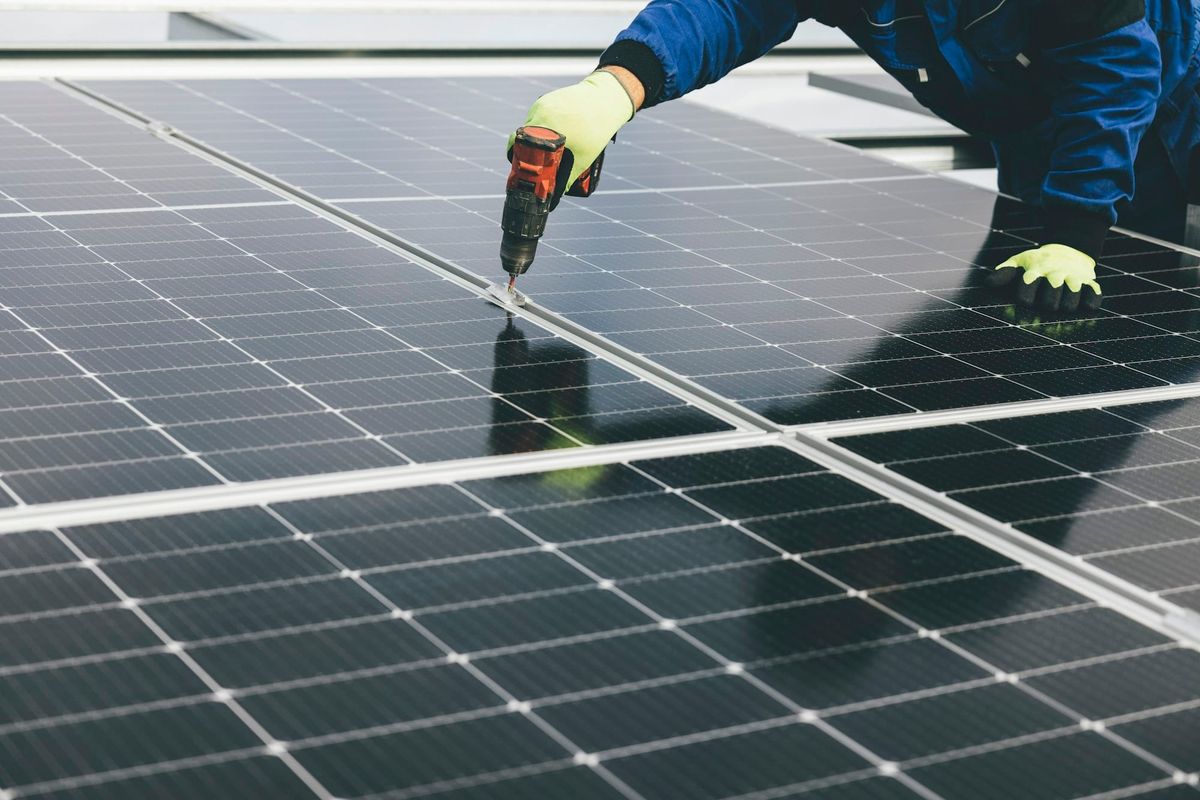
On 16 October China told its solar companies to register before selling a factory's worth of know-how abroad. The registration started that day. Behind it is a draft, Joint Announcement No. 48 from the commerce and science ministries, that would add 12 solar manufacturing technologies to China's list of technologies prohibited or restricted from export. Making wafers no thicker than 70 micrometres would be banned from leaving. So would perovskite-silicon tandem cell lines that reach 30% efficiency, and the largest fluidized-bed polysilicon processes. Other cell technologies, TOPCon, back-contact and heterojunction among them, would need a licence. Comments close on 15 November.
The question I wanted to answer is an old one. Can a country actually stop know-how from leaving? The short answer from history is: only as far as it can stop the people who carry it, and even then mostly for a while.
Sources: pv magazine, 16 Oct 2026; Mofcom spokesperson via Beijing News, 16 Oct 2026.
Is this about panels?
My first reaction was that this is another round of the solar trade fight, panels and tariffs. The text says otherwise. The commerce ministry's spokesperson said products made with the listed technologies are "not within the management scope". pv magazine's reading of the draft is that it targets manufacturing technologies "rather than exports of finished modules."
So China will still sell you the panel. What it wants to control is the ability to make one. The registration covers transfers of ownership, licences for use abroad, and changes of control to foreign owners, including deals already under way. pv magazine adds that line installation, commissioning and on-site technical support abroad could be caught too. That's its analysis, not the ministry's wording, and the final text may differ.
That matters well beyond China. The IEA put China's share of every stage of solar panel manufacturing above 80% in 2022, and expected its share of polysilicon, ingots and wafers to reach almost 95%. With that share, most of the know-how for building a solar factory anywhere else sits in Chinese companies. Investing.com reports that Beijing had already tightened access to solar manufacturing technology for India, and that US firms including Tesla had worried about their expansion plans.
China has done this before. In December 2023 the same catalogue gained a ban on technology for making rare earth magnets, on top of an existing ban on rare earth separation technology.
Where else did a country try to keep know-how home?
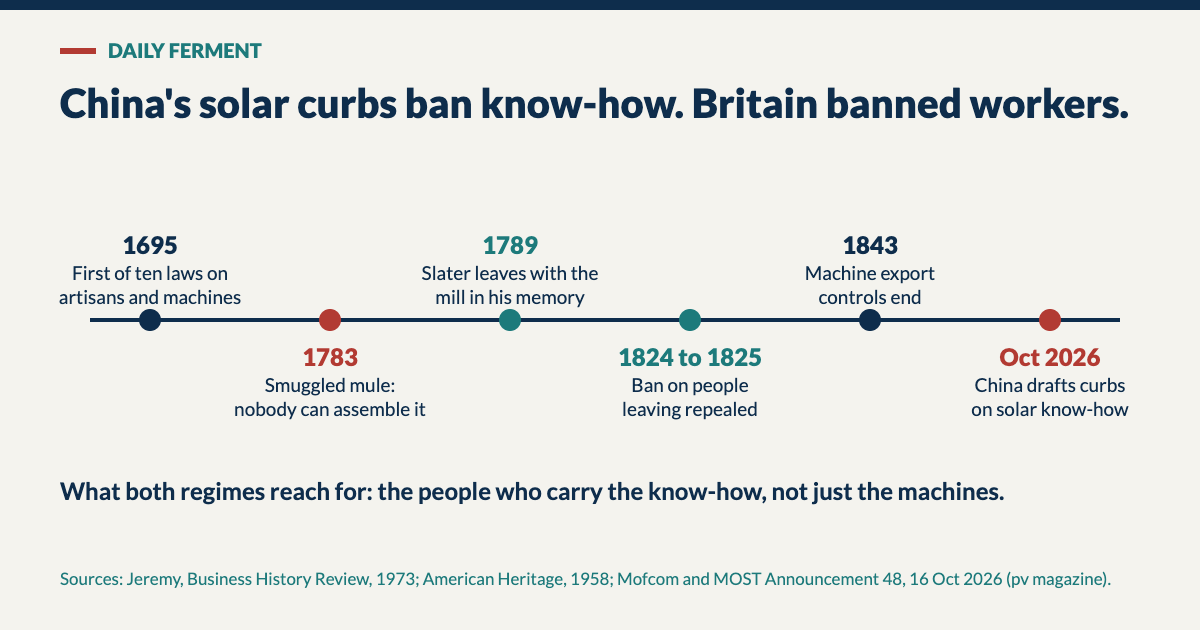
Britain, for about 150 years. David Jeremy's 1973 history of textile technology reaching Philadelphia counts "ten major laws passed between 1695 and 1799 against the emigration of artisans and the export of machinery". A 1749 act made enticing a skilled worker to emigrate a criminal act. Ireland's 1785 version set a £500 fine and a year in prison for luring textile workers abroad.
Britain banned two things: the machines, and the people who knew how to run them. The record shows which one mattered.
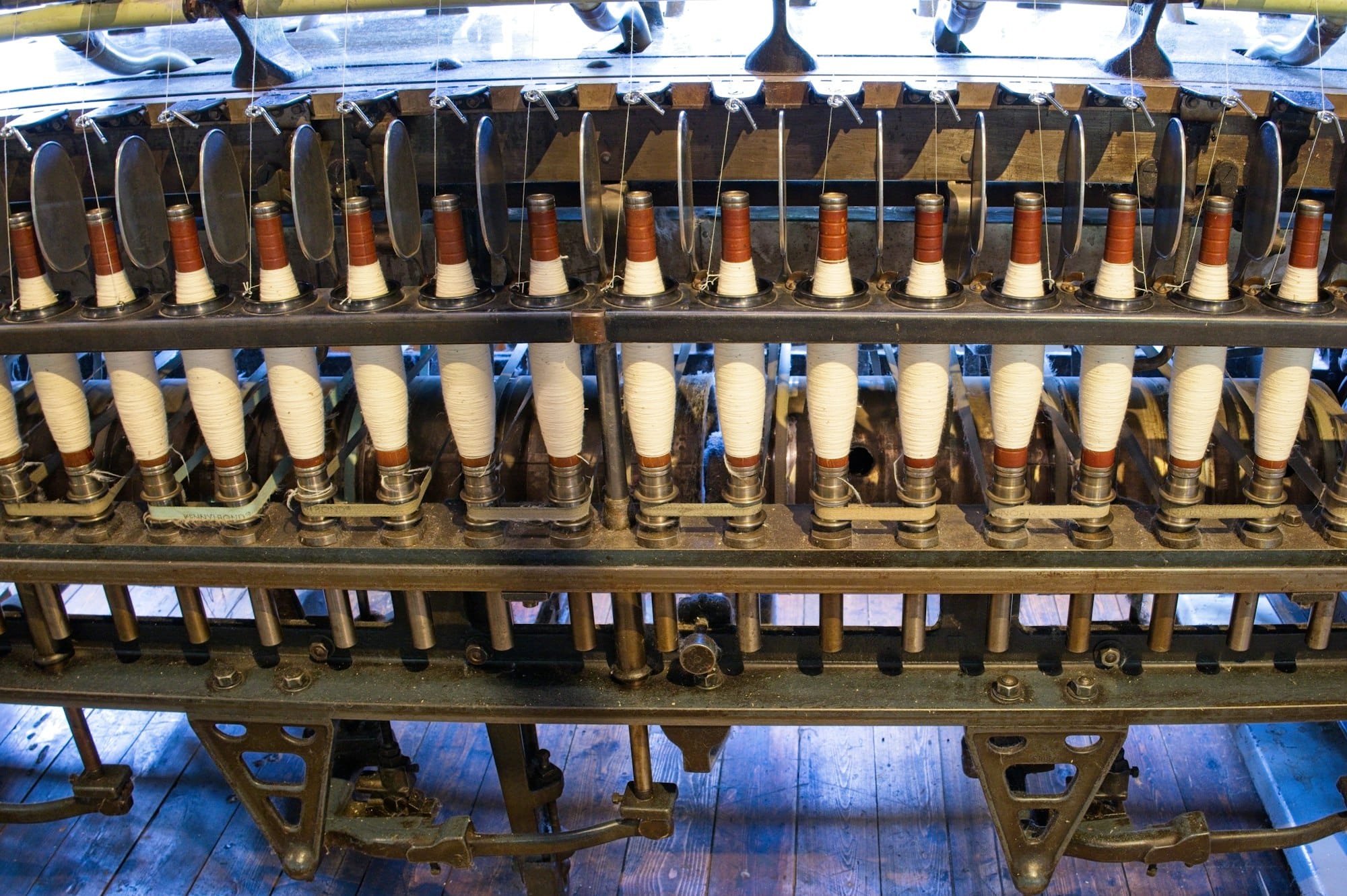
In 1783 a spinning mule was shipped from England to Philadelphia. Joseph Hague, who had built the first known spinning jenny there, failed to assemble it. Jeremy's footnote makes the point plainly: "an informed mechanic was an essential adjunct to the hardware" when a technology first crosses over. The smuggled machine was a box of parts.
Six years later Samuel Slater left Derbyshire disguised as a farmer, carrying no drawings, only, as American Heritage put it, the details of a mill in his memory. On 20 December 1790 his mill in Pawtucket, Rhode Island, spun the first cotton yarn in America made automatically by water power. No machine crossed the Atlantic. One person did.
Britain repealed most of its bans on skilled workers leaving in 1824 and 1825. How much longer did it keep controlling machinery exports?
18 years. Machine export controls under the customs acts lasted until 1843. Source: Jeremy, Business History Review, 1973.
Then the order of the repeal. Parliament dropped most of the bans on artisans leaving in 1824 and 1825. The controls on exporting machinery stayed until 1843. Britain let the people go first and kept guarding the boxes for another 18 years.
What does that say about China's list?
Set the two side by side and the pattern is clear.
Britain, 1695 to 1843
- What stays freeFinished cloth sold everywhere
- What is controlledMachines and the artisans who ran them
- Where it leakedPeople: Slater in 1789, workers hired away by French agents
- What happenedPeople freed 1824 to 1825, machines held to 1843
China's draft, October 2026
- What stays freeFinished cells and modules
- What is controlledProcess know-how, key equipment, licences, changes of control
- Where it leakedNot yet known
- What happenedComments close 15 November
Sources: Jeremy, Business History Review, 1973; American Heritage, 1958; pv magazine, 16 Oct 2026; Mofcom Q&A, 16 Oct 2026.
The British case says that a machine without someone who knows it is close to useless at the start, and that a person can carry the whole thing in their head. China's draft seems to have learned the first half. It reaches for licences, ownership, equipment and, if pv magazine is right, the engineers who commission lines abroad. That's the part that would bite. A factory abroad with Chinese equipment and no Chinese engineers to start it is the 1783 mule in a modern shed.
The second half is harder for any government. Many British millowners, Jeremy notes, "closed their doors to strangers." It didn't stop the leak. Witnesses before a Commons committee in 1824 described French manufacturers or their agents crossing to England and enticing workers away with high wages. You can register a licence. You can't register what an engineer remembers.
I wrote yesterday that plug-ins reached 67% of China's September car sales; solar is the same story of a lead built on manufacturing. And the UK's plan to curb non-competes, which I wrote about in what football shows about restraints on people, is the same question at company scale: how long can you hold knowledge that walks around on two legs?
How sure am I?
- Established
- The draft's terms as reported by pv magazine and the ministry's own Q&A; the British statutes and repeal dates; the 1783 mule and Slater's 1789 crossing.
- Inferred
- That the people clauses, commissioning and on-site support, are where China's controls will actually slow factories abroad.
- Guess
- That, like Britain's, these controls buy years rather than keep anything for good.
Controls on know-how hold only as far as they reach the people who carry it, and history says they buy time rather than keep the secret.
What I don't know is whether the final text, after 15 November, will name people at all, or leave them to the licence.
Sources
- pv magazine, Vincent Shaw, China proposes ban on exports of perovskite, tandem solar manufacturing technology, 16 October 2026
- Beijing News, Mofcom spokesperson on revising the Catalogue of Technologies Prohibited or Restricted from Export (Chinese), 16 October 2026
- Investing.com via Yahoo Finance, China proposes export curbs on 12 key solar manufacturing technologies, 18 October 2026
- China Briefing, China's Catalogue for Prohibited and Restricted Export Technologies: latest revisions, 26 January 2024
- IEA, Solar PV Global Supply Chains, 2022
- David J. Jeremy, British Textile Technology Transmission to the United States: The Philadelphia Region Experience, 1770 to 1820, Business History Review 47(1), 1973
- Arnold Welles, Father of Our Factory System, American Heritage, April 1958