When petrol cars become the minority, who pays?
Plug-in cars took 67% of China's new car sales in September. But nearly nine in ten cars on its roads still aren't plug-ins. Sweden's slow goodbye to cash shows what happens to the people still using the old thing.

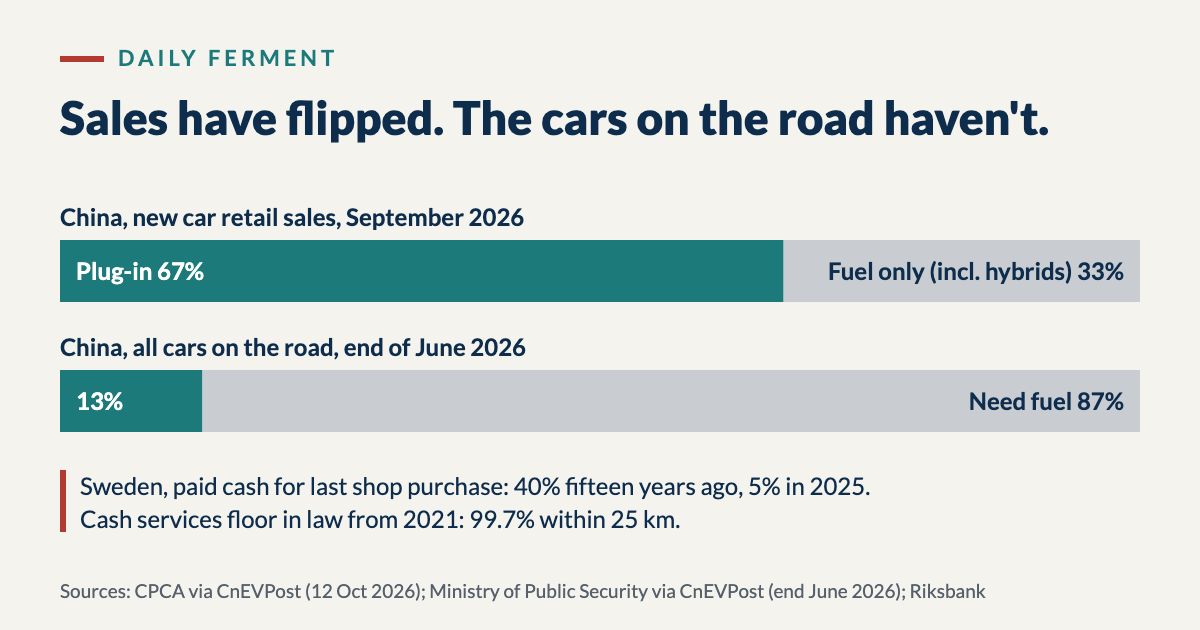
In September, 67.0% of new passenger cars sold at retail in China were plug-ins (battery, plug-in hybrid or range-extender), according to the China Passenger Car Association figures reported by CnEVPost on 12 October. It's a record. Work the numbers the other way and cars that run only on fuel, conventional hybrids included, came to about a third: 534,000 of 1.618 million. Sales of plain petrol cars were down 49% on a year earlier.
The headline everyone reaches for is that petrol is finished. The question I'd rather ask is a slower one: what happens to the people still driving the old thing once it's a minority of what's being sold?
Guess first: about two thirds of new cars sold in China in September were plug-ins. What share of the cars already on China's roads are?
About 13%. 48.97 million new energy vehicles in a fleet of 371 million cars at the end of June, by the Ministry of Public Security's count. Roughly 87% still need fuel.
Is petrol actually finished in China?
My first reaction was yes, more or less. A third of sales, falling fast.
Then I looked at the cars already on the road. China's Ministry of Public Security counted 48.97 million new energy vehicles at the end of June, 13.19% of a fleet of 371 million cars. So roughly 87% of the cars people drive in China still need fuel. New sales tell you where the fleet is going. They take years to tell you where it is.
Two more things kept me from the easy story. The total market shrank: retail sales were down 28.0% on a year earlier, so part of petrol's fall is fewer cars sold overall. And fuel demand is falling for reasons beyond electric cars. Sinopec's research arm expects gasoline demand to drop 8.7% this year, and the reports of that forecast put part of it down to high prices linked to the Iran war.
So the honest picture is a large group of petrol drivers whose numbers will fall for years, while the business of serving them shrinks faster. China Daily reported last month that Sinopec is "transforming thousands of traditional gas stations" into stations that add charging and battery swaps. That sounds sensible. It also means the network is now being planned around the buyers of the future, not the drivers of the present.
Who has been through this already?
Sweden, with cash.
Sources: Riksbank Payments Reports 2024 and 2026; IMF Financial Access Survey via FRED; Riksdag answer, 6 Aug 2020.
The Riksbank's surveys asked people how they paid for their last purchase in a shop. Fifteen years ago, 40% said cash. In 2023 it was 10%. In its 2026 report, covering 2025, it was 5%.
The machines went too, though more slowly than the habit. Sweden had 3,566 ATMs in 2011 and 2,049 in 2023, by the IMF's count. By 2024 the Riksbank was reporting that all the major banks had stopped handling cash over the counter in their branches. Last year, between May and September, up to 30% of the ATMs and deposit machines run by Bankomat, the banks' shared network, were out of service at certain times.
And the people left using cash weren't a random slice of the country. "Older people find it significantly more difficult to manage without cash than younger people," the Riksbank wrote in 2024, and every county administrative board considered the situation "unsatisfactory for older people and people with disabilities." The 2026 report says people outside big cities and people over 65 are the ones most likely to feel negative about it.
Sweden's answer was a floor written into law. From 1 January 2021, banks holding more than SEK 70 billion in public deposits have had to provide cash services across the country, and no more than 0.3% of the population may live more than 25 km by road from a place to withdraw cash. The market had been setting the network by how much cash moved. Parliament set it by who still needed it.
What carries over?
The network serving an old technology is paid for by volume. When volume falls, it thins, and it thins in the places where volume was already low: rural areas, older neighbourhoods, people who switch last because switching is hardest for them. Nobody has to be careless for this to happen. A network with big fixed costs and falling volume behaves this way on its own.
I wrote on 10 October about AI agents and lazy bank deposits, where the people who stay on the old product end up paying for staying. This is the physical version of that. In Sweden it showed up as a longer drive to an ATM that might be out of order. For a petrol driver in a small town it would be a longer drive to a pump.
Sweden, cash
- Share of new use5% of last shop purchases (2025)
- The networkATMs down about 43% from 2011 to 2023
- Who is leftOlder and rural people, per the Riksbank
- The floorIn law since 2021
China, petrol cars
- Share of new useAbout 33% of new car sales, hybrids included (Sept 2026)
- The networkSinopec converting thousands of stations
- Who is leftNot yet measured
- The floorNone found
Sources: as above; CPCA via CnEVPost; China Daily HK, 29 Sep 2026.
How sure am I?
- Established
- The September sales figures and the fleet count as reported from Chinese official data, and Sweden's cash figures, ATM count and law.
- Inferred
- That petrol supply in China will follow sales volume down the way cash services followed cash volume in Sweden. I haven't found national figures on petrol stations closing, only on conversions.
- Guess
- That the first pressure for a floor will come from rural drivers.
When an old technology drops to a minority of new purchases, the question moves from who is switching to who can't, and because the network that serves them is paid for by volume rather than need, the floor under them has to be set on purpose, as Sweden found with cash.
What I don't know is when that point arrives for petrol. A third of sales isn't it. Thirteen percent of the fleet certainly isn't. Sweden only legislated when cash had already fallen to a small share of purchases.
Sources
- CnEVPost, China September NEV retail sales, CPCA data, 12 October 2026.
- CnEVPost, China's NEV fleet reaches 48.97 million, 14 July 2026.
- Oilprice.com via Yahoo Finance, Sinopec sees China oil demand falling, 9 September 2026.
- China Daily HK, Penetration rate for EVs could hit 80%, 29 September 2026.
- Sveriges Riksbank, Payments Report 2026, March 2026, and Payments Report 2024, March 2024.
- IMF Financial Access Survey via FRED, ATMs in Sweden.
- Sveriges riksdag, written answer on access to cash, 6 August 2020, and government bill prop. 2019/20:23.