Can organ chips replace animal tests? Ask a pilot
The FDA now accepts non-animal tests in principle, and some organ chips beat animals at spotting toxic drugs. Rabbits are still used anyway. Flight simulators show what was missing: a pass mark.
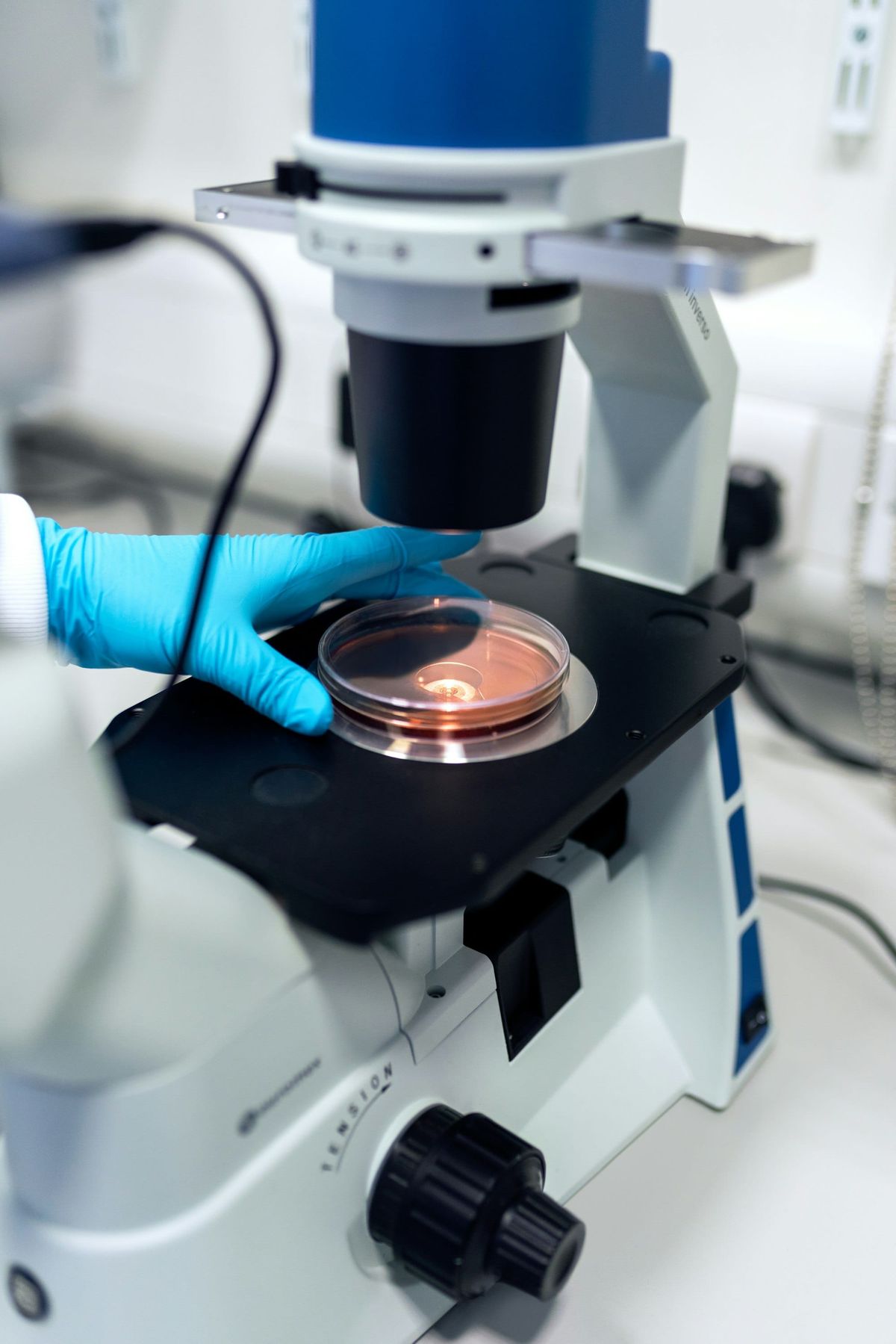
In 2009, by IEEE Spectrum's account, the journal Science turned down Donald Ingber's lung-on-a-chip paper and suggested his team also run the tests in mice. The chip was a clear polymer slab, smaller than a USB stick, lined with human lung cells, and it breathed. The team ran the mouse experiments, and the paper came out in 2010.
Seventeen years later the US Food and Drug Administration has gone the other way. On 21 September it issued a rule that swaps the words "animal tests" and "animal studies" in its drug regulations for "nonclinical tests" and "nonclinical studies". It doesn't ban animal studies or change the standard of evidence. It removes language that suggested animals were the only acceptable way.
So can organs on chips replace animal testing? Some already do the job better on specific tests. What they lack is less about the science than about the paperwork: a pass mark that every chip can be checked against.
Isn't the technology just not good enough yet?
That was my first reaction. The record says otherwise, at least for some tests. In one study a liver chip from Emulate flagged about seven out of every eight drugs that had passed animal testing and then proved toxic to human livers. Computer simulations of human heart cells from Oxford and Janssen flagged drugs that cause a dangerous arrhythmia with 89% accuracy, against 75% for animal studies.
Source: IEEE Spectrum, 29 Sep 2026, reporting the Emulate and Oxford/Janssen studies.
The harder fact is what that liver study cost. It took 870 chips and the work of 16 full-time people for 16 weeks. And it only counts for the use it tested. To make the same case for large-molecule drugs, Emulate would need another study like it. Spectrum's reporting puts it plainly: comparable studies "ostensibly need to be conducted for every commercially available NAM and every context in which they would be used."
A blood-cell test to replace the rabbit pyrogen test was validated in the mid-1990s. How long until Europe's official pharmacopoeia accepted it?
About 15 years. It was accepted in 2010, and rabbits are still widely used for the test worldwide. Source: IEEE Spectrum, 29 Sep 2026.
NAM is the field's name for these methods, new approach methodologies. There's an older warning in the same article. A blood-cell test to replace the rabbit pyrogen test, where a compound is injected into a rabbit and its temperature watched, was developed and validated in the mid-1990s. Europe's official pharmacopoeia accepted it in 2010. Rabbits, the article says, "are still widely used for this test worldwide."
So the problem isn't that the replacement doesn't work. It's that nobody has said, in numbers, what working means.
Where did a machine replace the real thing by rule?
The cockpit. On 24 June 1980 the US Federal Aviation Administration issued the rule changes behind its Advanced Simulation Plan, which let airlines train and check pilots in simulators "in lieu of the airplane". It didn't happen at once. A 1973 change had already let an approved simulator be "substituted for the airplane" for landing practice.
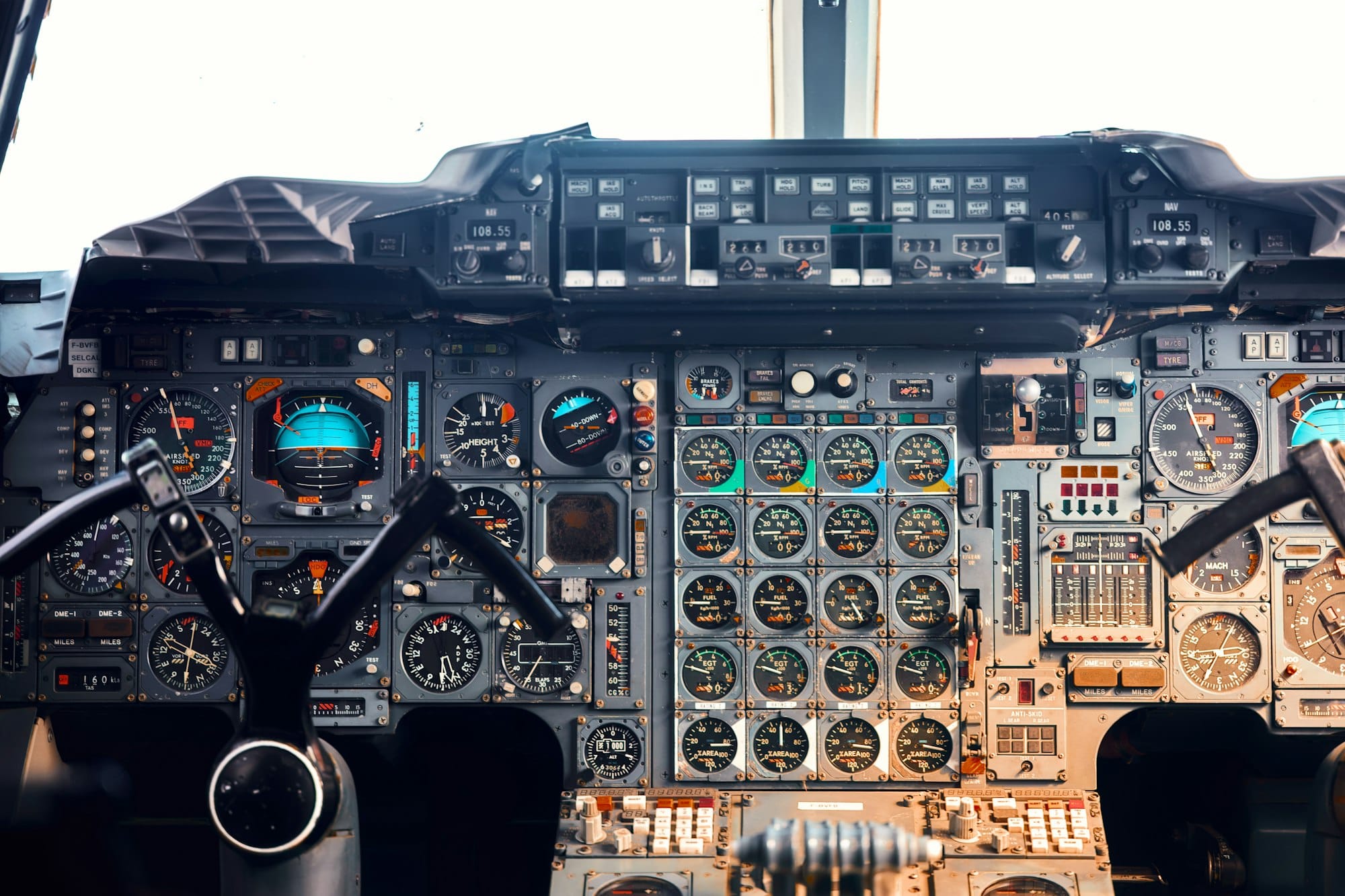
What made it work was the test guide. The FAA's 1986 circular on simulator qualification is very specific. Every simulator is compared to flight test data, "performance tests electronically recorded in the aircraft", in all tests. The operator submits an Approval Test Guide, "a group of tests required for FAA evaluation of the simulator". The tolerances are written down: pitch and angle of attack within 1.5 degrees of the real airplane, airspeed within 3 knots. They exist, the circular says, "to ensure satisfactory transfer of learning". And each simulator is checked again about every four months.
Nobody had to prove from scratch that simulators in general were as good as airplanes. An operator had to prove that this one machine matched this one airplane, against a list of numbers anyone could read. That's a much smaller job, and it can be repeated.
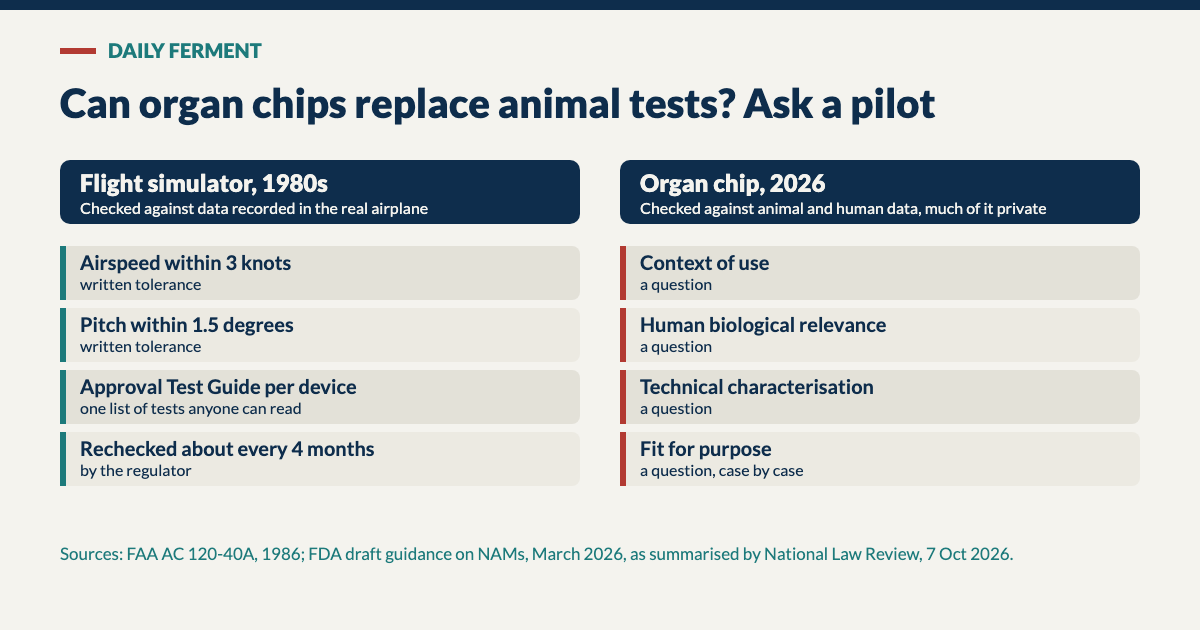
What would that look like for organ chips?
Side by side, the gap is easy to see.
Flight simulators, 1980s
- What it replacesTraining and checking in the airplane
- Reference it's measured againstFlight test data recorded in the real aircraft
- Pass markWritten tolerances, such as airspeed within 3 knots
- Who repeats the checkThe regulator, about every four months
Organ chips, 2026
- What it replacesSome animal safety tests
- Reference it's measured againstAnimal data and human outcomes, much of it proprietary
- Pass markFour considerations, including "fit-for-purpose"
- Who repeats the checkCase by case, per context of use
Sources: FAA AC 120-40A, 1986; IEEE Spectrum, 29 Sep 2026; National Law Review on FDA draft guidance, 7 Oct 2026.
The FDA's March 2026 draft guidance, as Foley & Lardner summarise it, asks four questions of a NAM: its context of use, its human biological relevance, its technical characterisation, and whether it is fit for purpose. Those are the right questions. They aren't a tolerance table. There are separate FDA routes for qualifying a tool once for many drug programmes, the Drug Development Tool Qualification Program and ISTAND, and that is the nearest thing to a simulator's test guide. I haven't checked how many organ chips have been through them.
There's also a problem with the reference. A simulator is measured against the plane it imitates, using data recorded in the aircraft itself. A chip has to be measured against human outcomes, and Spectrum reports that much of the animal and clinical data needed for those comparisons is proprietary. Ingber and others want it shared, and the FDA has called for an open repository of drug toxicity data.
I wrote yesterday about who early drug trials left out, which is the same question from the other side: what a test is measured against decides what it can see. And the coral study from the same day was a lab result still waiting for a plan. This is what that wait looks like at industry scale.
How sure am I?
- Established
- The FDA rule and what it does and doesn't change; the chip results and the cost of the liver study as IEEE Spectrum reports them; the 1980 simulator rules and the 1986 qualification circular.
- Inferred
- That a shared, numeric pass mark is what NAMs most lack, more than better chips.
- Guess
- That the first NAMs to spread will be ones qualified once for many programmes, the way a simulator type is, not ones that win case by case.
A replacement for a trusted test spreads when the regulator writes down a pass mark any device can be checked against, as aviation did for simulators, and stalls while every lab has to prove its own case from scratch.
What I don't know is whether a tolerance table even makes sense for biology, where the "real airplane" is a human body that varies from person to person. Kathrin Herrmann's line in the Spectrum piece may be the real limit: "The formal requirement may disappear, but the informal expectation persists."
Sources
- Brandon Keim, Tech to Replace Animal Testing Is Almost Ready. Scientists Are Not, IEEE Spectrum, 29 September 2026
- FDA, FDA Updates Regulations to Advance Innovative Alternatives to Animal Testing, 21 September 2026
- Oyvind Dahle, Beyond Animal Testing: FDA's 2026 Framework for Fit-for-Purpose NAMs, National Law Review, 7 October 2026
- FAA, Advisory Circular 120-40A, Airplane Simulator Qualification, 31 July 1986