Optimizely's code ran on 178 big websites and changed itself on purpose. A pill bottle explains why the locks didn't help.
On 16 Nov 2026 attackers used Optimizely Web to serve skimming code to 178 sites. Why domain allowlists didn't stop it, and what a 1982 pill bottle rule gets right.
On Monday, 16 November 2026, someone used Optimizely Web, a popular A/B testing service, to put malicious JavaScript on the websites of 178 organisations. Scott Helme of Report URI, who found and documented it, names Zoom, the BBC, CNN, Salesforce, GitLab, IKEA, HSBC, Equifax, Air France-KLM, Ledger and Peacock among them. Searches for an Optimizely data breach still mostly turn up an older, unrelated incident from February 2026. This one is new.
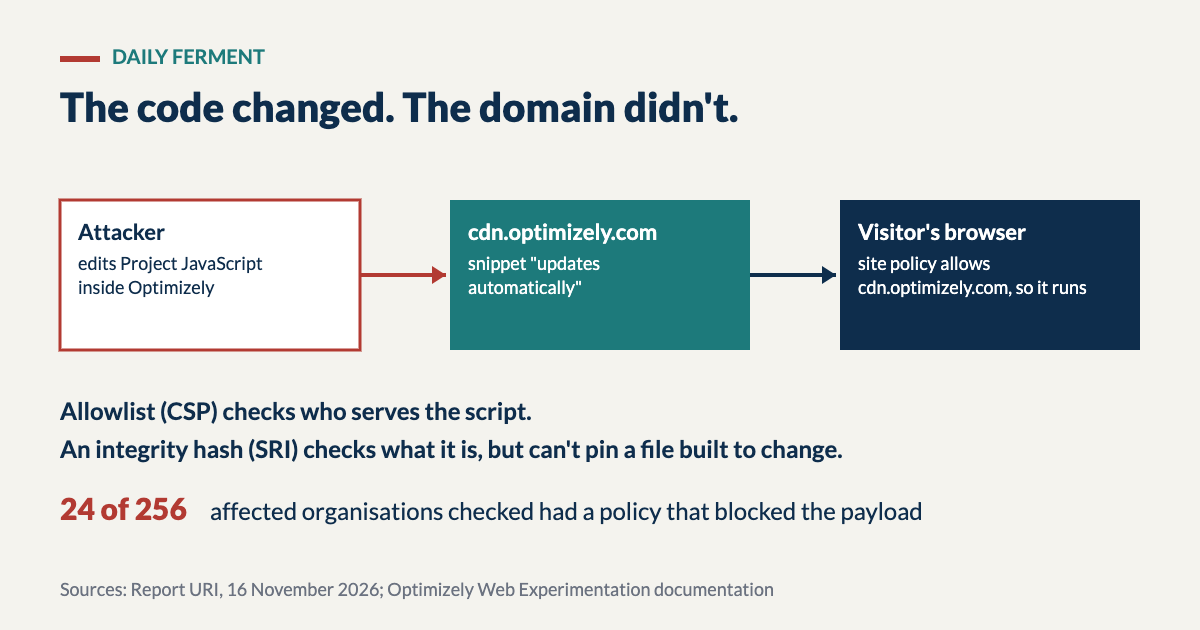
Why didn't those sites' security stop it? Because the code came from a place they had told their browsers to trust, through a script Optimizely's own documentation says "updates automatically." Most site defences check who is serving a script, not whether it changed.
What happened on 16 November?
Here's the sequence as Report URI published it, all times UTC:
- 04:21 First injection seen, in the BBC's Optimizely snippet.
- 08:10 First build of the crypto wallet swapper.
- 11:20 Zoom's snippet modified.
- 13:43 Card skimmer added.
- 17:13 to 17:57 iPhone exploit kit frame injected.
- 19:24 to 19:59 Report URI sweep: 186 of 1,611 Optimizely snippets infected.
- About 20:40 to 21:10 Mass clean-up.
- 21:52 One snippet still infected.
Source: Report URI, 16 November 2026. All times UTC, 16 November.
The attacker wrote code into a field called Project JavaScript inside customers' Optimizely projects. Everything else in each snippet was left alone. The code swapped cryptocurrency wallet addresses for the attacker's, read card numbers, expiry dates and security codes from forms, sent cookies and screenshots away, and on some iPhones loaded exploit kits. By 19:25 UTC the attacker's wallets had received about $7,040, which is small next to the reach.
Optimizely said in a status update, quoted by BNO News, that "an unauthorized party exploited a vulnerability in Experimentation" and "We've fixed the vulnerability and removed the injected code from affected projects." A spokesperson told Gizmodo the flaw was in the Experimentation account signup flow. When I checked Optimizely's status page on the morning of 17 November, I couldn't find the incident listed, so those quotes come from the two reports. How a signup flaw gave someone write access to other companies' projects hasn't been explained yet.
One caveat on the source: Report URI sells tools that detect malicious scripts, as Gizmodo pointed out. Its timeline is detailed and dated, which is why I'm leaning on it, but it has a product in this fight.
Why didn't the security policies block it?
Source: Report URI, 16 November 2026. The hours figure is my subtraction from its timeline.
Report URI checked the security policies of 256 affected organisations. How many blocked the malicious code?
24, about 15%. 68 had no policy at all. Source: Report URI, 16 November 2026.
The usual defence is a Content Security Policy, a header that tells the browser which domains may serve scripts. Report URI crawled 256 of the affected organisations' hosts. 68 had no policy at all. Only 24, about 15%, had a policy that blocked the payload. Helme's line on it is blunt: "Allowing cdn.optimizely.com was never going to help." The malicious code came from cdn.optimizely.com, because that's where every customer's snippet lives.
My first reaction was that this is a failure of the sites: they should have pinned the script. The web has a tool for exactly that. Subresource Integrity lets a page include a hash of the script it expects. MDN describes it as a way for browsers "to verify that resources they fetch (for example, from a CDN) are delivered without unexpected manipulation." If the file doesn't match, the browser refuses to run it.
Then I read Optimizely's setup page. It tells you to put one line in your page head, pointing at its CDN, and says "Do not modify the snippet." Then: "After you add it, the snippet updates automatically." That's the product. As I read it, tests are changed in Optimizely's app and the code on the live site follows, without a developer touching it. A file built to change can't carry a fixed hash. So the sites didn't forget a lock. The product they bought only works with the lock left off.
What does a pill bottle have to do with it?
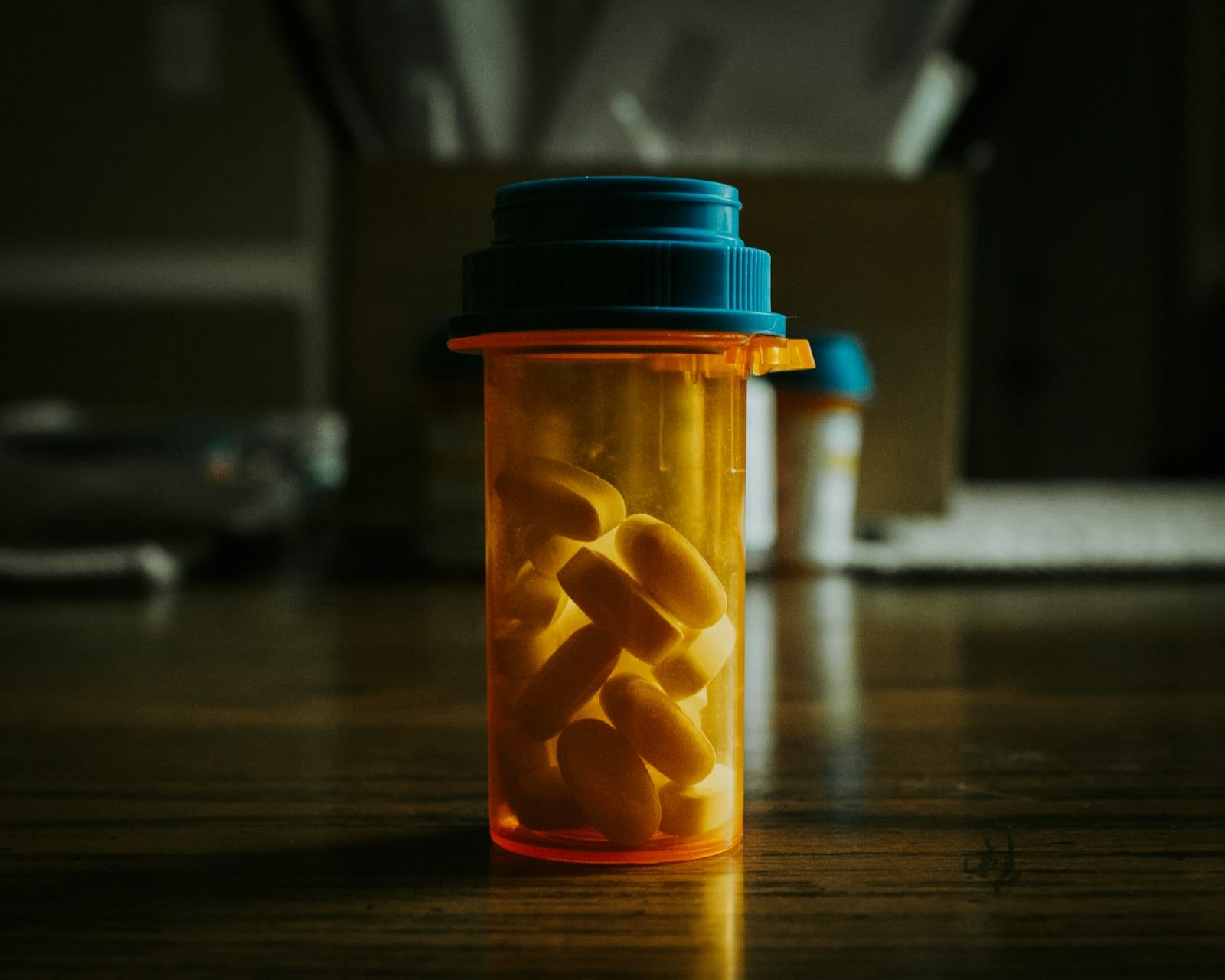
In the Chicago area, seven people died after taking Extra-Strength Tylenol capsules laced with cyanide. The Food and Drug Administration answered on 5 November 1982 with a rule requiring tamper-resistant packaging for over-the-counter drugs.
The interesting part came later. In 1998 the FDA renamed the rule. "Tamper-resistant" became "tamper-evident", and the Federal Register explains why: "no packaging or dosage form is tamper-proof". The seal under the cap isn't there to stop a determined person. It's there because "it is difficult to breach a feature without leaving visible signs of tampering." The protection is that you can see it happened.
Over-the-counter pill bottle, since 1982
- Who may supply it A licensed maker and pharmacy
- Shows it was opened A tamper-evident seal, required by FDA rule
- The regulator's own view "no packaging or dosage form is tamper-proof"
Optimizely snippet, 16 Nov 2026
- Who may supply it Content Security Policy allowing cdn.optimizely.com
- Shows it was changed Subresource Integrity could, but the snippet "updates automatically"
- What happened 24 of 256 checked sites blocked the payload
Sources: FDA final rule, Federal Register, 4 November 1998; Optimizely documentation; MDN; Report URI.
That's the reframe I find useful. A Content Security Policy is like trusting the pharmacy: it says who may supply the bottle. It says nothing about whether the bottle was opened. Subresource Integrity is the seal, and live-edited scripts are sold without one. So the question for anyone running Optimizely, or a tag manager, a chat widget, or any script that changes from someone else's dashboard, isn't "do we trust the vendor's domain?" It's "would we notice if the code changed?"
So what can a site do?
As far as I can see there are two honest options, and both cost something. One is to take a reviewed copy of the script, host it yourself, pin it with a hash, and give up live editing; every change goes through a developer again. The other is to keep live editing and watch the script for changes, which is a monitoring job (and, to be fair about it, the kind of thing Report URI sells). I'm inferring both from how the pieces fit, not from a guide that says so.
I wrote earlier about a case where the name on a piece of code was the whole trick: The backdoored Claude Code extension said Anthropic. This is the reverse. The name was real, and that's why it worked. It's also the same question as when a contractor's system is the way into a bank: whose breach is it? Visitors to HSBC's or Zoom's pages didn't choose Optimizely. The sites did.
How sure am I?
- Established
- Report URI's timeline and counts as published on 16 November 2026; Optimizely's statement as quoted by BNO News and Gizmodo; Optimizely's setup page ("updates automatically"); how Subresource Integrity works (MDN); the FDA's 1982 rule and its 1998 renaming to tamper-evident.
- Inferred
- That a self-updating snippet can't carry an integrity hash, and that a site's real choice is between pinning a reviewed copy and watching for changes. Report URI sells the second, which I've said.
- Still a guess
- How many other live-edit scripts (tag managers, chat widgets, other testing tools) sit on big sites with the same exposure. Nobody I read has counted.
If a vendor's code is built to change on your site without you, a rule about who may serve it won't protect you; you need a way to see that it changed.
More on Daily Ferment: The backdoored Claude Code extension said Anthropic. Anthropic never shipped it. and Hijacked registries minted real Google certificates. Property fraud already has the fix.
Sources
- Scott Helme, Report URI, World's Largest Brands Infected With Malware Via Optimizely, 16 November 2026.
- BNO News, Optimizely hack spreads malware to several websites, including HSBC, BBC and CNN, 16 November 2026.
- Mike Pearl, Gizmodo, Sprawling Malware Attack Reportedly Affects Zoom and Other Major Brands, 16 November 2026.
- Optimizely, Implement the one-line JavaScript snippet, Web Experimentation documentation.
- MDN Web Docs, Subresource Integrity.
- US Food and Drug Administration, Tamper-Evident Packaging Requirements for Over-the-Counter Human Drug Products, final rule, Federal Register, 4 November 1998.