A third of Amazon's Black Friday deals saved nothing. A dice experiment in sentencing shows why the struck-through price still works.
Groundwork checked 350+ Amazon Black Friday and Cyber Monday deals: nearly a third saved nothing. Why the struck-through price still works, and the EU rule that fixes it.

On Sunday, 16 November 2026, Groundwork Collaborative, an economic think tank in Washington, published a report called "Deal or Decoy? Amazon's Deceptive Discounts". Its researchers took more than 350 products from Amazon's own Black Friday and Cyber Monday deal pages in 2024 and 2025 and compared each sale price with what the same product had sold for in the month before.
So are Amazon's Black Friday deals fake? Not all of them. But in Groundwork's sample, nearly one in three were no saving at all: the "deal" price was the same as, or higher than, a price the product had in the previous month. Nearly one in ten cost more than they had a few weeks earlier.
I read the report, not a shopping cart. I didn't test any of this myself. What I wanted to know is why a struck-through price still works when most of us half expect it to be padded, and whether anyone has a rule that fixes it.
What did Groundwork actually find?
The numbers, as the report gives them:
Source: Groundwork Collaborative, Deal or Decoy?, 16 November 2026.
Men's UGG Butte boots were "on sale" for $179.98 on Cyber Monday 2025. What did they cost about four weeks earlier?
$98.40. The deal price was 83% higher. Source: Groundwork Collaborative, 16 November 2026.
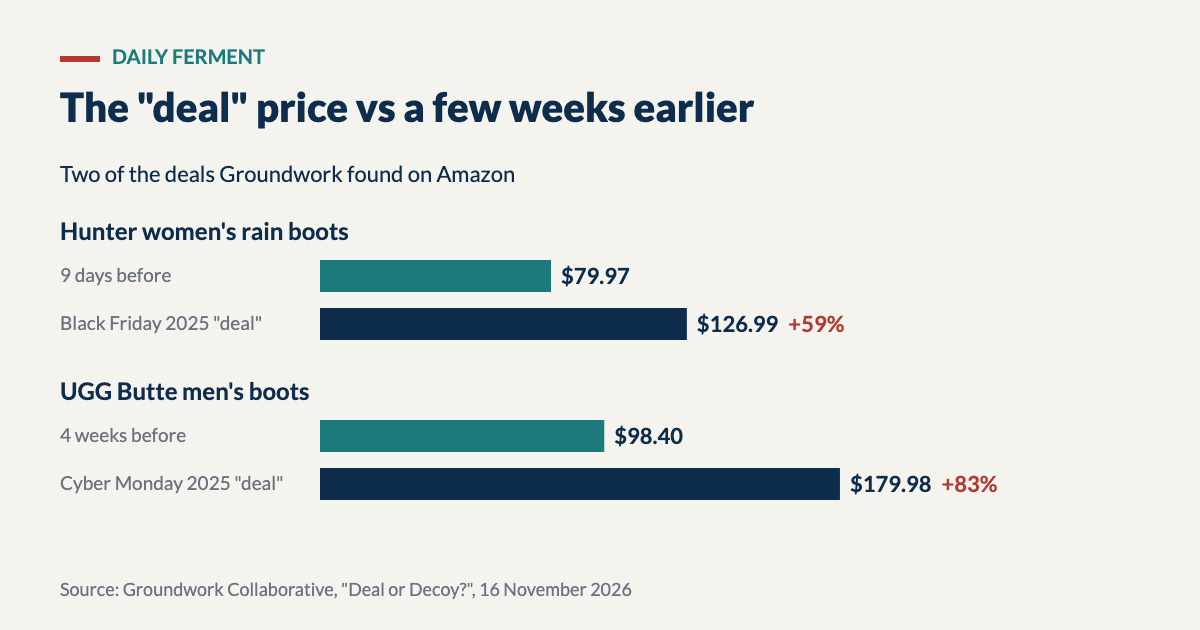
The examples are the part that sticks. A pair of Hunter women's short rain boots was "on sale" for $126.99 on Black Friday 2025. Nine days earlier it was $79.97. That's 59% more for the deal. A pair of men's UGG Butte boots was $179.98 on Cyber Monday 2025, against $98.40 about four weeks before, 83% more. Among the deals that were worse than the earlier price, the median one was 19% above what a shopper could have paid weeks before.
Amazon's Black Friday 2025 deals page told shoppers "we've handpicked some of the best ones you'll find." I looked for a reply from Amazon to the report and didn't find one by the morning of 17 November.
Two limits worth saying out loud. Groundwork is an advocacy group, and its report calls for regulation, so it went looking for this. And the page doesn't name the price history data it used. The method is simple enough to check, though: one product, two dates, two prices.
Why does a fake "was" price work on people who know better?
My first reaction was that this is old news. Everyone knows Black Friday prices get padded. If everyone knows, the padding shouldn't work, and Amazon wouldn't bother.
That reaction doesn't survive a 2006 study from Germany. Birte Englich, Thomas Mussweiler and Fritz Strack gave experienced legal professionals a criminal case and a sentencing demand, then asked for a sentence. In some versions the demand was made explicitly random, set by rolling dice. Their sentences still moved toward the number they'd been shown. Expertise and experience didn't reduce the effect. The authors' explanation is that a number, once in your head, makes the arguments that agree with it easier to find.
"Judicial sentencing decisions should be guided by facts, not by chance."
Birte Englich, Thomas Mussweiler and Fritz Strack, Personality and Social Psychology Bulletin, 2006, opening line of the abstractThat's the cross I was looking for. A lawyer knows a dice roll is irrelevant to a sentence, and it still pulls. A shopper half knows a struck-through price might be padded, and it still pulls. Knowing about the trick isn't the same as being immune to it. So advice that amounts to "be careful on Black Friday" is advice against a bias that careful experts in a courtroom couldn't shake.
If being careful doesn't fix it, the fix has to be about which number gets put in front of you.
Is there a rule that already fixes this?

There is, in the European Union. Groundwork's own recommendation is that retailers should have to show the lowest price a product sold for in the previous 30 days whenever they advertise a sale. That's close to EU law already.
A German consumer association took the discounter Aldi Süd to court over a weekly leaflet. Bananas were shown with a previous price of €1.69 and a "reduced" price of €1.29. But €1.29 was also the lowest price Aldi had charged in the previous 30 days. The Court of Justice of the European Union ruled on 26 September 2024 (case C-330/23) that a price reduction "must be determined on the basis of the lowest price applied by the trader during a period not shorter than 30 days prior to the application of the price reduction." The court said the point is that traders "are thus prevented from misleading the consumer."
The United States has a rule too, but it's softer. The Federal Trade Commission's Guides Against Deceptive Pricing (16 CFR 233.1) say a former price is fine if the product was "openly and actively offered for sale, for a reasonably substantial period of time." There's no number of days.
United States, FTC pricing guide
- The rule A former price must have been offered "openly and actively" for "a reasonably substantial period of time"
- Number of days None set
- Who picks the anchor In practice, the seller
European Union, Article 6a and Aldi Süd
- The rule A reduction is measured from the lowest price in at least the 30 days before
- Number of days 30
- Who picks the anchor The rule: the 30-day low
Sources: 16 CFR 233.1; CJEU press release 152/24, 26 September 2024.
Put next to the dice study, the difference matters. A rule that says "a reasonably substantial period" leaves the anchor up to the seller. A rule that says "the lowest price in 30 days" picks the anchor for them. It doesn't make anyone smarter. It changes the number that lands in their head.
What would a 30-day rule not fix?
This is the part I'm less sure of. A 30-day rule moves the trick rather than ending it. A seller who raises a price 31 days before a sale and holds it there has a clean "was" price under the EU rule. I haven't seen data on whether that happens on Amazon's European sites, so treat that as an inference, not a finding.
The same goes for how much it would help. I don't know of a study that measures what shoppers buy when the 30-day low sits next to the deal price. My guess is that it helps most on exactly the products in Groundwork's examples: boots, gadgets, things people don't price check every week.
For a reader this week, the practical version is simple. Ignore the struck-through number. Look for the lowest price in the last month, from a price tracker or the retailer if it shows one, and compare against that. It's the same thing the EU makes Aldi do with bananas. I wrote about a similar idea with job ads, where showing the real number changed who it helps: Job ads will have to show the salary. And about how a fix on paper can still miss most people: The EU's new refund form fixes the smaller problem.
How sure am I?
- Established
- Groundwork's findings as published on 16 November 2026 (350+ products, nearly 1 in 3 no saving, nearly 1 in 10 dearer, the boot examples); the CJEU's Aldi Süd ruling; the wording of the FTC guide; the 2006 dice study's finding as its abstract states it.
- Inferred
- That a 30-day rule moves the anchor rather than removing it: a price raised more than 30 days ahead still passes. I have no data on how often that happens.
- Still a guess
- How much showing the 30-day low next to a deal would change what people buy. I haven't found a study that measures it.
A struck-through price works even on people who know it might be a trick, so the fix has to change which number gets shown, not how careful the shopper is.
More on Daily Ferment: Job ads will have to show the salary. The price tag explains who that helps. and The EU's new refund form fixes the smaller problem
Sources
- Groundwork Collaborative, Deal or Decoy? Amazon's Deceptive Discounts, Breyon Williams, Elizabeth Pancotti and Lindsay Owens, 16 November 2026.
- Englich B, Mussweiler T, Strack F, Playing dice with criminal sentences: the influence of irrelevant anchors on experts' judicial decision making, Personality and Social Psychology Bulletin 32(2): 188 to 200, 2006.
- Court of Justice of the European Union, Press release No 152/24, Judgment in Case C-330/23 Aldi Süd, 26 September 2024.
- Federal Trade Commission, 16 CFR 233.1, Former price comparisons, Guides Against Deceptive Pricing.