School phone bans added a week or two of learning a year. A 1984 lecture on heart disease explains why that isn't small.
Harvard's study of 3.3 million students found strict phone bans add one to two weeks of learning a year. Tiny per child, and about half the yearly slide.
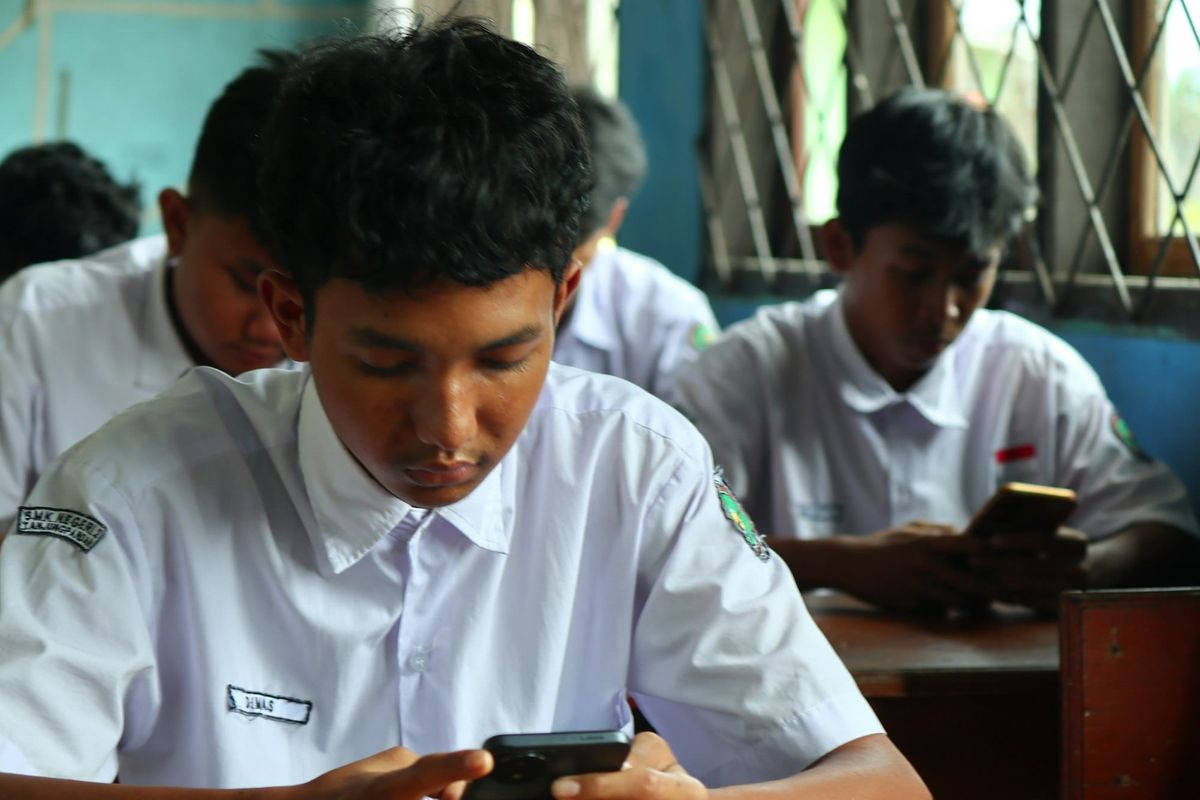
On 17 November 2026, Harvard's Center for Education Policy Research published the biggest study yet of school phone bans: about 3.3 million students in grades 3 to 10, at more than 4,600 US schools, tracked from 2021-22 to 2025-26. So do school phone bans work? A little, and the "little" is worth taking seriously. Schools that made students lock their phones in pouches all day saw yearly growth in math and reading rise by about 0.009 standard deviations. The authors put that at one to two extra weeks of school a year, or about half of what US students were losing each year before the pandemic.
That number got two very different reactions within a day. Some readers heard "proof bans work". Others heard "0.009, so basically nothing". I think both are reading it against the wrong yardstick.
What did the Harvard phone ban study find?
Source: Burland et al., CEPR, Harvard, November 2026, Table 2 and pages 3 to 4.
The report, "Phone-Free Schools and Achievement Growth: A Student-Level Analysis", is by Elizabeth Burland, Joanne Carminucci, Samantha Cullum, Daniel Dewey, Thomas J. Kane, Emily Morton and Douglas O. Staiger. It uses NWEA's MAP Growth tests, which students take in the fall and again in the spring, so it can compare each student's growth over a year rather than a school's average score. Schools that adopted Yondr pouches were matched with five similar schools that didn't, and the analysis was registered before the researchers saw the data.
The headline estimate is 0.0087 standard deviations a year for math and reading together. Split by subject it's 0.0079 for math and 0.0095 for reading. One caveat matters here: the combined estimate clears the usual bar for statistical significance (p = 0.041), but neither subject does on its own (p = 0.108 for math, 0.069 for reading). The pouches did change behaviour. Phones detected on school grounds fell about 11% in the first year and about 20% after that, and staff reported a 28 point drop in students misusing phones in class. The authors are careful that the device counts aren't a direct measure of use.
Is 0.009 standard deviations nothing?
My first reaction was yes. A hundredth of a standard deviation is the kind of effect that disappears into the noise of any one classroom. If you lined up two children, one from a pouch school and one from a school without pouches, you'd never tell them apart.
Then I checked what the authors compare it with.
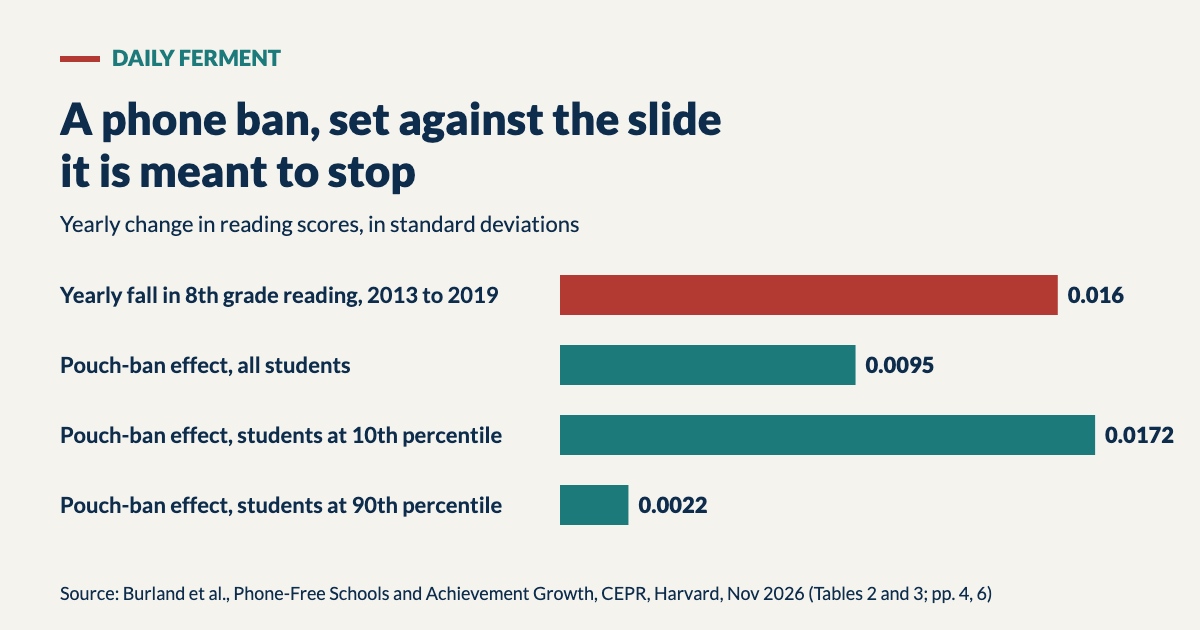
Before the pandemic (2013 to 2019), how fast were US 8th graders' reading scores falling each year, in standard deviations?
About 0.016 a year (math about 0.010). The pouch-ban reading effect, 0.0095, is about 59% of that. Source: CEPR report, pages 4 and 6; the percentage is my arithmetic.
Before the pandemic, from 2013 to 2019, US 8th graders' reading scores on the national NAEP test were falling by about 0.016 standard deviations a year, and math by about 0.010. Measured against that, the reading effect of 0.0095 is about 59% of a year's decline and the math effect of 0.0079 is about 79%, by my arithmetic. The authors round it to "about half". Kane's own phrase is that the bans "seem to plug about half of that leak." From 2013 to 2024 the cumulative fall was around 0.3 standard deviations, roughly a full grade.
So the right comparison isn't one child against another. It's this year's cohort against the trend. Small, steady losses added up to a grade. Small, steady gains can work the same way.
Did the effect really grow over time?
The New York Times headline said bans are "gradually" improving scores, and the CEPR news page uses the same words. The paper is more careful. In the first year the combined effect was 0.0086; in later years it was 0.0091. Reading rose from 0.0080 to 0.0141, but math fell from 0.0094 to 0.0035. When the authors tested whether the first-year and later effects were different, they couldn't tell them apart (p = 0.944 combined). They also say there aren't yet enough schools with long-standing bans "to conclude so with confidence."
So "gradually" is a hope consistent with the reading numbers, not a finding. I'd hold it loosely until the 2026-27 data is in.
Who gained most from the ban?
This is the part I found most interesting. In reading, the effect wasn't spread evenly. At the 10th percentile of growth, the students who would otherwise have had the worst year, the effect was 0.0172. At the 90th percentile it was 0.0022, close to zero. The difference is statistically clear (p = 0.001). In math the effect was about the same across the range.
That fits a point in the authors' abstract: phones may have contributed to the large losses among the lowest scorers, the 10th percentile, on the national NAEP test. A rule that helps everyone a little and helps the students sliding fastest about twice as much is doing more than its average suggests.
What does a 1984 lecture on heart disease have to do with it?
Smoking in the Whitehall study
- Person by person Age, smoking and grade explained only 7% of individual variation in lung cancer deaths
- Whole group 95% of the lung cancer deaths were in smokers
- Lesson A weak predictor of cases can be the main cause of the rate
Phone pouches in US schools, 2021 to 2026
- Person by person 0.0087 SD a year: you couldn't tell two children apart
- Whole group About 60% (reading) to 80% (math) of a year's pre-pandemic decline
- Lesson Judge it against the slide it's meant to stop
Sources: Marmot, Bulletin of the WHO, 2001, on Rose, 1985; CEPR report, 2026. Fractions of the decline are my arithmetic.
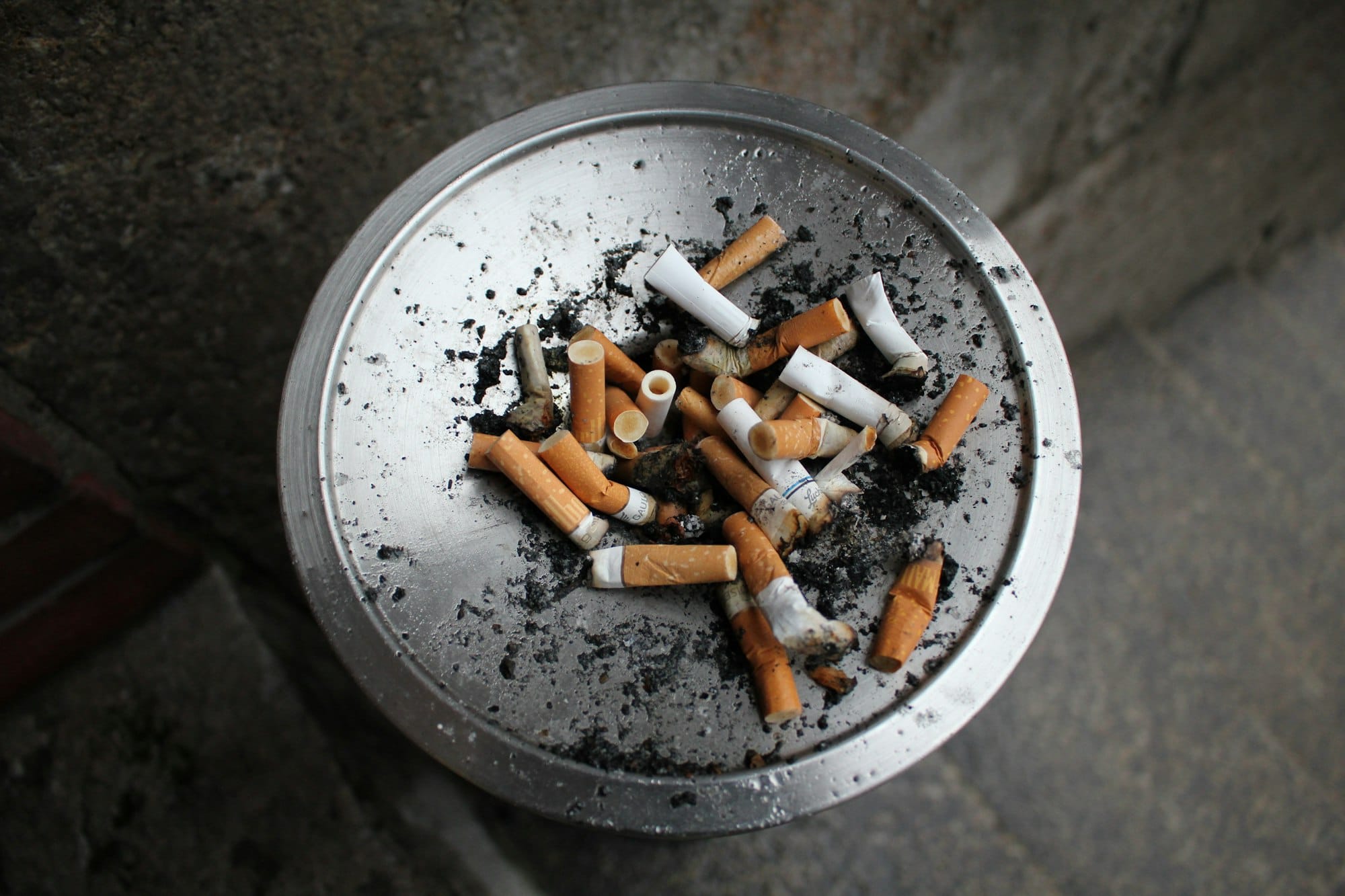
In August 1984 the epidemiologist Geoffrey Rose gave a lecture in Vancouver that became the 1985 paper "Sick individuals and sick populations". Michael Marmot, summarising it for the World Health Organization's Bulletin in 2001, puts the thesis in one line: "the causes of incidence rates may be different from the causes of individual cases within a population." Rose's abstract ends that "the prior concern should always be to discover and control the causes of incidence."
Marmot's example is from the Whitehall study of British civil servants. Age, smoking and employment grade together explained "only 7%" of the individual variation in lung cancer deaths. If you judged smoking by how well it predicts which one person dies, you'd call it weak. "Yet, the group differences are dramatic: 95% of lung cancer deaths in this cohort occurred in smokers."
The phone ban study has the same shape. Judged child by child, 0.009 standard deviations explains almost nothing about who does well. Judged as a shift in a whole population that has been sliding for a decade, it's half the slide. Rose's point, as I read it, is that these are two different questions, and a policy aimed at a whole population should be judged on the second one.
I used the same idea, from the other side, when a smartwatch started flagging high blood pressure: screening finds individuals, and false alarms decide whether it helps. A phone ban works less like screening and more like changing the air everyone breathes.
So is a phone ban worth it for a school?
On cost, the authors make a blunt comparison. Pouches cost about $22 to $25 per student, around $425 for a class of 17. A week of a teacher's salary is about $2,080, roughly five times as much. If the effect is one to two weeks of learning, the pouches are cheap.
The costs that matter more aren't in dollars. Two earlier studies the report describes, one in a single Florida district and one national, found discipline incidents rose in the first year of a ban before settling. The national one, using school averages, found no clear effect on scores at all. And the report's look at state-wide bans in 2025-26 found effects of a similar size but calls that analysis exploratory, because states that passed bans were already on different trends.
This is US data. Plenty of countries are having the same argument, and I don't know of a study this size outside the US. What carries over is the yardstick, not the exact number. I wrote before about what phones do to sleep, where the effect also depended on who had a fixed morning to keep. And about a school system being told it can't have Google Search without AI. Schools keep being asked to decide about technology on thin evidence. This is thicker than most.
How sure am I?
- Established
- The study's sample, estimates, p-values, cost figures and caveats as published by CEPR on 17 November 2026; Marmot's Whitehall figures and his summary of Rose.
- Inferred
- My percentages of the yearly decline (59% reading, 79% math), and that Rose's population frame is the right way to judge a school-wide rule. Rose wrote about disease, not schools.
- Still a guess
- Whether the effect grows after year two, as the headlines say. The paper can't show it yet, and I can't say how it carries to schools outside the US.
Judge a school phone ban against the size of the decline it is meant to stop, not against the differences between pupils; a small push on every child can matter more than a big push on a few.
More on Daily Ferment: Phones moved everyone's bedtime by an hour. Only people with fixed mornings lost sleep. and A smartwatch caught two in three hidden cases of high blood pressure. Smoke alarms show what decides if that helps.
Sources
- Elizabeth Burland, Joanne Carminucci, Samantha Cullum, Daniel Dewey, Thomas J. Kane, Emily Morton, Douglas O. Staiger, Phone-Free Schools and Achievement Growth: A Student-Level Analysis, Center for Education Policy Research, Harvard University, 16 November 2026 (released 17 November).
- Center for Education Policy Research, Phone-Free Schools, overview and quotes, 17 November 2026.
- Center for Education Policy Research, New Evidence Shows School Phone Bans Are Gradually Improving Test Scores, 17 November 2026.
- Michael Marmot, Economic and social determinants of disease, Public Health Classics, Bulletin of the World Health Organization, 2001, 79(10).
- Geoffrey Rose, Sick individuals and sick populations, International Journal of Epidemiology, 1985, 14: 32-38 (2001 reprint; abstract read).
- Figlio and Özek (2025), NBER working paper 34388, and Allcott et al., national study, both as described in the CEPR report.