1Password's breach took no passwords. It took the list a phisher needs.
1Password says no vault was opened. What the attacker copied is a list of who uses 1Password, and that is what a phisher needs.
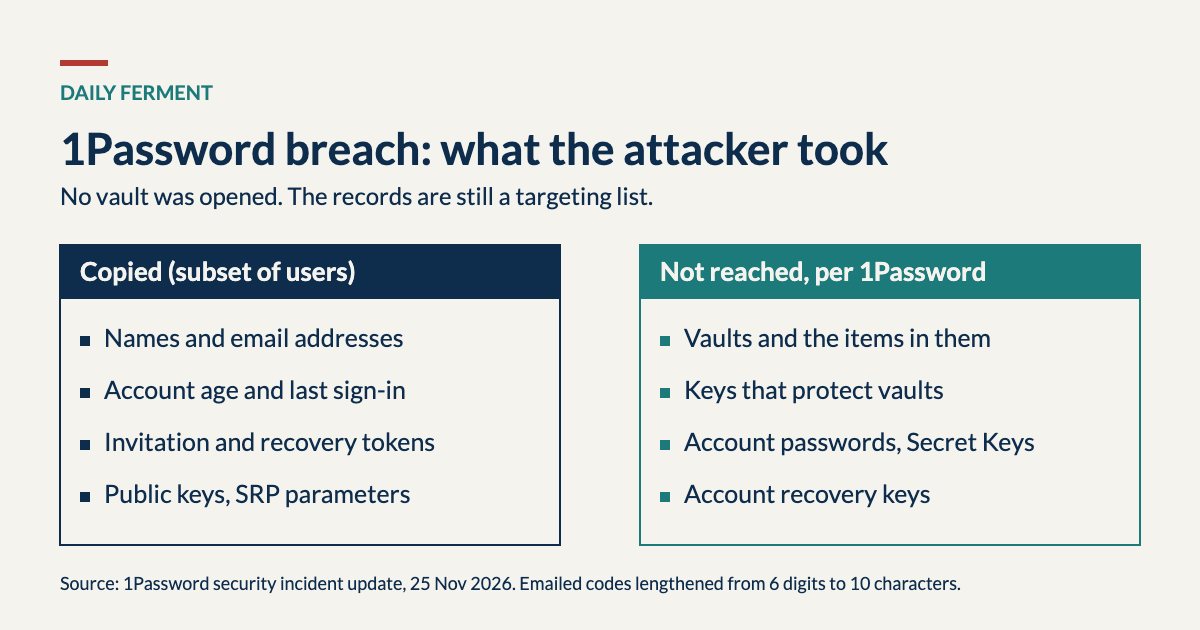
On Wednesday 25 November 1Password, the password manager, said an attacker had used an employee's corporate GitHub account to push malicious code to its backend and copy account records for a subset of customers. Were passwords stolen? No. 1Password says vaults, the items in them and the keys that protect them were never reachable. What was taken is names, email addresses, sign-in dates and some invitation and recovery tokens. That isn't nothing. It's a list of people who keep their secrets in 1Password, with enough detail to make a fake 1Password email sound right.
What 1Password says happened
The company began investigating on 19 November. Its post says the attacker copied source code from private repositories, got into the CI/CD system that builds and ships the product, and pushed code to backend services that downloaded customer records. Those records, for "a subset of our users", include names, email addresses, account and user identifiers, when the account was created and last signed in, public keys, Secure Remote Password parameters, and tokens from emailed links for invitations, provisioning and account recovery.
1Password says it rotated every internal credential that may have been exposed, found no evidence of account takeovers, and that customers don't need to change anything. The post doesn't say how many people are in that subset, or how the employee's GitHub account was taken in the first place. Those are the two things I'd most like to know. A developer's own account and tools as the way in is a pattern I've written about before, with the backdoored Claude Code extension.
My first reaction, and the check
My first reaction was relief, then a shrug. The design held. 1Password never holds your account password or your Secret Key, so a thief inside its servers can't open a vault. Compare LastPass in December 2022, when the attacker copied a backup of customer vaults that could then be attacked offline, one master password at a time. This is a different and much smaller kind of breach.
Then I read the list of fields again and asked what someone would actually do with them. Nothing on it opens an account. But almost everything on it helps you write a convincing email. You know the person's name, that they use 1Password, roughly when they joined and when they last signed in. For a small group, you know they had an invitation or a recovery in progress. 1Password's own advice points the same way: be wary of unexpected emails, texts or calls about invitations or account recovery.
Guess first: 1Password lengthened the code it emails from six digits to ten letters and digits. How many times more possible codes is that?
About 3.7 billion times, if letters count in one case only: 36 to the power of 10 is roughly 3.7 quadrillion, against one million six digit codes. My arithmetic; 1Password doesn't say whether case counts. Source for the change: 1Password, 25 Nov 2026.
That change closes the guessing route for anyone holding a stolen token. It does nothing about the other route, which is simply asking the person for the code.
The cross: what the FTC calls a sucker list

The US Federal Trade Commission has a consumer page on what it calls "the worst of the worst": refund and recovery scams, aimed at people who have already lost money once. The engine is a list. Scammers, the FTC says, "buy lists of people who've paid scammers. They call it a 'sucker list,'" holding a name, address and phone number, "the kind of scam that tricked you, and how much money you paid."
What makes that list valuable isn't a secret on it. A name and a phone number are in the directory. It's the context. Knowing which scam got you lets the caller tell a story that fits your life, and the FTC says they often pose as the very company that took your money, now offering a refund.
Hold the 1Password records against that. Name and email are the contact line. "Uses 1Password, joined in 2019, signed in on Tuesday" is the context. A pending invitation or recovery is the story. An email that says "finish recovering your 1Password account" lands very differently on someone who really did start a recovery last week.
An FTC "sucker list"
- Contact Name, address, phone number
- Context The kind of scam that tricked you
- The story it enables "We can get your money back"
- Secret on it None
The 1Password records, 2026
- Contact Name, email address
- Context A 1Password customer, account age, last sign-in
- The story it enables "Finish your account recovery" or "accept your invitation"
- Secret on it None that opens a vault, per 1Password
Sources: FTC, Refund and Recovery Scams; 1Password, 25 Nov 2026.
There's one difference, and it cuts in 1Password's favour. The FTC's lists are traded quietly, and the people on them don't know they're on one. This list was announced six days after the investigation began. A person who has read the warning is harder to fool than one who hasn't, which is the best case I know for publishing these notices fast, even before the "how many" is ready. I made the opposite complaint about a report that took 84 days.
What should 1Password users do?
1Password says you don't need to change anything, and nothing in its post contradicts that. What I'd do is narrower. Treat any message about a 1Password invitation or account recovery as suspect unless you started it. Open the app, or type the address yourself, rather than clicking. Never type your Secret Key into anything that arrived by email or text; 1Password says it is only needed the first time you sign in on a new device or browser. The FTC's version of the same advice fits too: look up the number yourself and never call the one they gave you.
A breach that takes no secrets can still hand over what a phisher needs most: a list of who to write to and which story they will believe.
How sure am I?
- Established
- What 1Password says was and wasn't taken, the dates and the code change, as stated in its post; the FTC's description of sucker lists.
- Inferred
- That these records are useful to a phisher the way a sucker list is. 1Password's own warning points that way, but I found no public report of phishing that uses this data yet.
- Guess
- That phishing aimed at 1Password customers will rise in the coming weeks. If it doesn't, I'll come back and say so.
I'm reading all of this from the company's own account. 1Password says it brought in independent experts to check its containment, and the part other security teams need, how one GitHub account reached production, isn't public yet.
More on Daily Ferment: A contractor's gateway let attackers into a bank. A school swimming lesson shows whose breach it is. and Optimizely's code ran on 178 big websites and changed itself on purpose. A pill bottle explains why the locks didn't help.