COP31 failed because any country can say no. Poland's parliament ran on that rule for over a century.
COP31 ended on 22 November with no deal, because UN climate talks run on consensus. This time the countries that said no were the ones that wanted more. Poland once ran a parliament on the same rule.
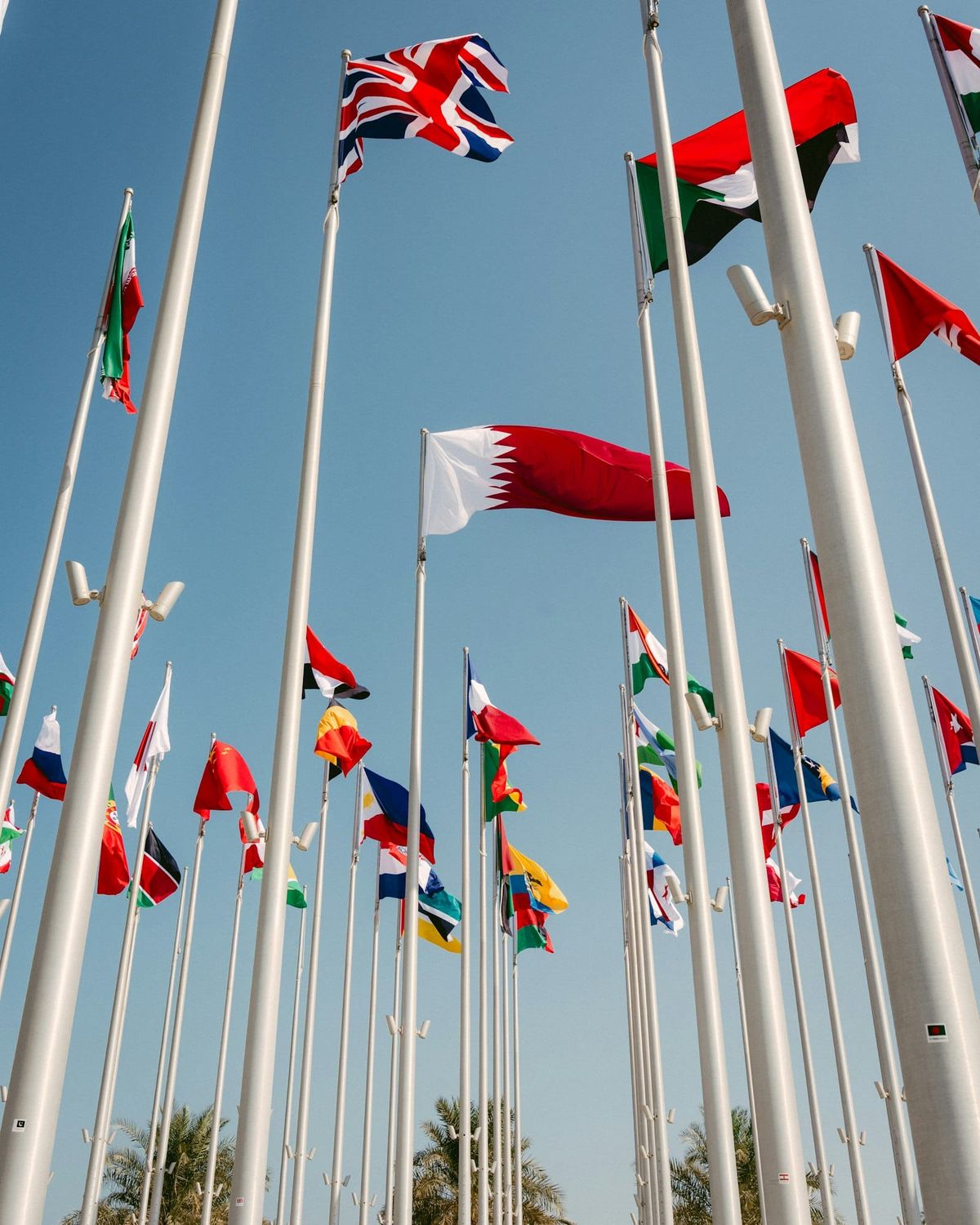
On Sunday 22 November, COP31 in Antalya, Türkiye, ended with no cover decision, the summary text that says what nearly 200 countries agreed. Why did COP31 fail? Because UN climate talks decide by consensus, and consensus means anyone can stop the text. This time the countries that stopped it were the European Union, the United Kingdom, Panama, the Marshall Islands, Norway, Vanuatu and Belize. They objected because the final draft did not mention fossil fuels at all. COP31 President Murat Kurum said it plainly from the chair: "I understand that there is no agreement on this text. For that reason, these decisions have not been adopted."
My first reaction was wrong
My first reaction was the familiar one: the oil producers blocked it again. That is half the story. According to Smithsonian and ABC News, reporting on the drafts, Saudi Arabia, Russia and other oil producers did get every explicit mention of fossil fuels taken out between the first and second draft. The first draft had called for "the immediate transition away from fossil fuels in energy systems."
But nobody on the oil side had to say no in the closing plenary. The text in front of the room already suited them. The no came from the other side. The EU, speaking through Ireland's climate minister Darragh O'Brien, said it could not accept a text with no reference to fossil fuels and called that omission "unconscionable." Panama, the Marshall Islands and others refused too.
So the veto everyone complains about was used, this time, by the countries that complain about it most. Panama's environment minister, Juan Carlos Navarro, told reporters: "We must change the process from consensus to majority if we want to get stuff done." His delegation had just used the consensus rule to stop the deal.
"We must change the process from consensus to majority if we want to get stuff done."
Juan Carlos Navarro, Panama's environment minister, after Panama objected to the text, as quoted by Smithsonian MagazineWhy can't COP just vote?
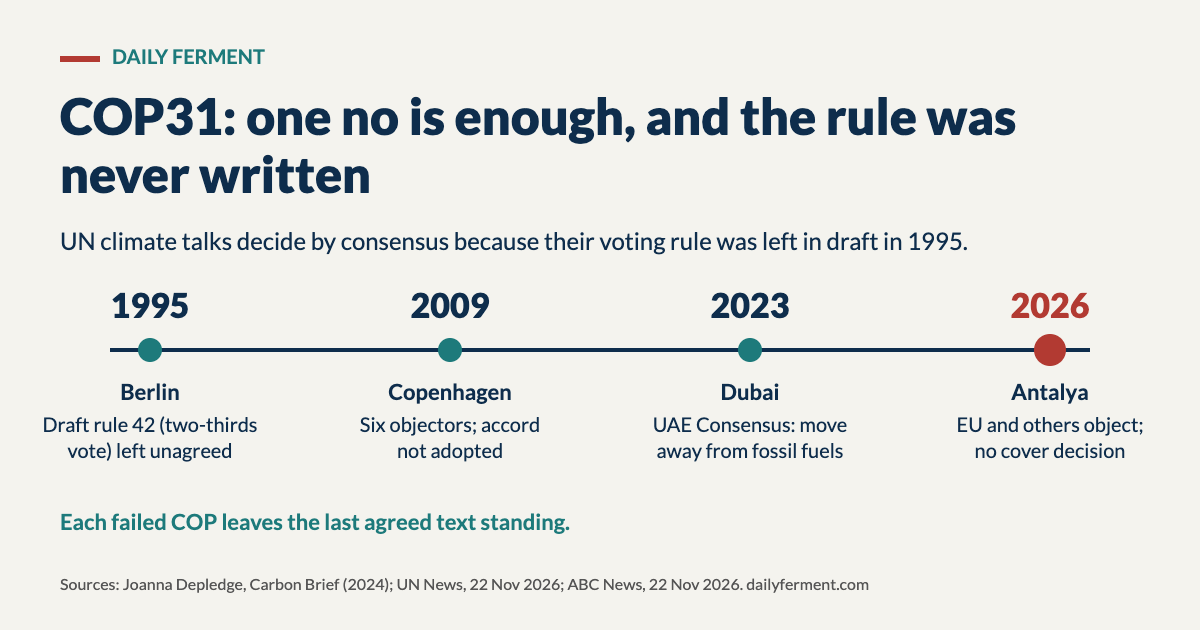
Because the countries never agreed how to vote. Joanna Depledge set this history out in Carbon Brief in 2024. The 1992 climate convention told the first COP, held in Berlin in 1995, to adopt rules of procedure, and to adopt them by consensus. The draft rules had a normal UN clause, rule 42, allowing a two-thirds vote as a last resort when consensus fails. OPEC members, mainly Saudi Arabia and Kuwait, wanted no vote at all. Donor countries such as the United States and France wanted consensus for money decisions. Nobody moved. Agreeing on how to decide turned out harder than agreeing on most of what got decided, which is the same lesson Toyota, Nissan and Honda are now learning about shared parts specs.
Thirty-one years later, the rules are still a draft. Every COP applies them as if they had been adopted, except rule 42. So consensus applies by default, not by design. There are two exceptions written into the treaty itself: amendments to the convention, the Kyoto Protocol and the Paris Agreement can pass with a three-quarters majority. Nothing else can.
- 1992 The climate convention asks the first COP to adopt rules of procedure, by consensus
- 1995 COP1, Berlin: draft rule 42, a two-thirds last-resort vote, is left unagreed
- 2009 Copenhagen: six countries object and the accord is never formally adopted
- 2010 Cancún: Patricia Espinosa overrules Bolivia, "consensus does not mean unanimity"
- 2023 Dubai: the UAE Consensus calls for transitioning away from fossil fuels
- 22 Nov 2026 Antalya: the EU and others object; no cover decision
Sources: Depledge, Carbon Brief, 2024; ABC News; UN News.
There is also no written definition of consensus. In practice it means nobody objects out loud. Presidents have stretched it before. In Cancún in 2010, Patricia Espinosa overruled Bolivia and said "consensus does not mean unanimity… one delegation does not have the right to veto." In Copenhagen in 2009 six countries objected and the accord was never formally adopted. A whole bloc objecting, as at COP31, is a different thing. No chair can gavel past the EU.
The cross: a parliament where one member could end the session
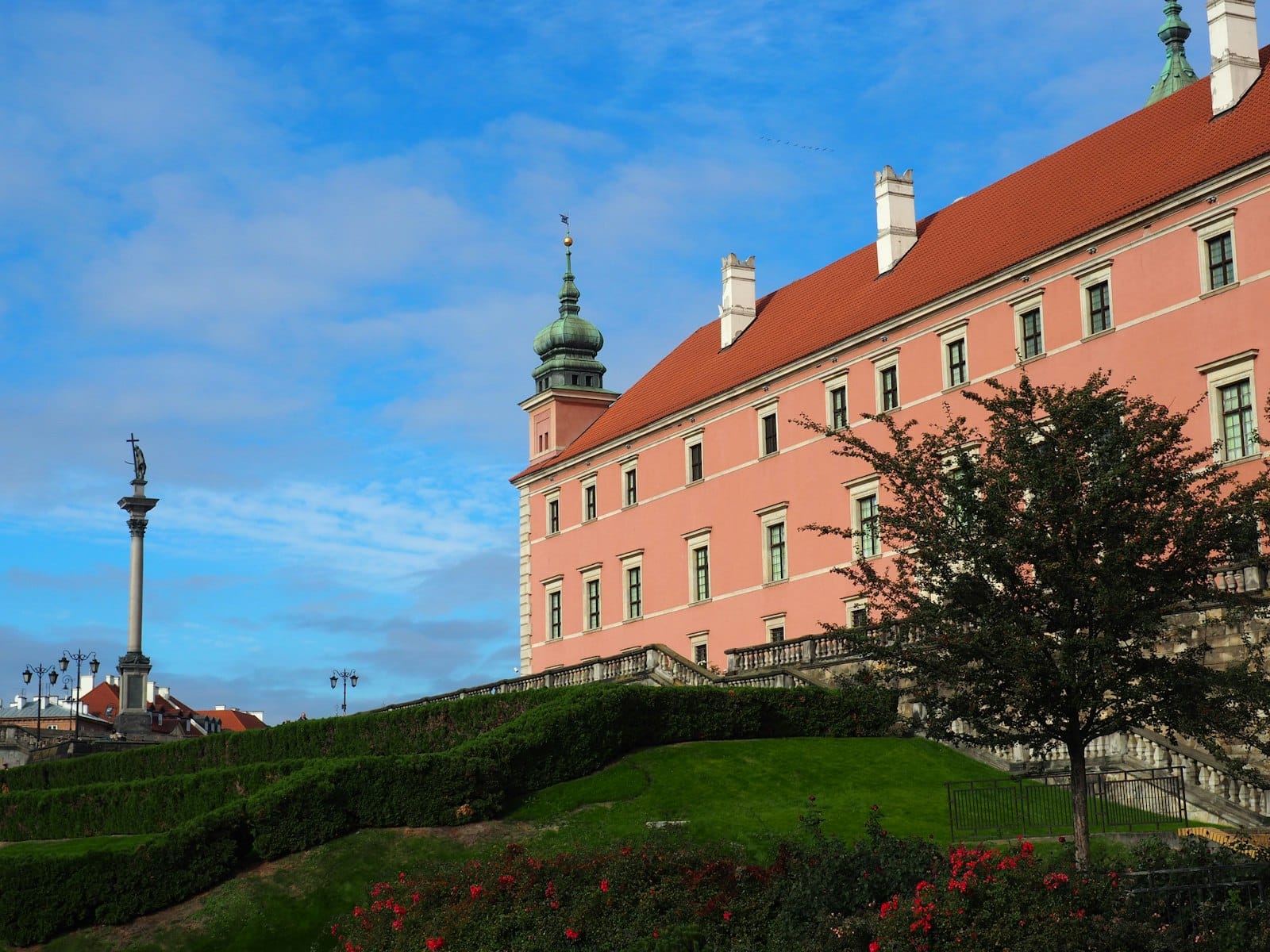
The cleanest test I know of a one-member veto is the Sejm, the parliament of the Polish-Lithuanian Commonwealth. Under the liberum veto, any single deputy could defeat a measure, and later dissolve the whole session and void everything it had passed. Britannica says it was first used to dissolve a session in 1652.
That date is itself a small lesson. The well-known story is that a deputy named Władysław Siciński broke up the Sejm that year. Historians cited on Wikipedia say he only vetoed continuing past the time limit. The first session ended early by one man's no came in 1669. The rule crept in through precedent, the same way the COP default did.
Then the numbers. From 1573 to 1763 about 150 Sejms met. Fifty-three passed no legislation at all, about a third by my arithmetic, and the historian Jacek Jędruch counted 32 of those as broken by the liberum veto. Under Augustus II, only 8 of 18 sessions passed any law. Britannica adds the part that should worry anyone at a COP: neighbouring powers "habitually bribed delegates" to force adjournments. The veto was abolished by the Constitution of 3 May 1791, after the First Partition had already taken land.
UN climate talks (COP)
- Who can stop a decision Any party that objects out loud; in practice, a bloc
- How the rule arrived Draft rule 42, with a two-thirds fallback vote, never adopted since 1995
- Workarounds Chairs gavel past lone objectors; treaty amendments by a three-quarters vote
- Who used it Oil producers in the drafting; the EU and island states at the close of COP31
Polish Sejm (liberum veto)
- Who can stop a decision Any single deputy
- How the rule arrived Precedent: 1652, then a whole session ended early in 1669
- Workarounds Majority voting for minor items from 1764 to 1766
- Who used it Deputies, and foreign powers through bribed deputies
Sources: Depledge, Carbon Brief, 2024; UN News, 22 Nov 2026; Britannica; Wikipedia, Liberum veto.
What the veto actually protects
Here is the pattern I think holds in both rooms. A unanimity rule does not favour caution or ambition. It favours whatever is already on the books. In the Sejm, that was the nobles' privileges, which is why reform kept dying. At COP31, what was already on the books was the 2023 UAE Consensus from Dubai, the first COP text to call for transitioning away from fossil fuels. The final Antalya draft only referred back to it. The EU's no kept the 2023 words as the latest agreed position, instead of a 2026 text that would have said less.
That is why the countries that want majority voting still defend the veto when it suits them, and why oil producers argued for consensus in 1995. Each side wants the rule when the status quo is theirs. It also explains Smithsonian's point on the other side of the argument: a majority vote might leave the most vulnerable countries with less say, not more. The Marshall Islands' no counted at COP31 exactly because it could not be outvoted.
What I think, marked as my view: the consensus rule works while the last agreement is good enough to defend. It breaks when the last agreement is too weak, because then the veto only freezes a position nobody thinks is adequate. Poland lived in that second state for most of a century. The climate talks are not there yet, but each failed COP leaves an older text standing a year longer, while the 1.5°C line gets crossed anyway.
A rule that lets any country say no does not favour the cautious or the ambitious. It protects whatever was agreed last, so it only works while the last agreement is good enough.
How sure am I?
- Established
- COP decisions need consensus because draft rule 42 was never adopted (Carbon Brief, citing the convention and the draft rules). The EU, UK, Panama, the Marshall Islands and others objected on 22 November and the cover decision was not adopted (UN News, ABC News).
- Inferred
- That the practical effect was to keep the 2023 UAE Consensus as the latest agreed language. The Antalya text only referred back to it; nobody has said so officially.
- Guess
- That more blocs will now use a closing objection as a tool, since this one showed it works from either side.
I also do not know what an adopted voting rule would have produced in Antalya. The oil producers never had to object, because the text they disliked never reached the floor.
COP32 meets in Addis Ababa next year. Simon Stiell, the UN climate chief, told the closing plenary that "the world cannot afford a repeat of this moment." Changing the rule needs consensus too.
More on Daily Ferment: Voters went against data centers in 40 of 41 ballot measures. Austria shows what a late no costs. and Fossil CO2 emissions are set to fall in 2026. A department store puzzle shows why the air still fills up.
Sources
- UN News: COP31 ends without climate pact as UN chief warns there is 'no ambiguity in the science' (22 Nov 2026)
- ABC News: UN climate conference ends without its signature agreement (22 Nov 2026)
- Smithsonian Magazine: The six biggest takeaways from COP31
- Joanna Depledge, Carbon Brief: The challenge of consensus decision-making in UN climate negotiations (5 Mar 2024)
- Britannica: liberum veto
- Wikipedia: Liberum veto (figures from Jędruch and others)