Nvidia jumped 31% when Jensen Huang came back. A starfish experiment shows what that number can't tell you.
Eleven days without its founder, in the middle of a chip rout. The share price measured what investors feared, not what Nvidia would lose.
On Monday, 23 November 2026, Nvidia's board reinstated Jensen Huang as president and chief executive, eleven days after he resigned, and Nvidia's shares closed 31.5% higher, at $165.05. It's tempting to read that as the market's price tag on one man. It isn't, quite. On the day he left, Nvidia did about 10 points worse than its rival AMD. On the day he came back, it did about 25 points better. In between, nearly every chip stock fell hard. So can Nvidia survive without Jensen Huang? Those eleven days don't say. They measured what investors feared, and a 1960s experiment on a beach in the Pacific Northwest shows why that's a different thing.
What happened between 12 and 23 November?
Huang co-founded Nvidia and has run it for 33 years. He resigned on 12 November, after news reports, as NPR summarised them, that he had affairs with several women, including an Nvidia executive who reported to him and an executive at a chip-buying company whom US officials believed had ties to Chinese intelligence. I wrote about the start of that investigation, and why the hidden part was the risk, in the 9 November piece.
On 17 November the board said it didn't intend to bring him back. On 23 November it voted unanimously to do exactly that, saying it was "satisfied with respect to Mr. Huang's candor and ability to lead NVIDIA" and that, after "input from senior levels of the United States government", it was confident his return "poses no national security risk." The independent investigation continues. President Donald Trump told CNBC he had convinced the board. Huang is due before congressional committees next week.
- 26 October Nvidia closes at $216.00
- 8 November The board announces an investigation into reports that Huang was the target of a foreign intelligence effort
- 12 November Huang resigns; the stock opens 13.1% down and closes 4.3% down
- 17 November The board says it doesn't intend to reinstate him
- 20 November A chip rout: Nvidia falls 14.0% in a day, to $125.53
- 23 November Reinstated by unanimous vote; Nvidia closes 31.5% up, at $165.05
Sources: NVIDIA, 23 November 2026; NPR, 23 November 2026; daily closes from Yahoo Finance, percentages my arithmetic.
How much did Nvidia's stock move because of Huang?
My first reaction was the obvious one: the market just said Huang is worth about a third of Nvidia. Trump made a version of the same argument, telling CNBC that persuading the board got easier "when the stock starts dropping forty, fifty percent." So I pulled the daily closes for Nvidia, AMD, Broadcom and the Nasdaq Composite and lined them up.
Guess first: from the close on the day Huang resigned to the close on 20 November, which fell more, Nvidia, which had lost its CEO, or AMD, which hadn't?
AMD. From the 12 November close to 20 November, Nvidia fell 24.5% and AMD fell 27.5%. My arithmetic from Yahoo Finance daily closes.
The forty percent is real if you start on 26 October: Nvidia fell 41.9% from there to 20 November. But it had already fallen 13.6% by 6 November, before any of the reporting, and AMD fell 15.5% over the same days. The Huang-specific part shows up best on single days. On 12 November Nvidia closed 4.3% down while AMD rose 5.9% and Broadcom rose 5.5%: a gap of about 10 points. Then, from that close to 20 November, Nvidia and AMD fell together, AMD slightly more. On 23 November Nvidia rose 31.5% while AMD rose 6.8% and Broadcom 3.0%: a gap of about 25 points.
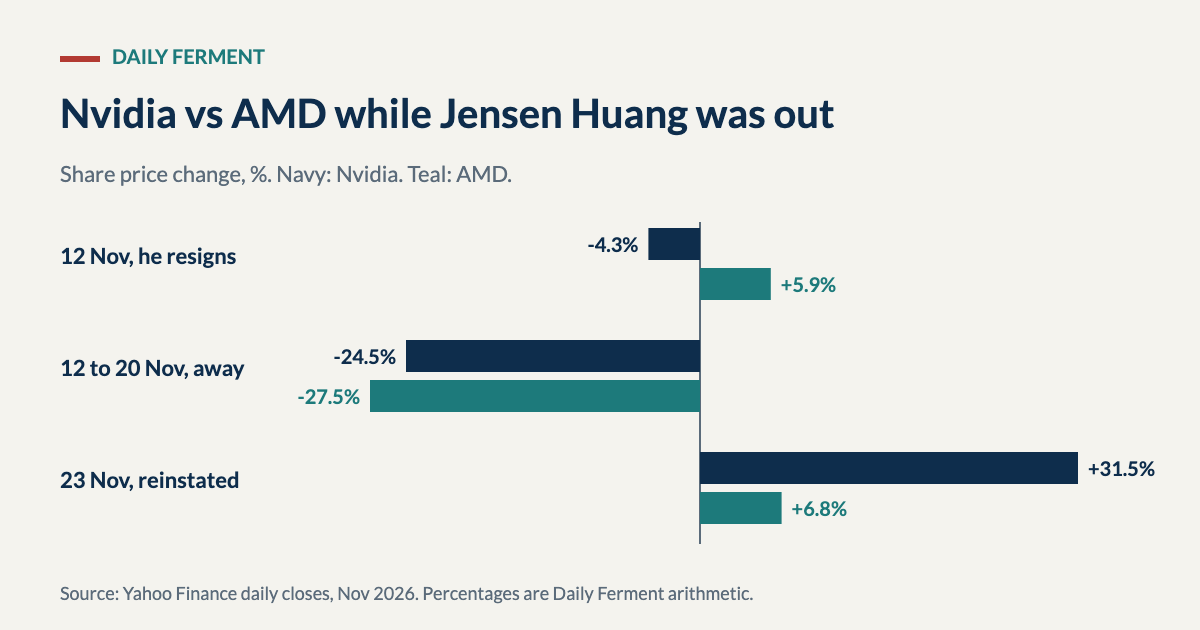
So the exit cost about 10 points against a peer, and the return was worth about 25. Those don't match, and that mismatch is the interesting part. Coming back from a low, in a market that had just had a terrible Friday, a stock moves for more reasons than one person. Some of Monday's jump is probably relief that the uncertainty ended, not a valuation of Huang himself. I can't separate the two from closing prices, and I don't think anyone can.
What does a starfish have to do with a chief executive?

In the 1960s an ecologist, Robert Paine, ran the experiment behind what is now the most cited empirical paper in the American Naturalist. On a stretch of rocky shore at Mukkaw Bay, about 8 metres long and 2 metres wide, he kept out the predatory ochre sea star, Pisaster ochraceus. Next to it he left an equal strip alone as a control.
The control didn't change. In the cleared strip, mussels took over and crowded out the other species that compete for space on the rock. Within a year the number of species there fell from fifteen to eight. Paine later called animals like that sea star "keystone" species: take one away and the whole structure changes.
Paine had two things Nvidia's board didn't. He had a control plot, an identical piece of shore where nothing was removed, so he could tell the starfish's effect from the weather and the season. And he had time: the effect took months to show. Nvidia's eleven days had no control, because there's only one Nvidia and AMD is a rough stand-in, and they overlapped a sector rout that moved everything. What the price measured was belief: investors' guess about life without Huang, revised daily.
Paine, Mukkaw Bay
- What was removed The ochre sea star, kept off the strip
- The control An equal strip of shore left alone
- How long About a year
- What it measured What the shore actually did without the predator
- Result Fifteen species down to eight
Nvidia, November 2026
- What was removed The founder and chief executive
- The control None; peers like AMD are a rough stand-in
- How long Eleven days, during a chip rout
- What it measured What investors expected, day by day
- Result About 10 points lost on exit, 25 regained on return, against AMD
Sources: Nature Education, 2010; Lafferty and Suchanek, American Naturalist, 2016; Yahoo Finance closes, my arithmetic. The pairing is mine.
So can Nvidia survive without Jensen Huang?
Nobody found out. That's the honest answer. Colette Kress ran the company as interim chief executive for eleven days, which is long enough for a share price to react and nowhere near long enough for a company to show what it does without its founder.
The case for the board's decision is strong on its own terms. Huang has led Nvidia for 33 years, the board says it questioned him and was satisfied, the government told it there was no security risk, and shareholders got back most of what they'd lost. The case against is put well in NPR's reporting. Rob Lalka of Tulane University said the board "basically went around its entire process that it had set in place for that investigation to put him back into power." Freada Kapor Klein called it "a resounding message that all that matters is money." Lawmakers in both parties criticised the decision, and the investigation hasn't finished.
My view, and it's only mine: the share price was the loudest voice in that room, and it was the least informative one. It told the board what investors feared. It couldn't tell them what Nvidia needs, any more than one tide could have told Paine what the sea star did. I made a similar point about a different price in the piece on Anthropic's first trading day: a single day's price is a vote, not a measurement.
How sure am I?
- Established
- The dates and the board's words, from Nvidia's release and NPR; the daily closes and the percentages computed from them; Paine's experiment as described by Nature Education and Lafferty and Suchanek.
- Inferred
- That the single-day gaps against AMD, about 10 points and 25 points, are the closest thing to a Huang-specific effect in the prices, and that some of Monday's jump was relief at the end of uncertainty.
- Guess
- How Nvidia would actually run without Huang over years. Eleven days can't show it.
Sources: as listed below.
When a founder leaves and returns within days, the share price measures what investors fear losing, not what the company would lose, because a short removal in a falling market has neither a control nor enough time.
The thing I'll be watching is next week's testimony, and then something slower: whether the new compliance officer and the national security committee change how Nvidia decides things when Huang disagrees. A company can depend on one person and still be built so that it doesn't have to. Paine's mussels didn't care about the forecast. They just took the rock.
More on Daily Ferment: Nvidia is investigating whether its CEO was a spy target. Clearance rules say the hidden part was the risk. and Japan's throne has one young heir. Software has a name for that.
Sources
- NVIDIA, NVIDIA Board Reinstates Jensen Huang as President, CEO and Board Director, 23 November 2026
- Shannon Bond, Danielle Kurtzleben and Scott Horsley, NPR, Trump claims credit as Jensen Huang returns to Nvidia, 23 November 2026
- Emily Peck and Madison Mills, Axios, Nvidia board reinstates Jensen Huang as CEO, 23 November 2026
- Yahoo Finance, NVDA daily chart data (also AMD, AVGO, Nasdaq Composite), read 24 November 2026
- Sharon C. Wagner, Nature Education Knowledge, Keystone Species, 2010
- Kevin D. Lafferty and Tom Suchanek, American Naturalist, Revisiting Paine's 1966 sea star removal experiment, 2016