A smartwatch caught two in three hidden cases of high blood pressure. Smoke alarms show what decides if that helps.
Google's watch study caught 65.8% of hypertension cases, more than an office cuff. Whether that helps depends on the false alarms, and smoke alarms show why.
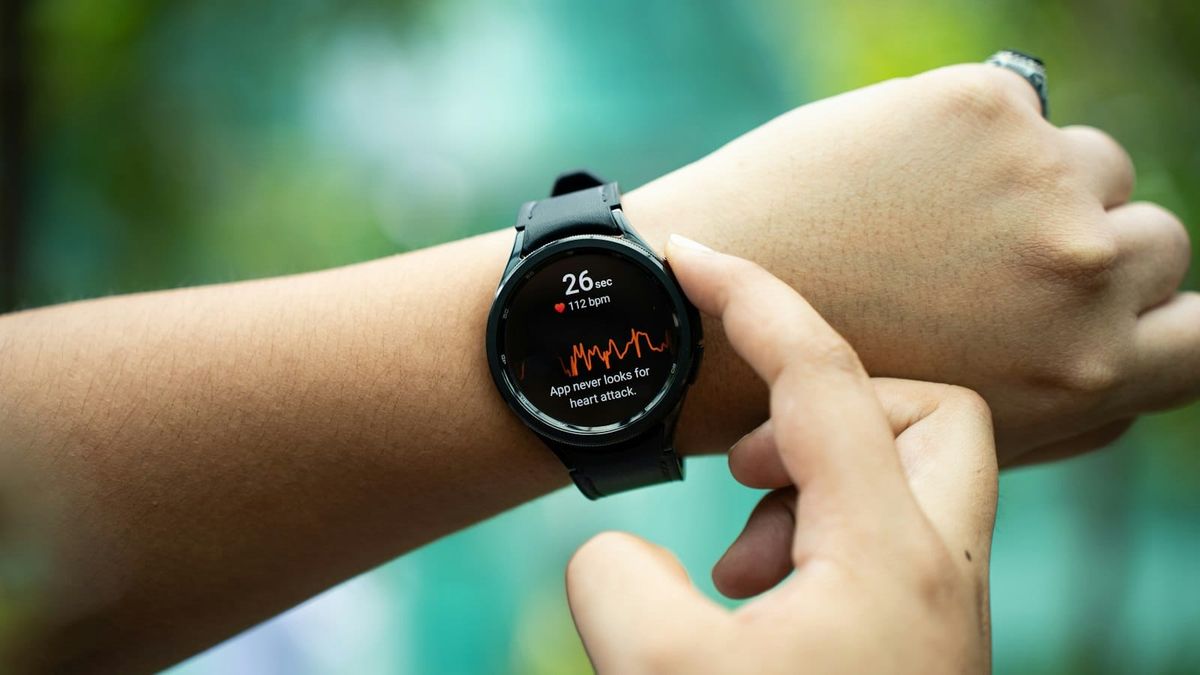
Can a smartwatch detect hypertension? On 5 November 2026, Google Research published a study in Nature that tested exactly that. In 196 adults with no known heart disease and no blood pressure medication, checked against 24-hour ambulatory monitoring, an AI model reading a consumer watch's pulse and motion sensors over seven days flagged 65.8% of the people who had hypertension. It wrongly flagged 10% of those who didn't. A single office cuff reading, judged the same way, caught 55.3%. So the answer is: partly, and in this study a bit better than a doctor's visit. The number that decides whether that helps anyone is the false alarm rate, and fire safety learned that the hard way.
Sources: Di Achille et al., Nature, 5 Nov 2026 (196 participants, 24-hour ambulatory reference); WHO hypertension fact sheet, 25 Sep 2025.
What the study measured
The paper, by Paolo Di Achille, Ming-Zher Poh and colleagues at Google Research with clinicians from Beth Israel Deaconess Medical Center, ran at five US sites. The model was pretrained on 492,347 hours of unlabeled sensor data from 2,109 people, then tested on the 196. It needs no cuff calibration. The reference was the gold standard: a cuff that measures blood pressure around the clock for a day.
Of the people the watch flagged, 80.6% really had hypertension. The office reading managed 77.8%. Both had the same specificity, 90%. The paper pitches this as "population-level opportunistic hypertension screening", nudging people toward a proper cuff test.
Google's own product is more careful. The blood pressure trends feature in its Health Guardian set, which the research "helped inform", was announced in August for qualified Pixel Watches and Fitbit Air, due from September. Its fine print says it is "not a prescreener for hypertension" and "not a replacement for a blood pressure monitor." The paper says screening. The product says not screening. That gap is worth holding onto.
My first reaction was the misses
65.8% means the watch missed about a third of the people with hypertension. My first reaction was that a tool which misses one in three is not one I'd want telling me I'm fine. That's the same worry I had about the skin cancer AI that would have sent melanomas home.
Then I checked what it's being compared with. The office cuff missed even more, 44.7% in this study. And the WHO estimates that 600 million of the 1.4 billion adults aged 30 to 79 with hypertension, 44%, don't know they have it. For most of them nothing is checking at all. Against that baseline, a watch that catches about two in three cases among the people who wear it is not obviously weak.
So the misses weren't the problem I thought. The other number is.
The number that matters is the false alarm
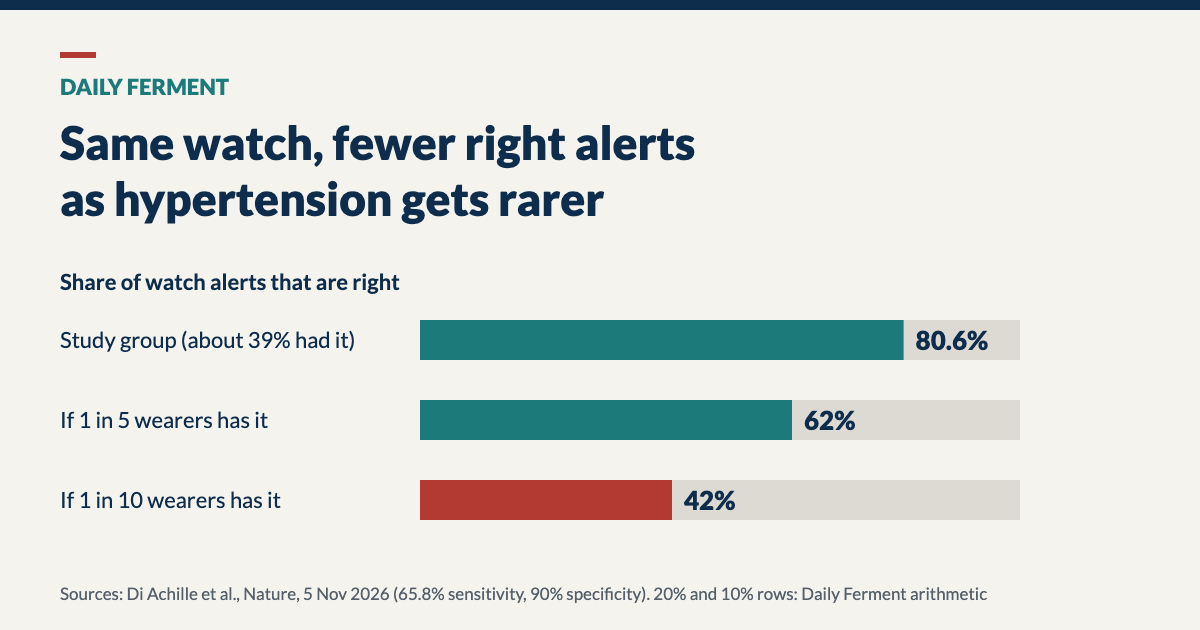
Guess first: if one in ten people wearing the watch has hypertension, what share of its alerts would be right?
About 42%. With 65.8% sensitivity and 90% specificity, 1,000 wearers give about 66 true alerts and 90 false ones. In the study, where about 39% had hypertension, it was 80.6%. (My arithmetic from the paper's figures.)
The 80.6% figure depends on how common hypertension was in the study. Working back from the percentages in the abstract, about 76 of the 196 people had it, roughly 39%. That's my arithmetic, not a figure the paper states in its abstract. Among everyone who wears a smartwatch I'd expect it to be rarer than that, though I haven't found a figure for watch owners.
Keep the same 90% specificity and 65.8% sensitivity. If one in five wearers has hypertension, about 62% of alerts are right. If it's one in ten, about 42% are. That means more than half the people told to go and get checked would turn out not to have it. Every one of them is a reason to start ignoring the watch.
What smoke alarms already taught us
Home smoke alarm (NFPA, US, 2012 to 2016)
- What it missesFires where it was missing (40% of deaths) or not working (17%)
- Why it stops workingMissing or disconnected batteries, 43% of failures
- The root cause"Power sources are often disabled because of unwanted alarms."
Watch hypertension alert (Nature, 2026)
- What it missesAbout a third of people with hypertension (65.8% caught)
- What it gets wrong10% of people without it are flagged
- The riskAt lower prevalence, most alerts can be false, and people learn to ignore them
Sources: Ahrens, Smoke Alarms in U.S. Home Fires, NFPA, January 2019; Di Achille et al., Nature, 5 Nov 2026. Prevalence point is my arithmetic.
Fire safety has run this experiment for decades. In the NFPA's 2019 report on US home fires, almost three in five deaths from 2012 to 2016 happened where there was no smoke alarm (40%) or one that didn't work (17%). When alarms failed, it was mostly because the power had been taken away: missing or disconnected batteries were 43% of failures. And the report says why: "Power sources are often disabled because of unwanted alarms."
A detector people switch off catches nothing. The burnt toast doesn't kill anyone directly. It just teaches people to pull the battery, and the real fire comes later. I wrote about the same thing with AI agents that ask for approval too often: every unnecessary prompt trains the human to click yes.
That's why I think Google's product wording is more honest than the paper's framing, not less. Calling the feature "trends" rather than a screener keeps the alarm quieter. It also means nobody should read silence from the watch as a clean bill of health. Those are two sides of the same choice.
A smartwatch hypertension alert gets judged by the cases it misses, but it lives or dies by its false alarms, because the share of alerts that are right falls as the condition gets rarer among the people wearing it.
- Established
- The study's figures (196 people, five US sites, 65.8% sensitivity, 90% specificity), WHO's 600 million unaware, NFPA's alarm failure figures, and Google's "not a prescreener" wording.
- Inferred
- The study prevalence (about 39%) and the alert accuracy at 20% and 10% prevalence: my arithmetic, assuming the watch performs the same outside a small study of people without known heart disease or medication.
- Still a guess
- How the shipped trends feature performs, and whether people will ignore it the way they pull smoke alarm batteries. I haven't seen data on either.
More on Daily Ferment: Nearly every donated NFL brain had CTE. The answer was in the ones nobody donated. and Phones moved everyone's bedtime by an hour. Only people with fixed mornings lost sleep.
Sources
- Di Achille P, Cai L, Wu J, et al. Opportunistically Detecting Signs of Hypertension on a Consumer Smartwatch. Nature, 5 Nov 2026
- Detecting signs of hypertension using wearable sensors, Google Research blog, 5 Nov 2026
- Track subtle changes in your body with Health Guardian features on Pixel and Fitbit, Google, 12 Aug 2026
- Hypertension fact sheet, World Health Organization, 25 Sep 2025
- Marty Ahrens, Smoke Alarms in U.S. Home Fires, NFPA, January 2019