F1 just crowned a 20-year-old. Science's best work keeps arriving later.
Kimi Antonelli is the youngest F1 world champion at 20 years and 68 days. In science the age of great work went the other way. The difference is what has to be learned first.
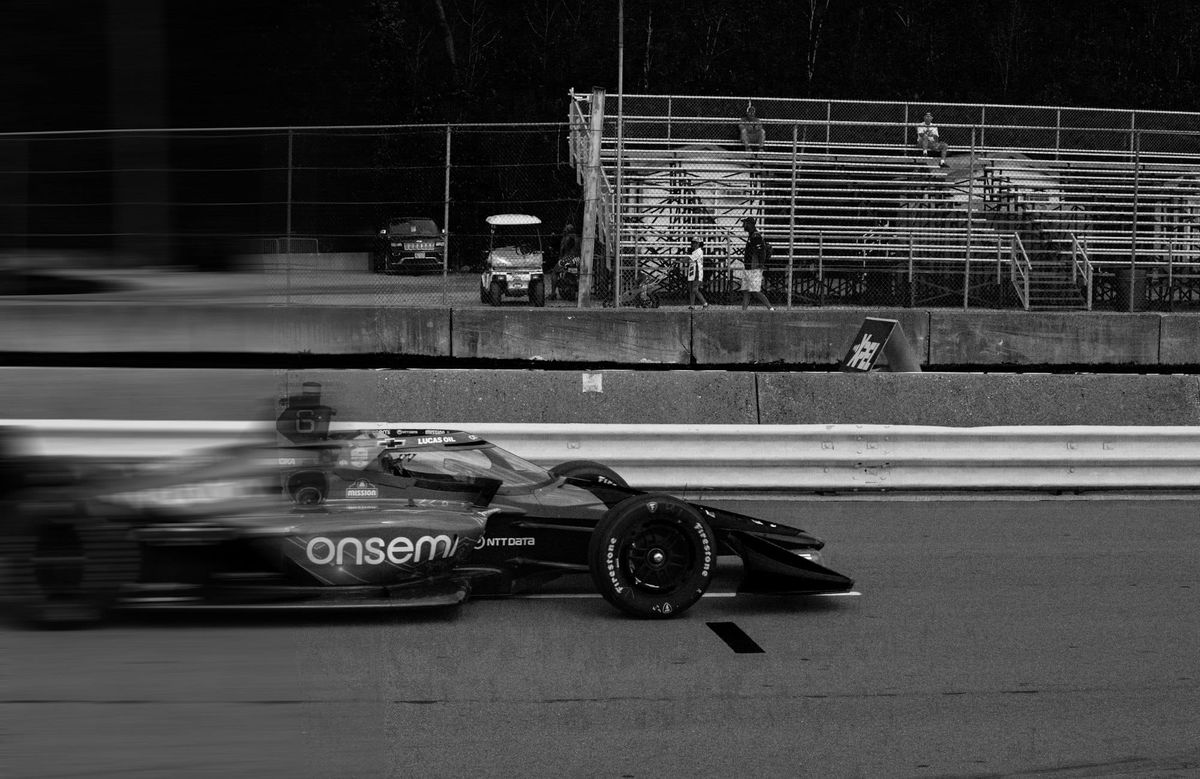
On Sunday 1 November 2026, Kimi Antonelli finished third in the Mexico City Grand Prix, and that was enough. At 20 years and 68 days, the Mercedes driver became the youngest Formula 1 world champion, beating Sebastian Vettel's record from 2010 by more than three years. Why do F1 champions keep getting younger when, in science, the age of great work has gone the other way? My answer: in F1 the learning can be packed into childhood and a simulator, and what a driver must know doesn't pile up from one generation to the next. In science it does.
How young is 20 for a world champion?
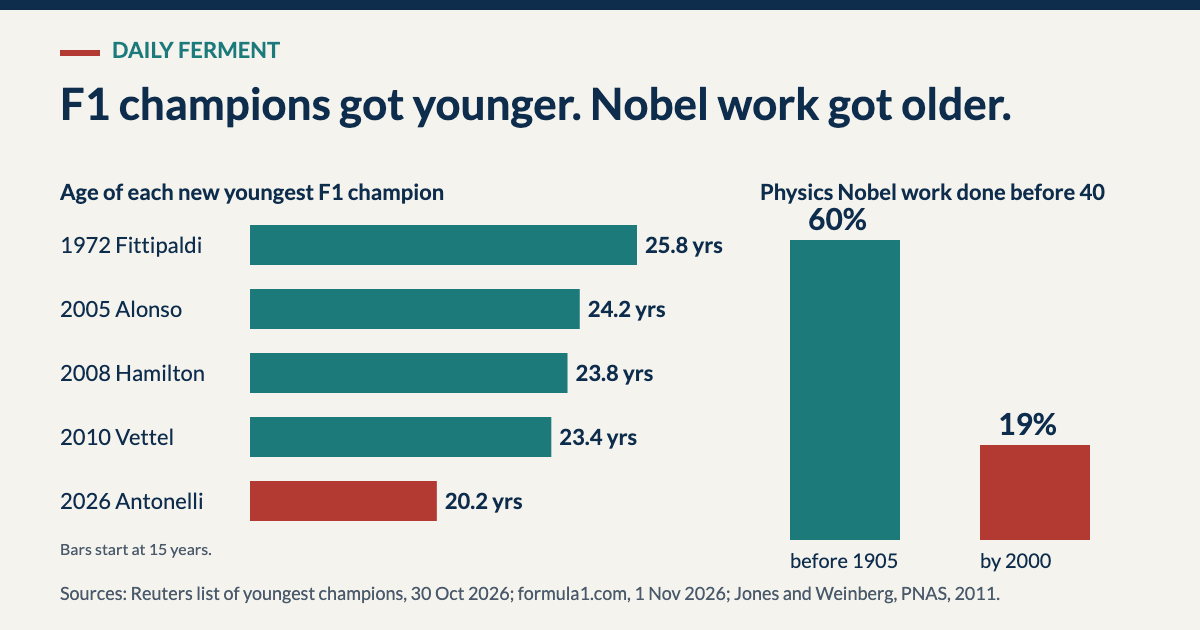
Young enough that the record moved in big steps, not small ones. Emerson Fittipaldi set it in 1972 at 25 years and 273 days. Fernando Alonso took it in 2005, Lewis Hamilton in 2008, Vettel in 2010 at 23 years and 134 days. Then nothing for sixteen years, until Antonelli took more than three years off it in one go.
- 1972 Emerson Fittipaldi, 25 years 273 days
- 2005 Fernando Alonso, 24 years 58 days
- 2008 Lewis Hamilton, 23 years 300 days
- 2010 Sebastian Vettel, 23 years 134 days
- 1 Nov 2026 Kimi Antonelli, 20 years 68 days
Sources: The National (Reuters), 30 Oct 2026; Sky Sports and formula1.com, 1 Nov 2026. formula1.com's 2021 list gives Vettel and Alonso one day less.
He did it in his second season. Mercedes announced in August 2024 that the then 18-year-old would replace Hamilton, after a testing programme in older F1 cars. Before Mexico he had won nine of the year's 18 races and led by 123 points, according to Reuters, and Sky Sports counts six of those wins before his 20th birthday in August. He's also the first Italian champion since Alberto Ascari in 1953.
Sources: Sky Sports and ESPN, 1 Nov 2026; Reuters via TimesLIVE, 28 Oct 2026; formula1.com, 7 Jan 2015.
My first reaction: young people are just faster
My first thought was the obvious one: reflexes peak young, so a sport built on reflexes gets young champions.
That doesn't survive a look at the record. Reflexes were just as young in 1972. If youth alone did it, the record would always have belonged to someone barely out of their teens. It didn't. Until 1972 nobody under 25 had won the title, and Alain Prost won his last one in 1993 at 38. Something changed in how drivers get good, not in what age does to the body.
The field that went the other way

The economist Benjamin F. Jones has spent years on the opposite trend. In "Age and Great Invention", published in the Review of Economics and Statistics in 2010, he found that "great achievements in knowledge are produced by older innovators today than they were a century ago." On his own summary, the mean age at which noted innovations are made rose by about six years over the 20th century.
His explanation is what he calls the burden of knowledge. Every generation adds to what the next one has to learn before it can do anything new, so "successive generations of innovators may face an increasing educational burden." People respond by studying longer and narrowing their expertise. The frontier keeps moving away, and it takes longer to reach it.
Guess first: before 1905, about 60% of Nobel-winning physics was done before age 40. What was the share by 2000?
19%, less than a third of the 1900 rate. In chemistry it fell to almost zero. (Jones and Weinberg, PNAS, 2011.)
Jones and Bruce Weinberg put numbers on the Nobel case in PNAS in 2011. Before 1905, about 60% of prize-winning physics was done before the age of 40. By 2000 it was 19%. In chemistry it went from 69% to almost nothing.
Formula 1
- Direction: record age fell from 25 (1972) to 20 (2026)
- What must be learned: this car, these tyres, these tracks
- Does it pile up: partly expires as cars and rules change (my reading)
- Can it move earlier: yes: karting, academies, home simulators
- What sets the floor: a rule, 18, since 2016
Great science and invention
- Direction: mean age of noted innovations up about 6 years over the 20th century
- What must be learned: everything the field already knows
- Does it pile up: yes, the burden of knowledge
- Can it move earlier: not much; people study longer and narrower
- What sets the floor: years of education
Sources: The National (Reuters), 30 Oct 2026; formula1.com, 7 Jan 2015; Jones, Review of Economics and Statistics, 2010, and NBER WP 11360; Jones and Weinberg, PNAS, 2011. The "does it pile up" row for F1 is my inference.
So why does F1 run backwards?
Put the two side by side and the difference is the shape of the knowledge, as I read it.
A driver's craft doesn't accumulate like a literature. The cars and the rules keep changing, so old knowledge partly expires. What a 2026 driver needs is not everything every champion before him learned. It's this car, these tyres, these tracks, and enormous amounts of practice. And practice is the one thing that can now be moved earlier. Karting starts in childhood. Teams run junior academies. In 2024, Antonelli said Mercedes was going to send him "a steering wheel and a small simulator at home" to learn the buttons. Mercedes' reserve driver Fred Vesti has talked about doing "closer to a thousand" simulator laps before one race weekend. A physicist can't simulate their way past a century of papers. A driver can log lap after lap of a circuit in a simulator long before they're old enough to race on it.
That's inference, not something a study I've opened has shown. But there's a tell in F1's own rulebook. In January 2015, as Max Verstappen was about to start a Grand Prix at 17, the FIA added a minimum age of 18 for a super licence, plus 40 points over three years in junior series. When a field can push learning that early, age stops being set by how long it takes to get good and starts being set by a rule. Antonelli got his seat at 18, the floor.
It reminds me of what I wrote about Japan's single young heir: a system's age profile is often a design choice that looks like nature. And of the Brewers winning on a third of the Dodgers' payroll, where how a team develops people mattered more than what it paid for finished ones.
What I'm still not sure of
The record history and the science numbers are solid. The mechanism is mine. Other things changed too: money in junior racing, fitness, the cars themselves. And one exceptional driver can move a record without telling us much about a trend. I'd want the average age of all race winners by decade before leaning harder on this, and I haven't found a source I trust for it yet.
- Established
- Antonelli's age and the record history; the super licence age and points rules from 2016; Jones's finding that great achievement comes later than a century ago, and the Nobel shares in Jones and Weinberg.
- Inferred
- That F1 got younger because practice can be moved into childhood and simulators while its knowledge does not pile up the way a science does. Money, fitness and the cars changed too.
- Still a guess
- That the age floor of 18 is now what sets how young a champion can be, and how long Antonelli's record lasts.
Champions get younger in fields where the learning can be pushed into childhood and a simulator, and older in fields where each generation must first learn everything the last one found, so the age of a field's stars tells you which kind of field it is.
More on Daily Ferment: Japan's throne has one young heir. Software has a name for that. and Lean says OpenAI's proofs check out. Who checks they prove the right thing?
Sources
- Formula 1, Antonelli crowned youngest ever F1 champion as Verstappen wins eventful Mexico City Grand Prix, 1 November 2026.
- ESPN, Kimi Antonelli makes F1 history as youngest world champion with maiden title, 1 November 2026.
- Sky Sports, Kimi Antonelli: how Formula 1's newest world champion has rewritten the record books, November 2026.
- Reuters via TimesLIVE, Antonelli ready for final push to become F1's youngest champion, 28 October 2026.
- The National (Reuters), F1's youngest champions: the five legends Kimi Antonelli can eclipse, 30 October 2026.
- Formula 1, Kimi Antonelli confirmed as Lewis Hamilton's replacement, 31 August 2024.
- Formula 1, New super licence points system from 2016, 7 January 2015; Jalopnik, FIA releases tougher F1 superlicense rules, 6 January 2015.
- F1Technical, Antonelli on his home simulator, 2024; GPFans, Mercedes' simulator work, 2026.
- Benjamin F. Jones, Age and Great Invention, Review of Economics and Statistics 92(1), 2010; author's summary; The Burden of Knowledge and the Death of the Renaissance Man, NBER Working Paper 11360, 2005.
- Benjamin F. Jones and Bruce A. Weinberg, Age dynamics in scientific creativity, PNAS 108(47), 2011.