Claude won't remake a specific game anymore. A Tetris ruling shows where the line really sits.
Claude Code now refuses to recreate a specific existing game, even renamed. A 2012 Tetris ruling drew a looser line, and neither one can see who owns the game.
Around 27 October 2026, two sentences appeared in the rules that Anthropic's Claude Code follows on its newest model, Claude Opus 5.5: "Do build original games, games in a genre, and games from the user's own designs and assets." And: "Do not build a recreation of a specific existing game, even if it is renamed or called original." So can you still use Claude to make a game like one you love? A genre game, yes. A recreation of one particular game, no, even under a new name. That line is stricter than the one a US court drew for Tetris clones in 2012, and the rule can't see who owns the game it refuses.
What did Anthropic actually change?
An X user called Chasm spotted the rule, listed under an internal flag named tengu_heron_brook, and said users can't switch it off. Anthropic didn't announce it. When Game Developer asked, a spokesperson pointed to a post by Addy Osmani, who works at Anthropic: "We added two sentences to Claude Code's prompt on Opus 5.5 to steer it away from recreating someone else's specific game". PC Gamer quotes the reason he gave, "because using Claude to infringe IP is against our usage policy", and his promise that "original games, genre games, and games built from your own design are meant to keep working."
Kotaku's example makes the line easy to picture. A racing game is fine. A racing game "like Need For Speed" trips the rule.
- 30 May 2012 A US court rules the iPhone game Mino infringed Tetris: rules free, look and feel protected.
- 19 Oct 2026 Digital Sun Games drops a large public playtest of ReVamp over AI cloning fears; a Discord-only test starts 29 Oct.
- About 27 Oct 2026 Two sentences appear in Claude Code's rules on Opus 5.5 under the flag tengu_heron_brook.
- 28 Oct 2026 Game Developer reports Valve's answer: it does not want to be a gatekeeper on tools.
- 30 Oct 2026 Anthropic points to Addy Osmani's post confirming the change.
Sources: Proskauer and Loeb and Loeb on Tetris v. Xio (2012); Game Developer, 19, 28 and 30 Oct 2026; Kotaku, 30 Oct 2026.
The timing isn't a mystery. On 19 October, Digital Sun Games, the studio behind Moonlighter, dropped a planned large public playtest of its next game, ReVamp, and moved to a small one on its Discord server instead. Its reason: it was "concerned by recent news of games being reverse-engineered, cloned, and published before the original is even out." Around the same time, Valve was asked at a developer conference in Busan what Steam would do about AI clones. Tom Giardino of Valve's business team said, as reported by Game Developer, "We don't want to be gatekeepers telling developers which tools they should or shouldn't use."
So the store won't draw the line, and Anthropic drew one inside the tool.
My first reaction: good, that's the right line
I liked the rule when I first read it. Cloning a small studio's game before it ships is plainly wrong, and the people who do it are not subtle.
Then I tried to say what "a recreation of a specific existing game" means, and I couldn't do it cleanly. A falling-block puzzle is a genre. Tetris is a specific game. Where does one stop? That question has been in front of a judge, and the answer isn't the one the rule gives.
Where the law drew the line for Tetris
A company called Xio Interactive made Mino, an iPhone game that played like Tetris. Xio set out to copy only the rules and the way the game works, which it believed copyright doesn't cover. On 30 May 2012, Judge Freda Wolfson of the US District Court for New Jersey ruled against it and gave summary judgment to Tetris Holding.
The interesting part is what she said was free. "The idea of a game that required one to rotate figures into a field was not protectible", in the words of the Loeb and Loeb summary, and neither were the rules or the purely functional features. What Xio lost on was the expression: the playing field's dimensions, the look and movement of the pieces, the ghost piece, the garbage lines, the colour changes, the board filling up at the end. Xio's own expert admitted those could have been designed almost any number of ways. The court called the similarity "akin to literal copying", even though no code or images were copied.
Guess first: Mino copied Tetris without copying a single line of its code or any image. Did the court still find it infringed?
Yes. The rules were free to use, but the field's dimensions, the pieces, the ghost piece, the garbage lines and the colour changes were expression. The court called the similarity "akin to literal copying". (Tetris Holding v. Xio Interactive, D.N.J., 30 May 2012, via Loeb and Loeb.)
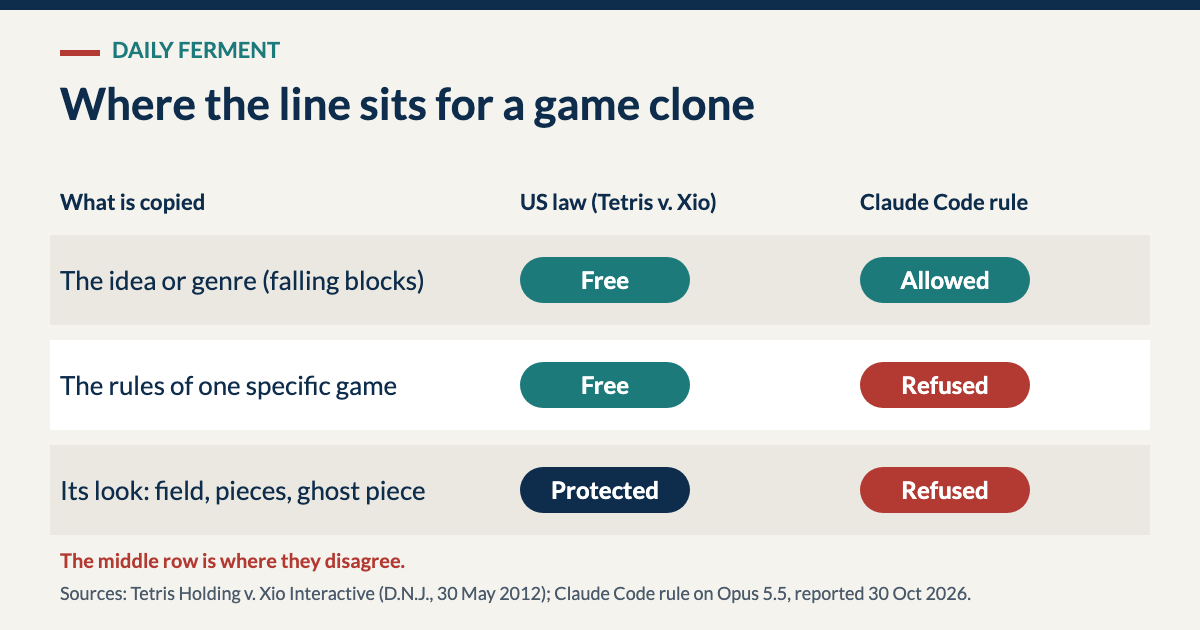
Put the two lines side by side and they don't match.
US law, Tetris v. Xio (2012)
- Asks: what was copied?
- The idea or genre: free
- The rules of a specific game: free
- The look, pieces and field: protected
- Knows who owns it: yes, the owner has to sue
Claude Code rule (Oct 2026)
- Asks: does the result recreate a specific game?
- The idea or genre: allowed
- The rules of a specific game: refused if it amounts to a recreation
- The look, pieces and field: refused
- Knows who owns it: no; "send it my way" if it is yours
Sources: Loeb and Loeb and Proskauer on Tetris v. Xio; rule text and Osmani's post as reported by Game Developer (30 Oct 2026) and PC Gamer (31 Oct 2026). The middle rows are my reading of how the two lines apply.
Who does the rule actually stop?
The law asks what was copied. Claude's rule asks what the result resembles. Those overlap in exactly one place: the lazy clone that copies the look wholesale. That's the copy a studio could already take to court, and it's also the one that's easiest for a model to recognise, because the request usually names the game. So the rule will probably slow the cheapest copies. That part is my inference, not something Anthropic has measured.
It misses in two directions. It refuses things the law allows, like a game that borrows the rules of a specific game with new art and a new feel, which is how a lot of genres started. And it can't see ownership. A developer who asks Claude to rebuild their own shipped game looks, to the model, like someone copying it. Osmani seems to know this. His post ends: "if Claude turns down something that's yours, send it my way." A large Reddit thread in r/technology is full of developers reporting exactly that, though I haven't checked those reports one by one.
And it does nothing about the rest of the market. Game Developer makes the obvious point that safety limits get worked around and that open-weight models carry no such rule. A determined copier switches tools. The polite one, who asked by name, gets stopped.
I wrote earlier about ChatGPT signing real cartoonists' names, where the older law turned out to be about the false mark more than the copying. This is the mirror case: a tool trying to police resemblance because it can't see the thing the law cares about, which is what was taken and from whom.
Who pays for clones now?
The cost that worries me isn't the refused prompt. It's ReVamp's playtest. Public demos are how small games get found, and a studio that hides its game until launch to stay ahead of copiers is paying for clones with visibility, whatever any single AI tool does. Giardino's advice, as reported, was to make games harder to copy, build a community and earn players' trust. That's sensible, and it's also a description of things big studios find easier than small ones.
There's a parallel to Epic's ban on hand-written code: rules about which tool may do what tend to land hardest on the people with the fewest alternatives.
- Established
- The rule text and Anthropic's confirmation through Addy Osmani's post, as reported by two outlets that agree; ReVamp's move to a Discord-only playtest; Valve's comment as reported; what the court decided in Tetris v. Xio.
- Inferred
- That the rule mostly catches the look-alike copies a court would already reach, refuses some things the law allows, and cannot tell an owner from a copier. Anthropic has not published how it decides what counts as a specific game.
- Still a guess
- Whether studios go back to public demos, and whether the rule changes how many clones reach stores at all, given open-weight models carry no such rule.
Claude's new rule judges a game clone by how much it resembles a specific game, which is stricter than the line US courts draw and blind to who owns the original, so it will slow the laziest copies while studios keep paying for clones by showing players less.
More on Daily Ferment: ChatGPT is signing real cartoonists' names. In 1858 that was called a false mark. and The backdoored Claude Code extension said Anthropic. Anthropic never shipped it.
Sources
- Bryant Francis, Game Developer, Anthropic appears to have ordered AI tool Claude to stop remaking video games, 30 October 2026.
- Rick Lane, PC Gamer, Anthropic updates Claude to 'steer it away' from letting users clone games, 31 October 2026.
- Lewis Parker, Kotaku, Anthropic nerfs Claude again to stop users from making AI slop out of any specific existing game, 30 October 2026.
- Bryant Francis, Game Developer, Moonlighter developer delays public playtest of next game over concerns of AI cloning, 19 October 2026.
- Imran Khan, Game Developer, Valve weighs in on Next Fest AI cloning phenomenon, 28 October 2026.
- Jeffrey Neuburger, Proskauer New Media and Technology Law, Videogame app developer breaks the rules on copyright infringement, 19 June 2012 (on Tetris Holding v. Xio Interactive, D.N.J., 30 May 2012).
- Loeb and Loeb, Tetris Holding, LLC v. Xio Interactive, Inc., June 2012.