A million people reserved a Cybertruck. About 70,000 bought one. A 1936 poll explains the gap.
Tesla is winding down the Cybertruck. A million reservations became about 70,000 sales, and the 1936 Literary Digest poll shows why big self-chosen numbers mislead.
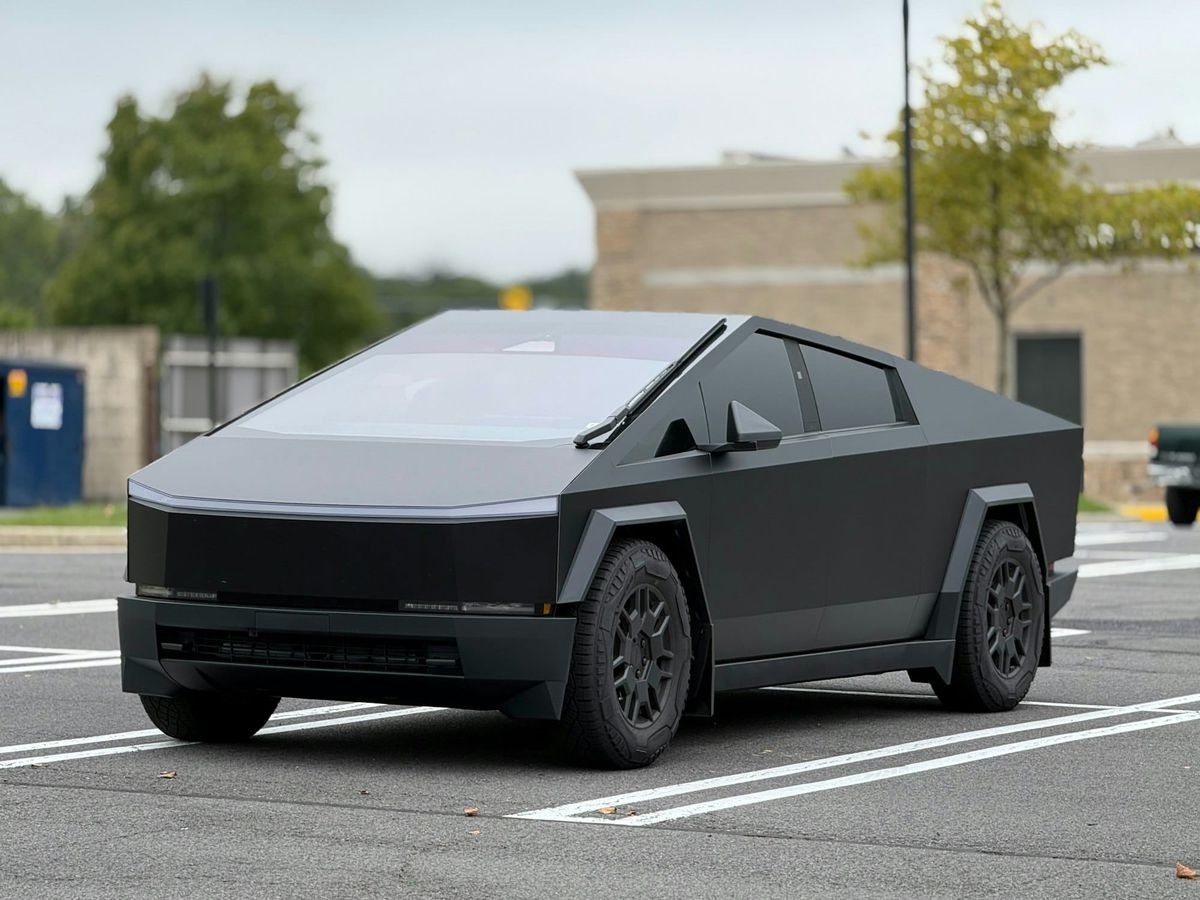
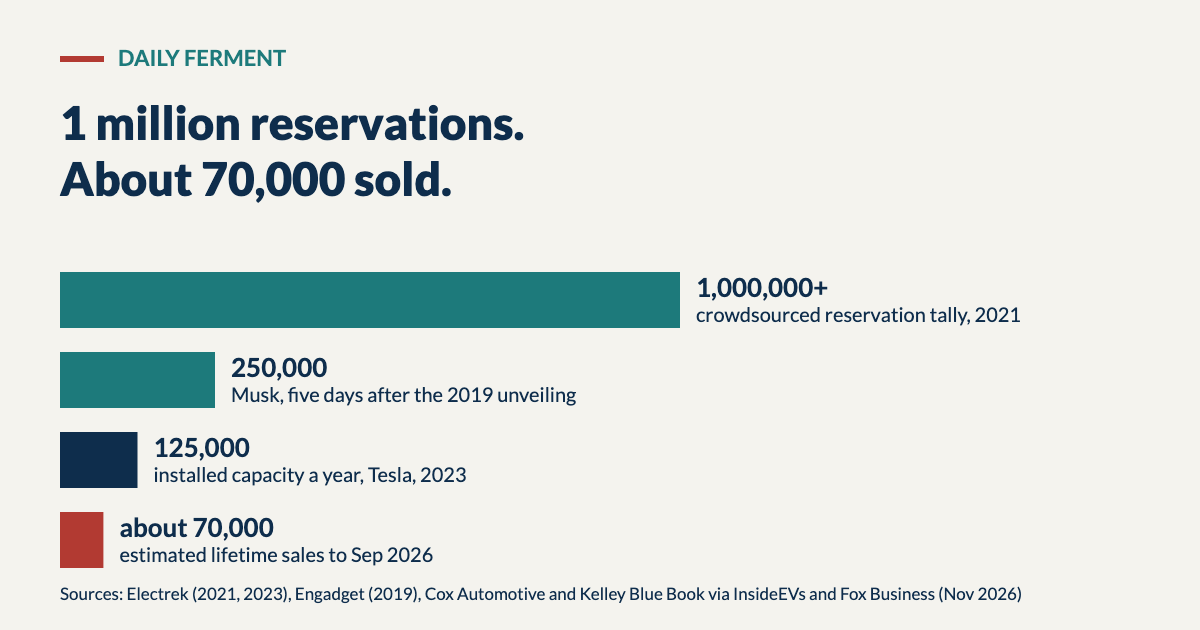
On 5 November 2026 Elon Musk wrote on X that Tesla "will be winding down production of the Cybertruck at Gigafactory Texas" around the middle of 2027, to make room for the Cybercab robotaxi. A crowdsourced tally counted over 1 million Cybertruck reservations by 2021. Industry estimates put lifetime sales at roughly 70,000 since deliveries began in late 2023. So how did a million reservations become about 7% of that in sales? My answer is that the list counted the people who chose to be counted, for a $39,900 truck that never shipped. Pollsters learned that lesson in 1936.
What did Tesla announce, and how many Cybertrucks sold?
Musk's post, as Fox Business and CBS News reported it on 6 November, said production would wind down "around the middle of next year to make room for increased Cybercab production". In a reply he called the Cybertruck the "best vehicle Tesla has ever made". Texas is the only plant that builds it.
Tesla doesn't report Cybertruck sales on their own, so the numbers are estimates. Kelley Blue Book counted 38,965 sold in the US in 2024 and 20,237 in 2025, a drop of 48%. Cox Automotive counted 11,586 from January to September 2026, according to InsideEVs. Add them and you land near the 70,000 lifetime figure. Meanwhile Tesla stopped taking orders for the cheapest trim still listed and raised the other two by $2,500.
Sources: Electrek, 2021; Kelley Blue Book via Fox Business; industry estimate and Cox Automotive via InsideEVs, 6 Nov 2026.
Where did the million reservations come from?
Not from Tesla. Five days after the November 2019 unveiling Musk tweeted "250k", and a reservation then cost $100, fully refundable, according to Engadget. For comparison, a Model 3 booking in 2016 cost $1,000. The million came later, in May 2021, from a crowdsourced Google Sheet that Electrek reported on. Tesla never published a count, or how many deposits were refunded.
Tesla planned as if the demand were real. Its results deck for the third quarter of 2023 listed installed capacity of "over 125,000 Cybertrucks" a year at Gigafactory Texas, as Electrek noted. Fox reports that Musk predicted annual sales of 250,000 once production started.
Guess first: Tesla installed capacity for over 125,000 Cybertrucks a year. In its best US year, what share of that did it sell?
About 31%. Kelley Blue Book counted 38,965 US sales in 2024, against installed capacity of over 125,000 a year. Sources: Electrek, 2023, Fox Business.
My first reaction, and why I think it was wrong
My first reaction was the obvious one: a $100 deposit you can get back is a free option, so of course the list was inflated. Make people pay real money and the number shrinks to the truth.
Then I went back to the most famous bad forecast in polling, because it has the same shape and the same easy explanation. In 1936 the Literary Digest mailed about 10 million postcard ballots and got nearly 2.4 million back. It predicted Alf Landon would beat Franklin Roosevelt 54% to 41%. Roosevelt won with about 61%. The textbook story says the Digest drew its list from car and telephone owners, who leaned Republican. Dominic Lusinchi tested that story in Social Science History in 2012 with later survey data, and found the car and phone owners favoured Roosevelt. His conclusion: "the principal cause of the 1936 Literary Digest poll fiasco was most probably nonresponse bias". The problem wasn't who got a ballot. It was who bothered to send one back.
That changes how I read the Cybertruck list. The deposit was cheap, but the bigger issue was who reserved: people who watched the truck unveiled on stage and wanted in within days. Raising the price of entry would have made the list shorter. It wouldn't have made it a sample of pickup buyers. Tesla did try a $250 deposit for one night in November 2023 and went back to $100 the next morning, Electrek reported, so there is no test of the deposit idea to look at.

The Digest's ballots were postcards. About 10 million went out and nearly 2.4 million came back, roughly one in four.
The 2.4 million who answered were not a smaller copy of the 10 million who were asked. They were the people keen enough to fill in a card and post it.
A reservation page works the same way. Anyone who saw the truck could reserve one. The count only tells you about the people who did.
The second problem: they answered a different question
The Digest at least asked about the candidates who were on the ballot. The Cybertruck reservations were a vote on a truck that started at $39,900. At the delivery event on 30 November 2023 the cheapest version shown was $60,990, and that one was promised for 2025; the all-wheel drive was $79,990 and the Cyberbeast $99,990, per The Drive. The cheapest truck on offer cost about 53% more than the one people had reserved. Today the two trims left start at $92,490.
So the reservation number had two separate faults. It counted people who chose themselves, and it counted them for a product at a price that didn't exist by the time they could buy it. Either one alone would make the number unreliable. Together they make it close to meaningless as a forecast, though it still worked as publicity.
The Literary Digest poll, 1936
- Asked about 10 million postcard ballots
- Answered nearly 2.4 million, about 24%
- Forecast Landon 54%, Roosevelt 41%
- Result Roosevelt about 61%
- Main cause who answered, not who was asked (Lusinchi, 2012)
Cybertruck reservations, 2019 to 2026
- Asked anyone who saw the November 2019 unveiling
- Answered over 1 million $100 refundable reservations, by a crowdsourced tally
- Forecast 250,000 a year (Musk); capacity over 125,000
- Result about 70,000 sold in total
- Extra fault the cheapest truck shown in 2023 cost $60,990, not $39,900
Sources: Lusinchi, Social Science History, 2012; Electrek; Fox Business; InsideEVs; The Drive.
- Nov 2019 Unveiled at $39,900 and up; Musk tweets "250k" reservations five days later
- May 2021 A crowdsourced tally passes 1 million reservations
- Oct 2023 Tesla lists installed capacity of over 125,000 a year
- 30 Nov 2023 First deliveries; the cheapest version shown is $60,990
- 2024 38,965 sold in the US, the best year
- 2025 20,237 sold in the US
- 5 Nov 2026 Musk: production winds down around the middle of 2027
Sources: Engadget, Electrek 2021, Electrek 2023, The Drive, Fox Business.
What should anyone read from a pre-order count?
Cars are just the loudest case. Waitlists, beta sign-ups, crowdfunding backers, "interested" clicks on an event, and pre-orders for a book all have the same two weaknesses. Before you build capacity on one, I'd ask two questions. Who chose to be counted, and how are they different from the people who didn't? And is the thing they signed up for the thing you will actually ship, at that price?
The 1936 lesson also points to the fix. George Gallup's poll that year used about 50,000 people, according to the Wikipedia summary, and it named Roosevelt the winner, even though Lusinchi puts its final forecast 6.8 points under Roosevelt's share of the two-party vote. A small sample chosen with care beat a huge one that chose itself. For a product, that means asking a smaller group you chose, at the real price, before you install 125,000 units of capacity. Tesla's best US year, by Kelley Blue Book's count, used about 31% of it.
I wrote earlier about the Roadster's 2017 deposits still waiting for a car, which is the same deposit model seen from the customer's side. For the other end of the curve, when buyers leave a technology instead of queueing for it, see what happens when an old technology becomes the minority.
- Established
- Musk's 5 November post as reported by Fox Business and CBS News. The Cox Automotive and Kelley Blue Book sales estimates. The 2019 and 2023 prices, the $100 deposit and the 125,000 capacity line. The Literary Digest figures and Lusinchi's finding that nonresponse, not the list, was the main cause.
- Inferred
- That self-selection and the price change explain most of the gap between reservations and sales. That the size of the deposit mattered less than who chose to reserve.
- Still a guess
- How many reservation holders actually bought a truck, and how many asked for their $100 back. Tesla never said.
A pre-order count tells you how many people chose to be counted for the product you showed them, not how many will pay for the product you ship.
More on Daily Ferment: The Roadster is back. Its 2017 deposits are still waiting. and MongoDB's CEO left for Meta. Why didn't the reassurance work?
Sources
- Fox Business, Tesla to wind down Cybertruck production at Texas factory next year to make room for Cybercab, 6 Nov 2026
- CBS News, Musk says Tesla will end Cybertruck production in 2027, 6 Nov 2026
- InsideEVs, Tesla Cybertruck production ending in 2027, CEO Elon Musk says, 6 Nov 2026
- Engadget, Tesla Cybertruck hits 250,000 pre-orders, November 2019
- Electrek, Tesla has over 1 million Cybertruck reservations, latest tally says, 25 May 2021
- Electrek, Tesla announces Cybertruck deliveries in November, claims 125,000 capacity, 18 Oct 2023
- Electrek, Tesla increases Cybertruck pre-order deposit but reverts, 28 Nov 2023
- The Drive, The promised $39,000 Tesla Cybertruck actually costs $60,990, 30 Nov 2023
- Wikipedia, The Literary Digest (1936 poll and Gallup)
- Dominic Lusinchi, "President" Landon and the 1936 Literary Digest poll: were automobile and telephone owners to blame?, Social Science History 36:1, 2012