Seven TV makers answered 17 questions on spying. Four said nothing. Salad dressing shows why silence tells you less than you think.
Seven TV makers answered 17 questions on spying and four said nothing. A lab test of 12 TVs shows why neither the answers nor the silence settle it.
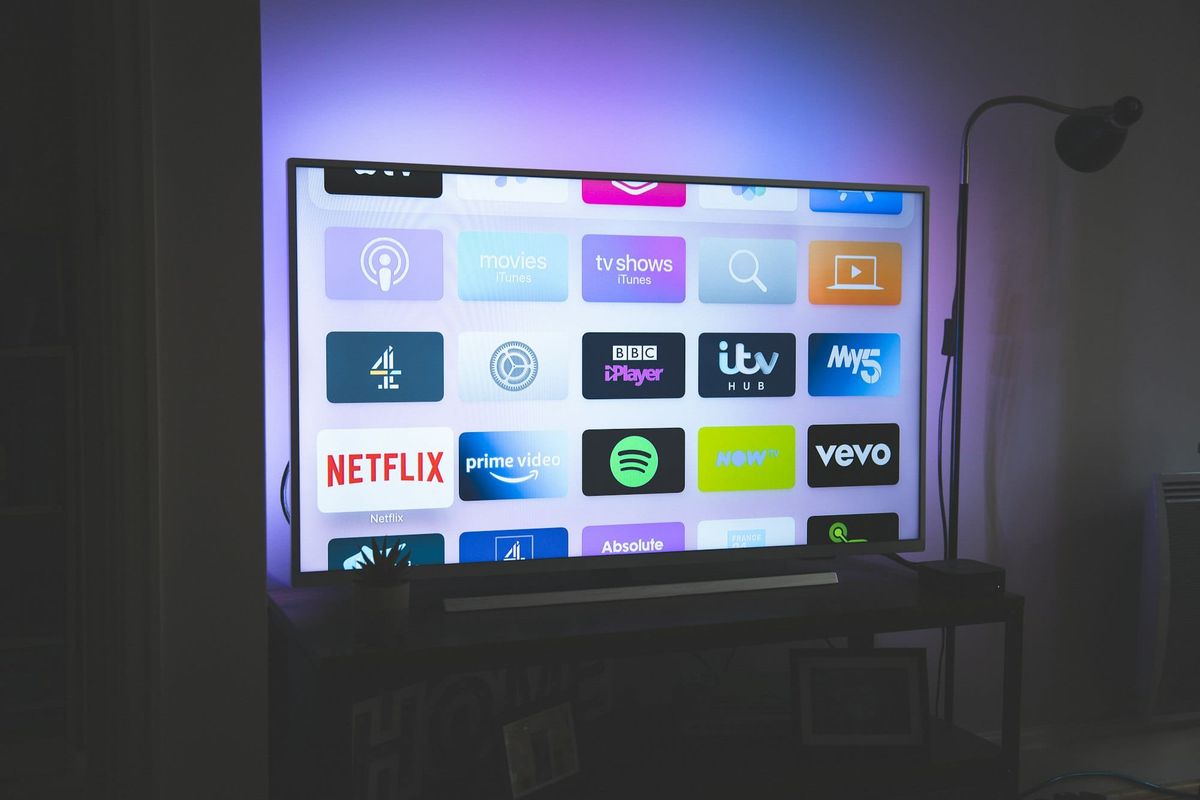
Eleven TV and streaming companies got the same 17 yes-or-no questions from John Higgins at The Verge a month ago. On Wednesday, 11 November 2026, he published what came back. Seven answered at least some of them. Hisense, Panasonic, Sony and Walmart's Vizio answered none.
So, do smart TVs spy on you? Many of them watch what's on the screen. They run automatic content recognition (ACR), which fingerprints the picture or the sound and sends it off to work out what you're watching. And switching it off doesn't always switch it off. In a Northeastern University test of 12 TVs, opting out fully worked on four of the seven TV systems that ran ACR. On Samsung, on Roku's own channel and on Vizio, traffic that looked like ACR kept going.
Sources: The Verge, 11 Nov 2026 (my count of the answers); Mammadov, Joshi, Dubois and Choffnes, Watching the Watchers, Northeastern University, PETS 2027.
That leaves a question the Verge piece can't answer on its own: what should a buyer make of the companies that said nothing?
What did the companies say, and what did they leave out?
Higgins wrote the questions as yes or no "so that companies couldn't just link to a confusing and legalese-ridden privacy policy." Amazon, Google, LG, Roku and Samsung answered all 17. TCL answered 14 and sidestepped three. Apple, whose Apple TV 4K box doesn't use ACR by its own account, gave a direct answer to 4 of the 17. Hisense, the Verge says, ignored five attempts to reach it. (The counts are mine, from the page.)
Samsung's answers were among the most reassuring. ACR is off until you turn it on, it said, and "If users opt out, the TV stops collecting new viewing data immediately".
My first reaction: assume the silent ones are the worst
Economists have a tidy result for exactly this. If a company can show a good fact about its product cheaply, it will. So the ones who stay quiet must be hiding something, and a sensible buyer should assume the worst about anyone who won't say. It's called unraveling, after papers by Sanford Grossman and Paul Milgrom in 1981. A later paper by Ginger Zhe Jin, Michael Luca and Daniel Martin sums up the theory bluntly: consumers "correctly infer the very worst from non-disclosure." No news is bad news.
By that logic I'd cross off Hisense, Panasonic, Sony and Vizio and buy from the five who answered everything.
Then I checked it against the lab test
The Northeastern study, "Watching the Watchers" by Ilgar Mammadov, Het Rutul Joshi, Daniel J. Dubois and David Choffnes, due in the Proceedings of the Privacy Enhancing Technologies Symposium 2027, didn't ask anyone anything. It ran 5,943 automated experiments on 12 TVs covering eight operating systems, which the authors put at about 95% of the US market. Every viewing scenario ran 30 times with ACR on and 30 times after opting out, in random order.
Guess first: Samsung said opting out stops collection "immediately". After opting out, in how many of 60 antenna test runs did the lab still see ACR-pattern traffic from the Samsung TV?
41 of 60. Also 18 of 30 HDMI runs and all 30 runs of Samsung's own streaming service. The traffic is encrypted, so the researchers call it consistent with ACR, not proven. Source: Watching the Watchers, Northeastern University.
Put the two lists side by side and the tidy result falls apart.
Among the silent four, Vizio fits the theory. On its SmartCast system the opt-out "had no observable effect on traffic to the identified ACR endpoint." Vizio's spokesperson told the Verge that traffic is "routine operational data", not ACR. But a Sony set running Google TV stopped cleanly when told to. A Hisense set running Google TV showed no ACR traffic at all. VIDAA OS, which the Verge says runs on Hisense and Toshiba TVs (the study tested it on a Supersonic set), also respected the opt-out. It failed a different test badly: its ACR messages went out unencrypted, and the researchers could read more than 57 million detection results from over a million other people's TVs on a server that needed no login. VIDAA has since added a login. Panasonic wasn't tested.
Among the companies that answered everything, Samsung's reassurance didn't match the lab. After opting out, traffic consistent with ACR continued in 41 of 60 antenna runs, 18 of 30 HDMI runs and all 30 runs of Samsung's own streaming service. Roku's opt-out doesn't cover Roku's own channel, which TCL's settings menu discloses and Roku's doesn't.
One caveat carries a lot of weight. The traffic is encrypted, so the researchers say they "cannot confirm the contents" and call what's left after opt-out "suspicious", not proven.
So on the opt-out test, the silent companies went one bad and two fine, and a full set of answers didn't predict behaviour either.
"We interpret the continued presence of traffic consistent with ACR tracking after opt-out as suspicious, though we cannot confirm the contents of the network traffic (due to encryption), nor whether data is processed or retained on the server side."
Mammadov, Joshi, Dubois and Choffnes, Watching the Watchers, as quoted by The Verge, 4 November 2026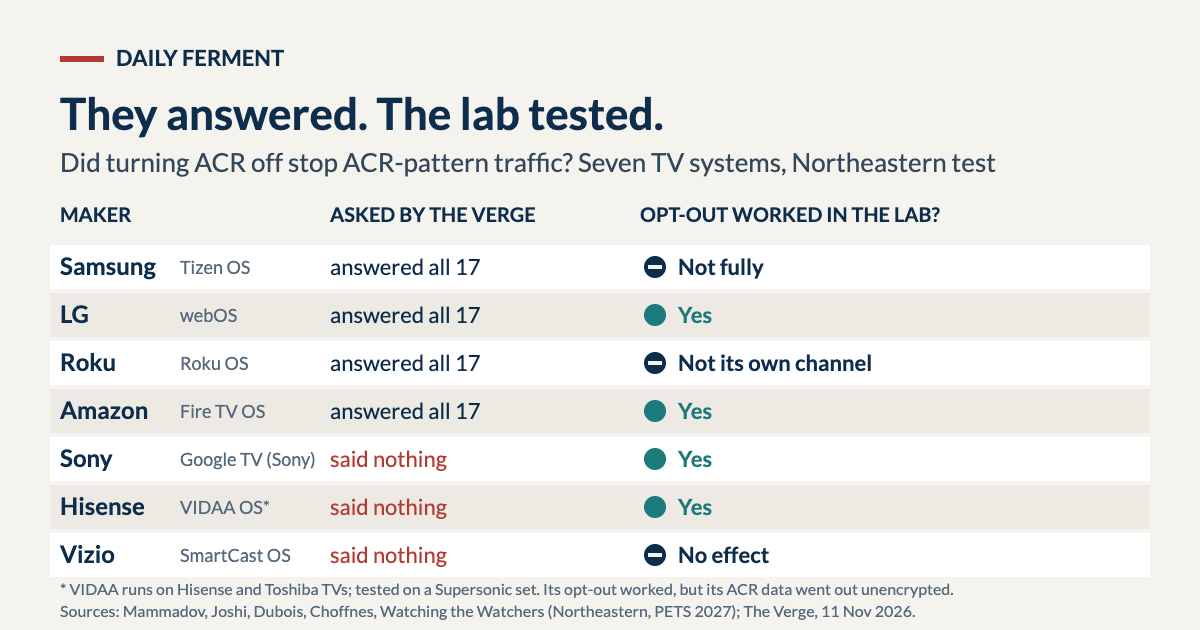
Why didn't the rule work? Look at a salad dressing shelf

Unraveling has a condition that's easy to skip. Jin, Luca and Martin state it: the result holds "as long as the information is verifiable and the costs of disclosure are small." Even in their lab, where everything could be checked, people were "insufficiently skeptical about undisclosed information."
The best real-world test I know of sits in a supermarket. Alan Mathios studied salad dressing sales before and after the US Nutrition Labeling and Education Act made nutrition labels compulsory in 1994 (Journal of Law and Economics, October 2000). Before the law, according to Cornell's summary of the paper, every low-fat dressing carried a label and most high-fat ones didn't. Silence was close to a perfect signal. Shoppers didn't read it: unlabeled high-fat dressings made up almost 75% of purchases by the least educated shoppers and almost 50% by the most educated. Once labels were required, high-fat sales fell about 5%.
Two things made the label work. It was a number anyone could read, and someone could test the bottle. A TV company's answer has neither. You can't see what your TV sends. It took a university lab, network capture gear and nearly six thousand runs to see it, and even they can't read the encrypted part.
Salad dressing, early 1990s
- Who disclosed every low-fat dressing; most high-fat ones did not
- What silence meant almost always high fat
- Did shoppers read it? no: unlabeled high-fat bottles were almost 75% of purchases by the least educated shoppers, almost 50% by the most educated
- Could it be checked? yes, a lab can test a bottle
- What changed it compulsory labels from 1994; high-fat sales fell about 5%
Smart TVs, November 2026
- Who disclosed 7 of 11 companies answered at least one question
- What silence meant mixed: Vizio's opt-out had no observable effect, Sony's and VIDAA's worked
- Did answers match? not always: Samsung's opt-out left ACR-pattern traffic
- Could it be checked? only by a lab, and not the encrypted contents
- What changed it nothing yet
Sources: Cornell Chronicle summary of Mathios, Journal of Law and Economics, Oct 2000; The Verge, 11 Nov 2026; Watching the Watchers, Northeastern University.
I wrote in September about why MongoDB's reassurance didn't work after its chief executive left for Meta: a statement that costs nothing and can't be checked moves very little. The TV answers show the other half of that. When nothing can be checked, silence doesn't move much either. It's the same gap I found with the family graph on your Mac: the data exists, and the person it's about has no way to look.
What can you do about a smart TV now?
The study's own advice is short. Disconnect the TV from the internet and watch through a streaming box that doesn't run ACR. Or turn ACR off on the systems where the opt-out worked in their tests: LG's webOS, Fire TV OS, Google TV on Sony and VIDAA OS. The researchers also published a blocklist for home network filters.
A company's answer about what its device collects is worth what someone outside can test, and when nobody can, its silence is worth about the same.
How sure am I?
- Established
- The companies' answers as the Verge printed them, and the study's figures with its own caveat about encryption.
- Inferred
- That silence carried little information here. That rests on four silent companies, three with systems the lab tested, and on traffic nobody outside can read.
- Guess
- That a compulsory, tested disclosure for TVs, like the nutrition label, would change what people buy. Nothing here tests that.
The Verge says it will add answers if the silent four reply. I'd rather read the next lab test. It's the same question I asked about whether camera locations should be public: who gets to check the thing that's watching.
More on Daily Ferment: Your Mac keeps a guess about who your family is. A 2017 exam ruling says a guess about you is yours to see. and MongoDB's CEO left for Meta. Why didn't the reassurance work?
Sources
- John Higgins, I asked every TV manufacturer 17 questions about how they spy on you, The Verge, 11 November 2026.
- Ilgar Mammadov, Het Rutul Joshi, Daniel J. Dubois and David Choffnes, Watching the Watchers: Privacy Analysis of U.S. Smart TV Automatic Content Recognition, Northeastern University, Proceedings of Privacy Enhancing Technologies Symposium 2027 (paper page).
- John Higgins, Does opting out of TV tracking work?, The Verge, 4 November 2026.
- Ginger Zhe Jin, Michael Luca and Daniel Martin, Is No News (Perceived as) Bad News? An Experimental Investigation of Information Disclosure, NBER Working Paper 21099, revised May 2018.
- Alan D. Mathios, The Impact of Mandatory Disclosure Laws on Product Choices: An Analysis of the Salad Dressing Market, Journal of Law and Economics 43(2), October 2000.
- Susan S. Lang, Mandatory nutrition labeling reduces high-fat purchases, Cornell Chronicle, 23 April 2001.