Fossil CO2 emissions are set to fall in 2026. A department store puzzle shows why the air still fills up.
Global fossil CO2 emissions are set to fall 0.4% in 2026, yet CO2 in the air still rises 2.2 ppm. A department store experiment shows why both are true.
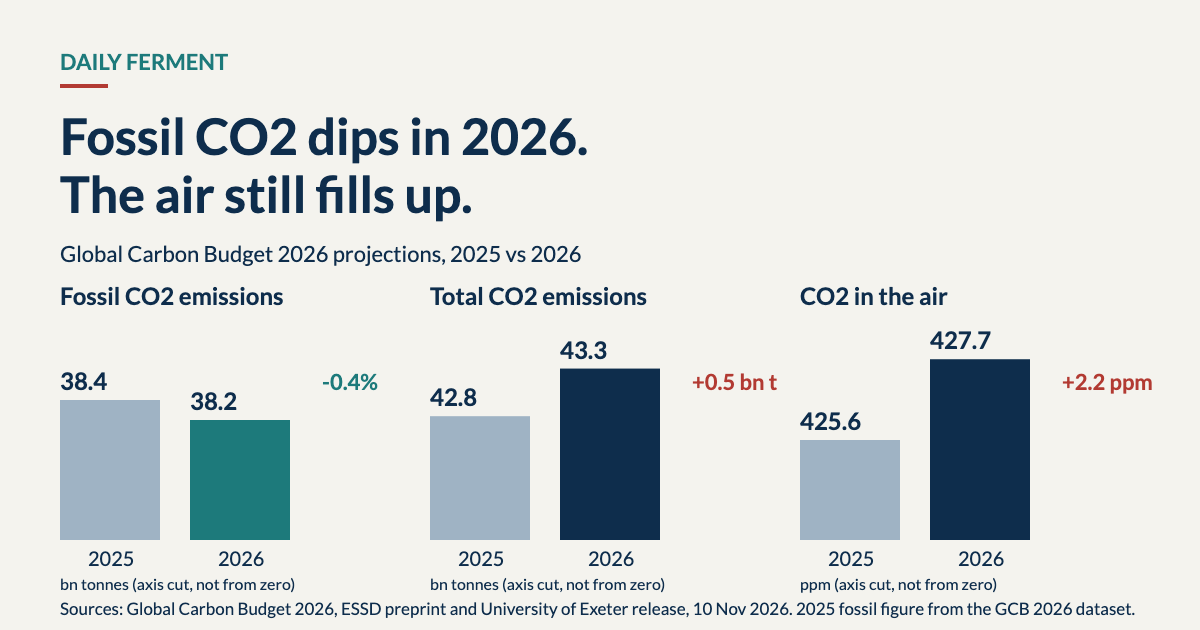
Global fossil CO2 emissions are projected to fall 0.4% in 2026, to 38.2 billion tonnes, according to the Global Carbon Budget 2026 published by the Global Carbon Project on 10 November 2026. So have global CO2 emissions peaked? Not yet, and the same report says so. Total CO2 emissions, fossil plus land-use change, are projected to rise to 43.3 billion tonnes, up from 42.8 billion tonnes in 2025. And the amount of CO2 in the atmosphere is set to climb another 2.2 parts per million, to 427.7 ppm. Emissions dipped. The level in the air kept rising.
Both headlines that ran that day were true. Why they can both be true is the most useful thing in the report, and the clearest explanation I found comes from a management school.
What did the Global Carbon Budget 2026 actually find?
The Global Carbon Budget is the yearly accounting of where humanity's CO2 comes from and where it goes, written by more than 140 scientists and led by Pierre Friedlingstein at the University of Exeter. The 2026 edition is out as a preprint in Earth System Science Data, still open for review until 17 December, alongside a paper in Nature Climate Change led by Corinne Le Quéré.
The University of Exeter release breaks the fossil number down. Oil is down 1.9%, which the team calls "likely a short-term response to the energy shock triggered by the Iran conflict." Gas is down 0.3%. Coal is up 0.6%. By country, China is projected down 0.9%, the United States down 1.3%, the European Union down 1.5%, and India up 4.4%.
Then the part the "falling emissions" headlines skip. Emissions from land-use change are projected to rise to 5.1 billion tonnes this year, driven by peat fires and forest degradation in Southeast Asia as El Niño dries the region. That rise is bigger than the fossil fall, which is why the total still goes up.
Sources: Global Carbon Budget 2026 (ESSD preprint, 10 Nov 2026); University of Exeter release, 10 Nov 2026.
My first reaction, and the check
My first reaction was relief. A fall in global fossil emissions, in a year when energy demand still grew, sounded like the turn people have been waiting for. Le Quéré's own line points that way: "A further acceleration could turn the tide on global emissions within a few years."
Then I read the quote from Glen Peters at the CICERO Center for International Climate Research, in the same release.
"A drop in emissions in one year is not a peak unless it is driven by structural change."
Glen Peters, CICERO Center for International Climate Research, University of Exeter release, 10 November 2026That's one reason to be careful: most of this year's fall is oil, and oil fell because of a war. Friedlingstein says the same thing more bluntly: "a reduction driven partly by geopolitical shocks is not a sustainable climate solution." But there's a second reason, and it holds even if the fall were entirely structural. Try this before reading on.
If the world emits slightly less CO2 in 2026 than in 2025, does the amount of CO2 in the air go down?
No. The Global Carbon Budget 2026 projects atmospheric CO2 to rise by 2.2 ppm, to 427.7 ppm, in the same year fossil emissions fall 0.4%. The air keeps filling as long as more goes in than comes out.
Why a department store explains the CO2 headline

That management school is MIT Sloan, where John Sterman built a test that has nothing to do with the atmosphere. You get a graph of how many people walked into a department store each minute over half an hour, and how many walked out. Then four questions: when did the most people enter, when did the most leave, when were the most people inside, and when were the fewest inside.
In the baseline run reported by Matthew Cronin, Cleotilde Gonzalez and Sterman in 2009, the takers were 173 graduate students in a systems course at MIT Sloan, all of whom had studied calculus. About 96% got the most-entering question right and about 95% got the most-leaving question. On the two questions about how many people were inside, only 44% and 31% did.
The flows were easy. The stock was hard. The authors call this "stock-flow failure", and they found it wasn't explained by graph reading, background knowledge, motivation or cognitive capacity. Many people use what they call a correlation heuristic: they assume the number of people inside behaves like the number coming in. So when the entrances peak, the crowd must peak. It doesn't. The crowd keeps growing for as long as more people come in than go out, and it peaks only when entries fall below exits.
Sterman had already pointed this at climate. In a 2007 paper in Climatic Change with Linda Booth Sweeney, MIT graduate students were asked about CO2, and most believed concentrations could stabilize while emissions were still higher than removal. The authors compared it to believing that "a bathtub filled faster than it drains will never overflow."
The department store task
- Inflow people walking in each minute
- Outflow people walking out each minute
- Stock people inside the store
- Common mistake "most people inside" when most walk in
- When the stock peaks when exits overtake entries
The atmosphere in 2026
- Inflow 43.3 bn t of CO2 emitted, fossil and land use
- Outflow CO2 taken up by oceans and land
- Stock CO2 in the air, 427.7 ppm
- Common mistake "emissions fell, so we've peaked"
- When the stock peaks when uptake matches emissions
Sources: Cronin, Gonzalez and Sterman, OBHDP 2009; Sterman and Booth Sweeney, Climatic Change 2007; Global Carbon Budget 2026.
That's the whole puzzle of the two headlines. "Emissions fall" is about the door. "CO2 keeps rising" is about the room.
How far would emissions have to fall before the CO2 level stops rising?
The ESSD preprint gives the 2025 accounts. Humanity emitted about 11.7 billion tonnes of carbon (42.8 billion tonnes of CO2). The ocean took up about 3.2 and the land about 3.6. About 4.4 stayed in the air.
Here is my own rough arithmetic on those numbers, not a figure from the report. About 38% of what we emitted in 2025 stayed in the atmosphere. For the level to stop climbing, the inflow has to come down to what the sinks remove. Holding the sinks where they were in 2025, that means emissions roughly a third or more lower than today. This year's projected fossil cut is 0.4%. The real sinks won't hold still, either: they respond to how much CO2 is in the air and to weather like El Niño, and the report says the land sink only recovered this year after weakening in the 2023-24 El Niño. So treat my number as a sense of scale, not a forecast.
The carbon budget makes the same point another way. It is itself a stock: 150 billion tonnes of CO2 left before warming reaches 1.5°C, which the Exeter release calls "less than four years of emissions at the current rate." And the budget counts all CO2, fossil and land use together, which went up this year. On my reading, the 0.4% fossil dip doesn't slow the draw on that account at all. I wrote about what a missed 1.5°C target can still do a few weeks ago; this report is the arithmetic underneath that argument.
So is the good news real?
Partly, and I don't want to bury it. The Nature Climate Change paper finds that 59 countries emitted less in 2025 than in 2019 while their economies grew, and that solar, wind and electric vehicles are on track to offset 64 to 79% of the emissions from new energy demand through 2028. Total CO2 emissions grew 0.3% a year over the past decade, against 1.7% a year the decade before. The inflow is flattening. That's real and it's what has to happen first.
What it isn't, yet, is a peak in the thing that warms the planet. Even a true peak in emissions would only mean the room fills more slowly. The authors' own conclusion is careful: "a sustained peak and decline in global CO2 emissions could be a few years away." If I could put one line under every headline about it, it would be this: a smaller inflow still means a rising level, just a slower one.
The El Niño part is worth watching too. This year it pushed land-use emissions up through fires in Southeast Asia, and the release expects it to hit the land sink next year. I looked at how El Niño and warming get mixed up in a single storm's numbers earlier; here it shows up on both sides of the ledger at once.
A fall in emissions is a smaller inflow, not a peak in what's in the air: the Global Carbon Budget 2026 projects fossil CO2 down 0.4% while atmospheric CO2 still rises 2.2 ppm, and on 2025's numbers emissions would have to drop by roughly a third or more before that level stopped climbing.
How sure am I?
- Established
- The Global Carbon Budget 2026 projections (fossil CO2 down 0.4%, total 43.3 billion tonnes, 427.7 ppm, 150 billion tonnes left for 1.5°C), published 10 November 2026 as a preprint still under review; the department store results (44% and 31% correct on the stock questions) from Cronin, Gonzalez and Sterman, 2009.
- Inferred
- That emissions would need to fall by roughly a third or more before CO2 in the air stopped rising. That is my arithmetic on 2025's numbers with the sinks held fixed, which they won't be.
- Guess
- Whether 2026 turns out to be the first year of a lasting decline in fossil emissions. The report's own authors say the oil drop is likely short-term.
Everything here is read from published sources, not tested firsthand.
More on Daily Ferment: We will overshoot 1.5°C. Can a missed target still do its job? and Sodium batteries are signing deals before they're cheaper. Chile's saltpeter lost the same way.
Sources
- University of Exeter, Fossil CO2 emissions decrease in 2026, Alex Morrison, 10 November 2026.
- Friedlingstein et al., Global Carbon Budget 2026, Earth System Science Data preprint essd-2026-895, 10 November 2026.
- Le Quéré et al., A further acceleration of clean energy is needed for global CO2 emissions to peak and decline, Nature Climate Change, 10 November 2026.
- Cronin, Gonzalez and Sterman, Why don't well-educated adults understand accumulation? A challenge to researchers, educators, and citizens, Organizational Behavior and Human Decision Processes 108(1), 2009 (author copy).
- Sterman and Booth Sweeney, Understanding public complacency about climate change, Climatic Change 80(3-4), 2007.