Google's AI proved the RSA-breaking sieve works as fast as everyone assumed. Gothic vaults got the same kind of proof in 1966.
Cogentic's proof matches the sieve's exponent but carries a constant of 105. On a 2048-bit key that is slower than trying every divisor.
On Wednesday 25 November Google Research posted six mathematics papers to GitHub, written, it says, by Cogentic, an agent built on Gemini 4, with no human input after the first prompt. The one people are asking about claims a proof that any whole number can be factored in time LN[1/3, 105]. Does that break RSA? No. It proves that the shape of the running time attackers already rely on, the General Number Field Sieve's, is achievable without unproven assumptions. But the proven algorithm carries a constant of 105, against about 1.92 for the sieve. On a 2048-bit key, that makes the proven version slower than trying every divisor.
Sources: Cogentic factoring paper, Google Research, 25 Nov 2026; PostQuantum.com on RSA-896, 19 Sep 2026.
What Google posted
The Cogentic folder holds ten papers so far, six of them dated 25 November. Two are about factoring: the L[1/3] result, and a deterministic one that factors without any random choices in time exp(3(ln N)3/4). Another covers discrete logarithms in finite fields of small characteristic. The rest are on game theory, graph reconstruction and the log-rank conjecture. The README credits a harness built by Yang Cai, Vineet Gupta, Yanchen Jiang, Christopher Liaw, Aranyak Mehta, Grigoris Velegkas and Di Wang, and says a full Lean 4 formalisation of the factoring proof "has also been completed and will be released in a companion submission". It isn't public yet.
The paper is clear about what it claims. For more than three decades there was a gap between what could be proved about factoring and what the fastest method actually does. Lenstra and Pomerance proved L[1/2, 1] in 1992. The number field sieve runs in L[1/3, 1.92], "but only under unproven smoothness, splitting, and full-rank heuristics." Cogentic's paper closes the exponent gap, 1/2 down to 1/3, and says so plainly. It also says it chose "transparent explicit constants (105 and 40) rather than optimizing them".
My first reaction, and the check
My first reaction was a small jolt. "Unconditional" sounds stronger than "heuristic", and 1/3 is the sieve's exponent. If the best attack just got a guarantee, shouldn't keys be worried? Then I put the numbers in. The L notation hides a constant in the exponent, and that constant matters enormously at real key sizes. This is the same lesson as with OpenAI's Lean-checked proofs: check what exactly was proved before deciding what it means.
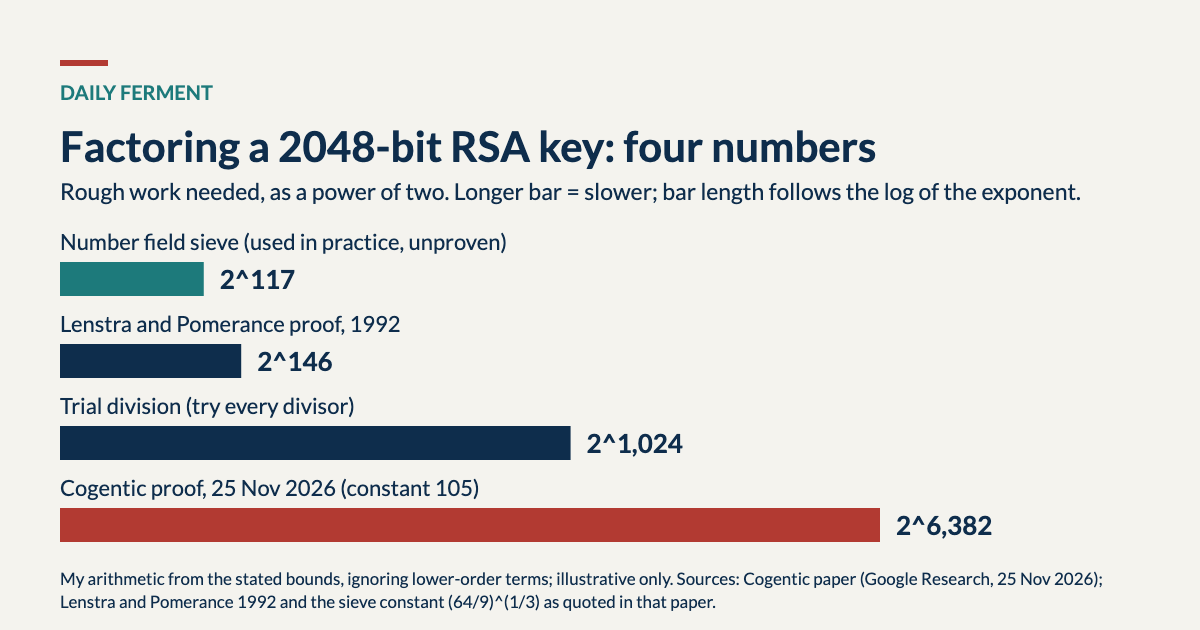
Guess first: for a 2048-bit RSA key, how much work does Cogentic's proven bound allow, written as a power of two? The sieve needs about 2^117.
About 2^6,400. Trying every possible divisor up to the square root needs only 2^1,024. My arithmetic from the stated bounds, ignoring lower-order terms. The bounds are asymptotic, so this only shows scale, not a real running time. Source for the bounds: the Cogentic paper.
How I got these numbers
LN[a, c] is exp(c (ln N)a (ln ln N)1 minus a). For a 2048-bit N, ln N is about 1,420 and (ln N)1/3(ln ln N)2/3 is about 42.2. Multiply by 1.923 and convert to base two: about 117. Multiply by 105: about 6,382. Lenstra and Pomerance's L[1/2, 1] gives about 146. The paper's definition is a limit as N grows, so plugging in one size ignores the lower-order terms. It shows scale, nothing more.
What actually moved RSA this year
Something did change for RSA in 2026, and it wasn't a proof. In February 2020 six researchers factored the 829-bit RSA-250 with the number field sieve and the open-source CADO-NFS software, using roughly 2,700 core-years. This September two teams ported the same sieve to GPUs with AI agents doing much of the work. Eric Lu of Cognition factored the 862-bit RSA-260 on 3 September; Stephen Weis of Anthropic factored the 896-bit RSA-896 on 19 September, in about ten days and roughly 30 GPU-years, according to PostQuantum.com's report. Weis said he had not meaningfully improved the sieve's running time, that RSA-2048 is unaffected, and that RSA-1024 keys are now within reach of many organisations with GPU fleets.
- 1992 Lenstra and Pomerance prove factoring in L[1/2, 1]
- 28 Feb 2020 RSA-250 (829 bits) factored with the sieve, about 2,700 core-years
- 3 Sep 2026 RSA-260 (862 bits) factored on GPUs, Cognition's Devin agent
- 19 Sep 2026 RSA-896 factored on GPUs with Claude, about 30 GPU-years
- 25 Nov 2026 Cogentic posts a proof of L[1/3, 105]
Sources: RSA-250 announcement, 2020; PostQuantum.com, 19 Sep 2026; Cogentic paper.
So the two kinds of progress point different ways. The GPU records made the old, unproven method cheaper to run. The Cogentic paper made a new, proven method that nobody would run. For anyone holding keys, only the first one matters.
The cross: Gothic vaults got their proof in 1966
Medieval builders put up vaults with what Boothby and Coronelli, below, call pre-rational techniques. Before 1966 engineers leaned on a "middle third rule": keep the line of thrust inside the middle third of the arch. In 1966 Jacques Heyman published "The Stone Skeleton" and applied the safe theorem of plasticity to masonry: "if a line of thrust can be found which is in equilibrium with the external loads and which lies wholly within the masonry, then the structure is safe."
According to a 2024 reappraisal by Thomas Boothby and Dario Coronelli, the method "allowed the profession to make sense out of many of the pre-rational techniques" of medieval building, and it is still widely used to assess old bridges and churches. It rests on three idealised assumptions: stone has no strength in tension, unlimited strength in compression, and never slides.
Heyman's proof didn't move a stone. The vaults stood before 1966 and after. What it changed is what engineers could say with certainty, and the assumptions it needed have their own limits; Boothby and Coronelli point to Milan and Reims, where crushing stress may be a real danger the theory sets aside. Cogentic's paper sits in the same place for factoring. The sieve worked before Wednesday. Now there is a guarantee of its exponent, built on an idealised machine with a constant no one would pay. The vaults didn't get stronger. RSA didn't get weaker.
Gothic vaults
- What worked in practice Pre-rational techniques, then the middle third rule
- The proof Heyman, The Stone Skeleton, 1966
- What the proof assumes No tension, unlimited compression, no sliding
- What changed on the ground Nothing stood up or fell down because of it
Factoring
- What worked in practice The number field sieve, on heuristics, since the 1990s
- The proof Cogentic, L[1/3, 105], 25 Nov 2026
- What the proof assumes An idealised Turing machine; a constant chosen for clarity
- What changed on the ground No key got easier to break
Sources: Boothby and Coronelli, Heritage, 2024; Cogentic paper, 2026.
Is RSA-2048 still secure?
As far as this paper goes, yes, exactly as secure as it was on Tuesday. What would change that is a cheaper attack: a better constant or exponent for a method someone can run, more hardware for the sieve, or a working quantum computer. Scott Aaronson wrote on 25 November that he had heard from sources he trusts that AI labs may hold results bearing on deployed cryptography, and in the same post said he was much less sure what they are and didn't want to spread rumours. I have nothing to add to a rumour. If you still have 1024-bit RSA keys anywhere, the September records are the reason to retire them, not this paper.
A proof that an attack works as fast as everyone already assumed changes what is known, not what is safe; keys get weaker when attacks get cheaper, and this paper made nothing cheaper.
How sure am I?
- Established
- What the paper and README state: the bounds, the constants, the earlier results it cites, and that the Lean files aren't released yet. The RSA-250 record.
- Inferred
- The power-of-two figures, which apply asymptotic bounds to one key size, and the RSA-896 details, which I read in a secondary report.
- Guess
- That the proof holds up once the Lean formalisation is public. I can't check it myself. If it fails, I'll say so here.
This is the second machine-made proof I've written about this week, after the Riemann hypothesis with Claude. The pattern so far is the same each time: the proof arrives first, and working out what it changes takes longer.
More on Daily Ferment: NIST's curve seeds were timestamps. No record said so. and Eight certificate keys could be guessed in 256 tries
Sources
- Google Research: Cogentic research papers (GitHub, accessed 26 Nov 2026)
- Cogentic: Unconditional Integer Factorization in Time L_N[1/3, O(1)] (25 Nov 2026), README and paper
- Boudot, Gaudry, Guillevic, Heninger, Thomé, Zimmermann: Factorization of RSA-250 (28 Feb 2020)
- Marin Ivezic, PostQuantum.com: RSA-896 Factored With Claude on Spare GPUs, 16 Days After RSA-260 (19 Sep 2026)
- Thomas E. Boothby and Dario Coronelli: The Stone Skeleton: A Reappraisal, Heritage 7(5), 2024
- Scott Aaronson, Shtetl-Optimized (25 Nov 2026)