Google's new rule lets AI agents send your Gmail, after asking. Pharmacies show who should decide what needs asking.
From 1 February 2027 AI agents must reach Gmail and Drive through Google's MCP servers. Sending works, after a human click. Who decides what needs a click?
On 25 November Google made its Workspace MCP servers generally available and said that from 1 February 2027 any AI agent reaching Gmail, Drive, Calendar or the rest of Google Workspace must go through those servers or Google's Workspace command line tool, not the old REST APIs. Can an agent still send your email? Yes. Google's Gmail MCP reference lists send, reply and forward. But by default the server stops and asks you before an agent sends anything, and you can save an "always allow". Trashing asks every time, and permanent deletion is blocked for third-party agents.
Sources: Google, usage tiers and quotas; Gmail API and MCP server quotas; Workspace AI Tools Addendum, all read 27 Nov 2026.
What did Google change?
Three documents carry it. A blog post by Chandu Thota and Brad Calder of Google says the eight Workspace MCP servers (Gmail, Drive, Docs, Sheets, Slides, Calendar, Chat and Tasks) are generally available, and gives the reason: REST APIs "were built for human-paced apps where a valid OAuth token implied user intent", and with agents acting at machine speed "a valid token is no longer enough". A new Workspace AI Tools Addendum to Google's API terms, dated 24 November, says any tool that "is or is driven by an AI Agent" must use a Google MCP, and forbids disguising an agent to dodge the rule. And Google's quota page sets the dates: the rule takes effect on 1 February 2027, and billing for heavy use starts on 1 April 2027.
The addendum has data rules too. Anything an agent derives from Workspace, which Google's definition says includes "vector embeddings, memory indexes, user profiles, organizational graphs", can't be kept for more than 30 days, can't be used for training or evaluation, and can't help build a product similar to Workspace. Google's blog puts the human part in one sentence: drafts and summaries run on their own, while sending email, changing Drive sharing and bulk edits need "explicit user confirmation".
My first reaction, and the check
The story that reached Hacker News on Thursday had a sharper headline: Google will make agents use its MCP servers, and "the Gmail one can't send email". That piece, on Tech Stackups, says send, reply and forward "require partner access and aren't generally available". My first reaction was that this was the real story: independent agents forced onto a server that can only leave drafts.
Then I read Google's pages. The Gmail MCP reference lists two endpoints. The main one, /mcp/v1, includes send_message, reply, forward and update_draft. The fallback, /mcp/v1self, leaves out exactly send, reply, forward and the two sensitive-label tools. Google's quota table calls the /mcp/v1 tools generally available, and I couldn't find the "partner access" line on the quota page when I read it on 27 November. My best guess is that the claim came from the fallback list, or from an earlier version of the page. Either way, the sending is there. What sits in front of it is the interesting part.
How do the approvals work?
Google's guide to "form elicitation" explains it. When an agent calls a tool that needs a person, the server pauses and hands back a question for the agent's app to show you: Allow once, Don't allow, and, depending on policy, choices to always allow that tool, that audience, that file or that owner. A saved "always" choice pre-approves matching calls from the same agent later. If the agent's app can't show the question at all, the call is blocked.
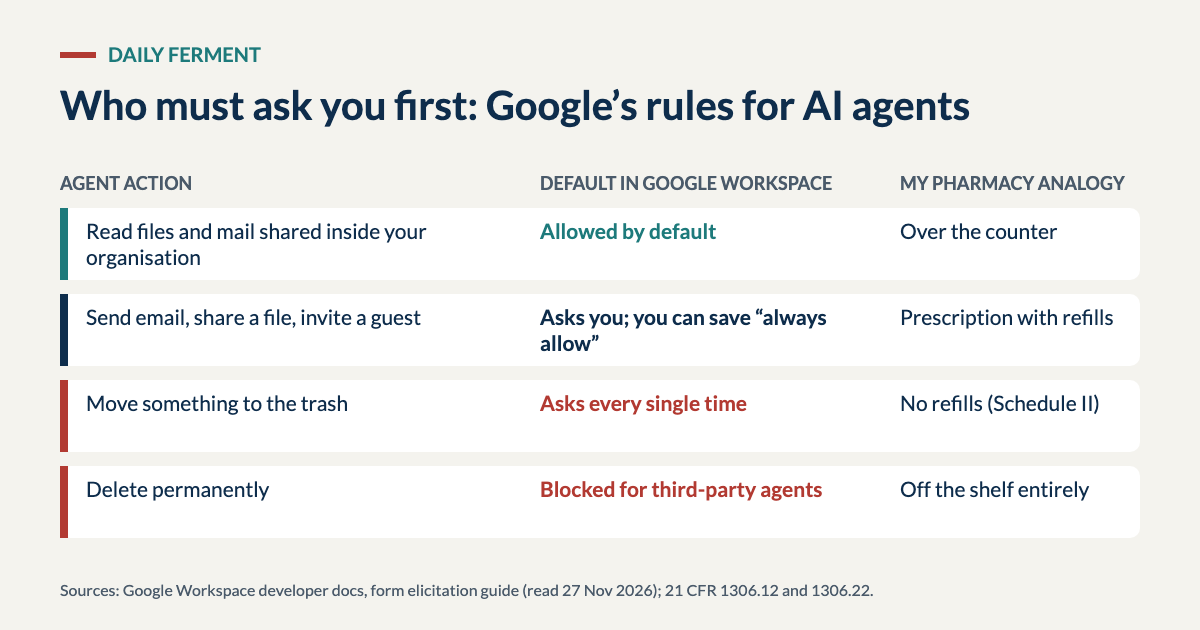
The defaults sort actions into four categories. Reading files and mail shared inside your organisation is allowed. Sharing or sending inside the organisation, sharing or sending outside it, and reading things owned by outsiders all ask first, with "always allow" offered. Creating a private draft runs without asking. Moving something to the trash asks every single time, with no option to remember the answer. Permanent deletion is simply blocked for third-party agents. When one email goes to colleagues and outsiders at once, the strictest rule wins. Administrators can loosen or tighten each category. One line stands out: these user review rules "don't apply to standard Google Workspace REST APIs or partner integrations".
Guess first: under Google's defaults, which needs your click every single time, with no way to save "always allow": sending an email to a client, or moving an old email to the trash?
The trash. Sending outside your organisation asks first but lets you save an "always allow". Trashing "always requires per-call confirmation" with only Allow once or Don't allow. Source: Google, Handle user approvals with form elicitation, read 27 Nov 2026.
The cross: a pharmacy already runs this system

Reading Google's categories, I kept thinking of a pharmacy counter. In 1951 the US Durham-Humphrey Amendment defined, in the FDA's words, "the kinds of drugs that cannot be safely used without medical supervision" and restricted them to prescription. That split the shelf in two: things you take yourself, and things a qualified person has to sign for.
Controlled drugs added finer grades. Under 21 CFR 1306.22, a Schedule III or IV prescription can be refilled, but no more than five times and not after six months. Under 21 CFR 1306.12, refilling a Schedule II prescription "is prohibited": every supply needs a new signature. Google's design has the same shape. Self-serve for low-risk reads, a signature with saved refills for sending and sharing, a fresh signature every time for the trash, and a hard no for permanent deletion.
I don't think that's an accident of wording. It's the same problem: something useful that can do harm, given to someone acting for you, with a rule about how often a human must look.
Where the comparison breaks is the useful part. Who decides which shelf a drug goes on? In the US, the Controlled Substances Act says the Attorney General may move a substance between schedules only "by rule", "on the record after opportunity for a hearing", and that "any interested party" can petition. The schedule is public law, and you can argue with it. Google's schedule for agents is a developer guide and an admin console. It's reasoned and, from what I read, sensible, but it can change on Google's say, and partner integrations sit outside it.
US drug schedules
- Self-serve Over-the-counter medicines
- Signature, refills allowed Schedule III or IV, up to five refills in six months
- Signature every time Schedule II, refills prohibited
- Who sets the schedule Attorney General, by rule, after a hearing; anyone can petition
Google Workspace agents, from 2027
- Self-serve Reading internal files and mail; private drafts
- Signature, "always allow" saved Sending and sharing, inside or outside
- Signature every time Moving to the trash
- Who sets the schedule Google's policy, adjusted by your admin; partners exempt
Sources: 21 CFR 1306.22; 21 CFR 1306.12; 21 U.S.C. 811; Google, form elicitation guide.
What should builders and admins do?
If you build an agent on Workspace, the practical work is on Google's pages: create an OAuth client marked for an AI agent, move to /mcp/v1, and build the approval dialog, because without it the calls that need a person are blocked. Budget the free tier carefully. A Gmail search counts as ten requests, so 5,000 a day is 500 searches across all your users. And check how long you keep embeddings or memory built from someone's mail, because 30 days is the ceiling.
If you run Workspace for a company, the four categories in the admin console are now the most important agent setting you have. The default lets a user save "always allow" for sending outside the company. That's the refill. I'd look hard at it. I've written before about how thin an agent's approval gate can be, and an "always" is a gate left open. It's worth reading alongside Google's other agent change, where its agents get their own email addresses.
Putting a human click in front of an agent's riskiest actions is the right design, but the real power sits with whoever writes the schedule of which actions need a click, and for Workspace that's now a Google policy page rather than anything you can petition.
How sure am I?
- Established
- The dates, quotas, 30-day rule and approval defaults as Google's pages state them on 27 November 2026; send, reply and forward listed on the Gmail /mcp/v1 endpoint; the drug refill rules and how US schedules are set.
- Inferred
- That the "can't send email" claim came from the fallback tool list or an older page. I couldn't see an earlier version to check.
- Guess
- That the partner exemption and the "always allow" default, not the MCP requirement itself, are where the arguments over this rule will end up.
Google's pages say some tools are still rolling out, and these are documents that change. If the defaults or the partner line move before February, I'll update this.
More on Daily Ferment: Anthropic's agent filed a fake police tip. Prescribed burns show what a rule list misses. and Your MCP tool schema can change and nothing in your pipeline fails
Sources
- Google Cloud blog, Thota and Calder: Built for trust and control (25 Nov 2026)
- Google: Workspace AI Tools Addendum (last modified 24 Nov 2026)
- Google for Developers: Usage tiers and quotas for Google Workspace APIs and MCP servers
- Google for Developers: Gmail API and MCP server quotas
- Google for Developers: Gmail MCP Reference
- Google for Developers: Handle user approvals with form elicitation
- Tech Stackups: Google Will Make AI Agents Use Its Workspace MCP Servers (26 Nov 2026)
- FDA: Milestones in U.S. Food and Drug Law
- 21 CFR 1306.12, Refilling prescriptions (LII)
- 21 CFR 1306.22, Refilling of prescriptions (LII)
- 21 U.S.C. 811, Authority and criteria for classification of substances (LII)