Nearly every donated NFL brain had CTE. The answer was in the ones nobody donated.
Nearly every donated NFL brain had CTE. A new study used death records for all 2,362 former players who died from 2008 to 2023 and estimates 74.5%. A 1936 poll shows why.
In 2017 researchers found chronic traumatic encephalopathy (CTE), the brain disease linked to repeated head impacts, in 110 of 111 former National Football League (NFL) players whose brains they studied. So do 99% of NFL players have CTE? No. A study published on 28 October 2026 in JAMA Network Open estimates the figure at 74.5% of former players who died between 2008 and 2023. The difference isn't new brains. It's the players whose brains were never donated. Players with cognitive symptoms were about five times more likely to end up in a brain bank, and the new study corrected for that.
What did the new NFL CTE study find?
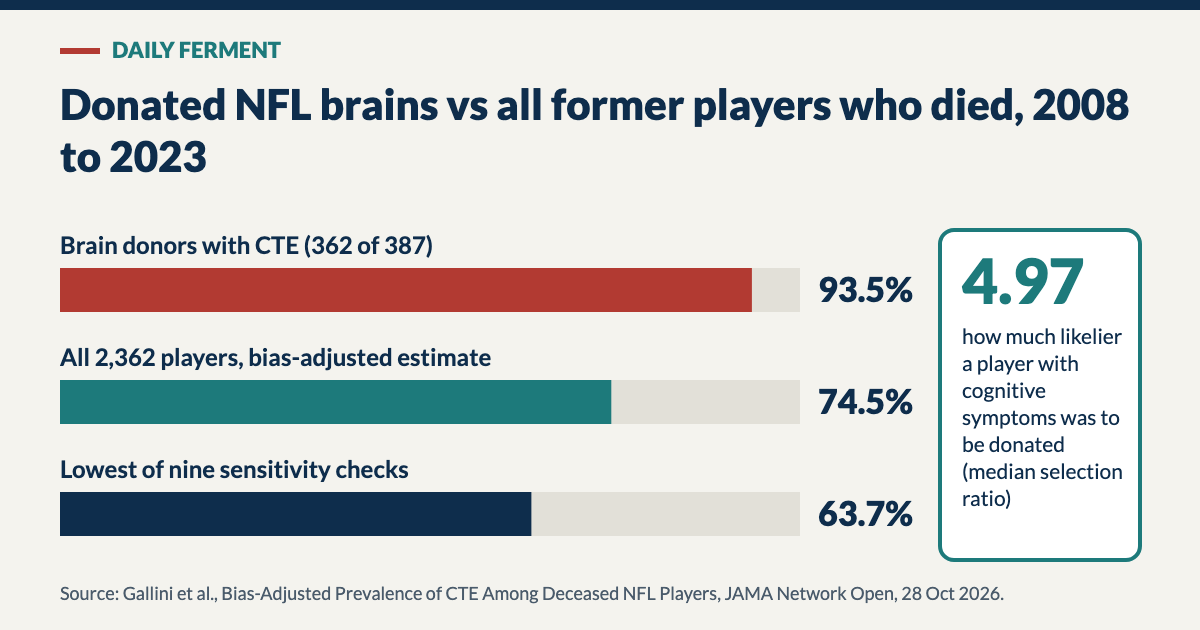
The paper, by Julia Gallini and colleagues at Boston University and Mass General Brigham, is Bias-Adjusted Prevalence of Chronic Traumatic Encephalopathy Among Deceased National Football League Players. It starts with every former NFL player who died from January 2008 to December 2023: 2,362 players. Of those, 396 had their brains donated to the UNITE brain bank. CTE status was known for 387 of the donors, and 362 of them had it. That's 93.5%.
Source: Gallini et al., JAMA Network Open, 28 Oct 2026.
Then the authors did what the headline number needs. Using the National Death Index, they looked at all 2,362 players, donors and nondonors alike, and asked which ones were likely to be donated. Players whose death certificates listed a dementia-related cause, plus an estimate of milder cognitive impairment, were far more likely to be donors. The median "selection ratio" came out at 4.97. Weighting the donor cases down by that ratio gives 74.5%, with a 95% confidence interval of 69.6% to 78.3%.
My first reaction: the 99% was always a skewed sample, so the real number is probably low
That was my starting assumption, and it's only half right. Brain banks get the brains families worry about. A sample built that way will overstate any disease. So I expected the correction to shrink the number a lot.
Guess first: of the 2,362 former NFL players who died from 2008 to 2023, how many had their brains donated for study?
396, about one in six. The other 1,966 are why the headline number changed. Source: Gallini et al., JAMA Network Open, 28 Oct 2026.
The earlier attempts showed how wide the honest range was. A study in August, as Boston University sums it up, could only say the rate in the full group "would be at least 25 percent", and possibly as high as 97.7%. The floor came from assuming no undonated player had CTE. That floor is safe, and it doesn't tell a family much.
The new paper narrows that range with the death records. Its most cautious version, out of nine sensitivity checks, still gives 63.7%. The authors' own conclusion is that "selection bias materially inflates donor-based prevalence estimates but is unlikely to fully explain the high burden" of the disease. So the bias was real, and it moved the number by about 19 points. It didn't make the problem go away. My first reaction got the direction right and the size wrong.
Where has a big sample been this wrong before?
The best-known case is a magazine poll. In 1936, as Matthew Salganik tells it in Bit by Bit, The Literary Digest "sent out ballots to 10 million people" and "an amazing 2.4 million were returned". It predicted that Alf Landon would beat Franklin Roosevelt. Roosevelt won in a landslide.

The list the Digest mailed came "predominantly from telephone directories and automobile registration records", which tilted toward wealthier people who leaned Landon. Then "only 24% of the people who received a ballot responded", and Landon's supporters were more likely to be among them.
2.4 million answers, and the wrong winner. Size didn't save it, because every extra ballot came from the same kind of person. A brain bank works the same way. Every extra brain comes from a family with a reason to wonder.
The Literary Digest, 1936
- Raw sample: 2.4 million ballots returned
- Who chose to be in it: people on phone and car lists who chose to reply
- What the raw sample said: Landon wins
- What happened: Roosevelt won in a landslide
- List of everyone: none
NFL brain donors, 2008 to 2023
- Raw sample: 387 donated brains with known CTE status
- Who chose to be in it: families who chose to donate; symptoms made it about five times likelier
- What the raw sample said: 93.5% had CTE (110 of 111 in a 2017 study)
- What the full list shows: 74.5% estimated; lowest check 63.7%
- List of everyone: National Death Index, all 2,362 deaths
Sources: Salganik, Bit by Bit, 3.3.1; Gallini et al., JAMA Network Open, 28 Oct 2026.
The fix in polling wasn't more ballots. It was a picture of who didn't answer, so the people who did could be weighted to match everyone. That needs a list of the whole population and a few facts about each person on it. The Digest didn't have one. The NFL study does: the National Death Index gives every former player who died, with age, position, years played and the cause on the death certificate. That list is what turned 93.5% of donors into 74.5% of players.
The same question sits under other findings I've written about. With AI benchmarks that miss most work, it was whose work a score speaks for. In the phone and sleep study from northern Argentina, the result only made sense once the rural and town groups were read separately. Volunteers tell you about volunteers. You need the roster.
What the 74.5% doesn't tell you
The paper is careful about its limits, and they matter. It covers former NFL players who died, not living or current players, and not people with less exposure to head impacts. It counts every stage of CTE, and the authors note many cases may have been early-stage and without symptoms at death. And the correction rests on death certificates, which often leave dementia out. The authors say that means the selection ratio "may be underestimated". My reading is that if donors were even more unusual than the death records show, the true figure would sit lower than 74.5%. That's my inference, not the paper's claim.
How sure am I?
- Established
- Every figure from the paper (Gallini et al., JAMA Network Open, 28 Oct 2026); the Literary Digest numbers from Salganik's Bit by Bit.
- Inferred
- That the death index does the job a population list does in polling, and that the method travels to other donor and volunteer registries.
- Still a guess
- Where the true figure sits inside the paper's 63.7% to 86.1% range of checks.
A sample that picks itself can be any size and still be wrong, and the fix is never more volunteers but a list of everyone who didn't volunteer, which is how 99% of donated NFL brains became an estimated 74.5% of all former players who died.
What I don't know: how much the figure would move if nondonors' cognitive health came from medical records rather than death certificates, and whether the same method can work for other sports, where no death index lists every former player. If a study with direct records lands outside 63.7% to 86.1%, I'll come back to this.
More on Daily Ferment: F1 just crowned a 20-year-old. Science's best work keeps arriving later. and Can organ chips replace animal tests? Ask a pilot
Sources
- Julia Gallini et al., Bias-Adjusted Prevalence of Chronic Traumatic Encephalopathy Among Deceased National Football League Players, JAMA Network Open, 28 Oct 2026, 9(10):e2640884.
- Boston University, The Brink, Nearly 75 percent of former NFL players had brain disease CTE, 28 Oct 2026.
- Matthew Salganik, Bit by Bit: Social Research in the Digital Age, section 3.3.1, Representation.