Google says schools can't have Search without AI. Microsoft said that about Internet Explorer.
Google says K-12 schools that switch AI off lose Google Search too, because the two are "deeply integrated". Its own Web filter, public since May 2024, says they can be split.

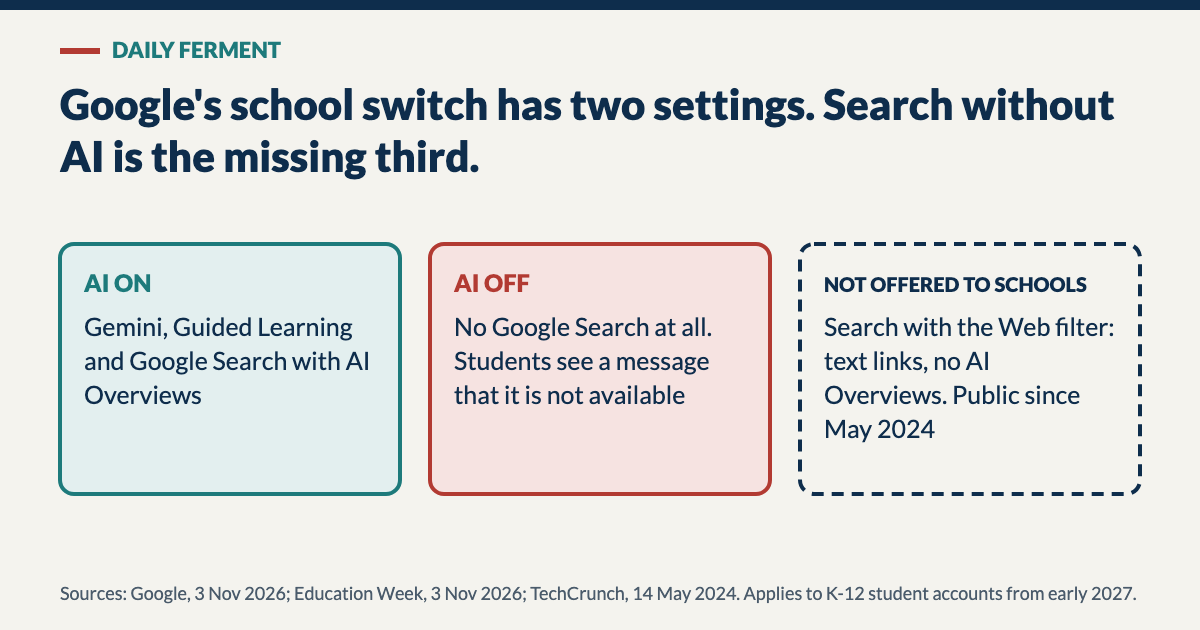
On 3 November 2026 Google said that from early next year its AI tools, Gemini, Gemini Notebook and Gemini in Classroom, will be off for K-12 student accounts until a school turns them on. Google Search sits in the same switch. A school that wants no AI at all loses Google Search for its students. So can you use Google Search without AI? Anyone can, today: Google has offered a "Web" filter that shows only text links since May 2024. School accounts are the exception. The separation exists. Google just isn't offering it to schools.
What did Google announce?
The announcement came in a post by Chris Phillips, Google's vice president and general manager for education. Access to Gemini, Gemini Notebook, Gemini in Classroom and Google Search "will be entirely off for K-12 student accounts" until administrators "explicitly turn them on". Google's stated reason is that schools asked for it: "We believe schools should have control over AI in their classrooms."
The catch wasn't in the blog post. Phillips explained it to The New York Times. If a school has switched AI off, its students "will not have access to search, and they'll see a message from their school that indicates it's not available." His reason was short.
"Search and AI are deeply integrated."
Chris Phillips, vice president for education at Google, to The New York Times, 3 Nov 2026Education Week describes the choices. Schools can turn on Gemini, Search or both, set them by grade, and limit students to Guided Learning, an AI coach that walks through a problem instead of handing over the answer. What they can't pick is Search without the AI summaries. That matters most to districts like New York City and Los Angeles, which restricted student AI this autumn. Forbes puts them at 1.4 million students between them. Los Angeles had hoped to keep Search with AI Overviews turned off.
- 14 May 2024 Google launches the "Web" filter: text links only.
- 5 Aug 2024 Judge Amit Mehta finds Google monopolised general search.
- Aug 2026 Google turns AI features on by default in Classroom for schools that allowed Gemini.
- Sep 2026 New York City and Los Angeles restrict student access to generative AI.
- 3 Nov 2026 Google: AI and Search off by default for K-12 students; no AI means no Search.
- Early 2027 The change takes effect.
Sources: TechCrunch, 14 May 2024; Covington, Aug 2024; The New York Times, 3 Nov 2026; Google, 3 Nov 2026.
My first reaction: this is just tying
That was it, almost word for word. A company with the search engine everyone needs makes you take the AI it wants you to use. Plenty of people said the same. New York City's mayor, Zohran Mamdani, told CBS News that Google is "trying to use its monopoly power to force AI into our public schools."
But "tying" is a conclusion, and I wanted to check the claim underneath it first. Google's case is that this isn't a bundle, it's one product: the AI is part of how Search works now. If that's true, there's nothing to separate. So the question I'd ask isn't whether Google is being pushy. It's whether Search without AI is something Google can't build, or something it already ships.
Guess first: Google says Search and AI are too integrated to split for school accounts. When did it launch a Search filter that shows only text links?
May 2024, at Google I/O. In Google's words the "Web" filter "shows only text-based links". Proton's June 2026 guide says choosing it means "your results will reload without AI Overview". Sources: TechCrunch, 14 May 2024; Proton, 3 Jun 2026.
It ships it. At Google I/O in May 2024, as TechCrunch reported, Google added a "Web" filter that, in its own words, "shows only text-based links". Proton's guide from June 2026 says choosing it means "your results will reload without AI Overview", and adding udm=14 to the address does the same thing by default. Schools have found their own workarounds. Education Week says Fairfax County Public Schools is testing a Chrome extension that hides AI Overviews, and a filtering company already sells a block for AI content in Google results.
So the claim that Search and AI can't be pulled apart holds for the school switch Google designed, not for Search itself. That's a narrower claim, and it has been tested in court before.
Where have we heard "too integrated to separate"?
Microsoft, in the late 1990s. Microsoft said Internet Explorer was part of Windows, not a separate product sold alongside it. The courts looked at how that integration was built. In the D.C. Circuit's own summary of its 2001 ruling in United States v. Microsoft, Microsoft "excluded IE from the 'Add/Remove Programs' utility" and "commingled in the same file code related to browsing and code used by the operating system."

The court held that those two acts had "no offsetting justification" and were exclusionary conduct in breach of section 2 of the Sherman Act. On the wider tying claim it didn't rule integration illegal at all. It sent the claim back "to apply the rule of reason rather than the rule of per se illegality", which means looking at what the design did and why.
That's the part I find useful. The question wasn't whether a browser could live inside an operating system. It was whether customers were stopped from taking it out, and whether Microsoft had a reason for stopping them.
Microsoft, 1990s to 2001
- What it wanted to spread: Internet Explorer
- What customers already needed: Windows
- The claim: the browser is part of the operating system
- Could it be separated: IE was kept out of Add/Remove Programs and its code commingled with the OS
- What was decided: those two acts exclusionary; tying sent back for the rule of reason
Google, 2026
- What it wants to spread: Gemini, AI Overviews, Guided Learning
- What schools already need: Google Search
- The claim: "Search and AI are deeply integrated"
- Could it be separated: the public Web filter has shown text links only since May 2024
- What was decided: nothing yet; the change lands in early 2027
Sources: D.C. Circuit, Massachusetts v. Microsoft, 30 Jun 2004, summarising 253 F.3d 34 (2001); Google, 3 Nov 2026; The New York Times, 3 Nov 2026; TechCrunch, 14 May 2024.
So is Google doing what Microsoft did?
Not exactly, and the differences cut in Google's favour. Microsoft took away a way out. Google is adding one: until now there was no off switch for AI on student accounts, and in August Google had turned AI features on by default in Classroom. Schools get more control in 2027 than they have today. Google can also argue that Guided Learning was built for students, and that a search engine without its newest features is a worse product.
The parallel is narrower than "Google is the new Microsoft". It's about the test. The court didn't ask whether the browser and the operating system were integrated. It asked whether the design choices that stopped customers separating them had a reason behind them. Google has already answered that question for its consumer product, by building the Web filter. It hasn't explained, as Education Week notes, why that same option can't be a school setting.
This matters more because of who Google is in search. In August 2024 Judge Amit Mehta found that Google holds a monopoly in general search, with a share around 90%. I wrote last week that Search has fallen below half of Alphabet's revenue while still growing. A pattern runs through Google's AI products too: the switch you're given covers less than you'd expect, as it did when Discord put public chats on Google and the opt-out didn't reach the summaries.
My view, and it is only mine: the fair version of this policy is three settings, not two. AI on, AI off with plain Search, and nothing. Google already has the second one built.
How sure am I?
- Established
- What Google announced and the quotes, from Google's post and the reports of 3 Nov 2026; the Web filter launch in May 2024; the Microsoft rulings as the D.C. Circuit summarised them.
- Inferred
- That the Web filter shows the separation is a product choice for school accounts, not a technical limit.
- Still a guess
- Whether Google adds an AI-free Search setting for schools before early 2027.
When a company says two products are too integrated to separate, the useful test is whether it already separates them somewhere else, and Google already does, in the Web filter it gave every user in May 2024.
What I don't know: whether the school setting applies outside the United States (neither Google's post nor the reports I read say), whether Google adds plain Search for schools before the change lands, and how the Web filter behaves on a managed student account. If Google ships an AI-off Search setting for schools, this piece is out of date and I'll say so.
More on Daily Ferment: A judge says Google never made publishers a deal. Now it picks who gets one. and Google will pay for AI answers. It won't show the meter.
Sources
- Chris Phillips, Google, Designing responsible AI for learning, 3 Nov 2026.
- Dana Goldstein and Natasha Singer, The New York Times, Google will turn off search for schools that reject AI, via The Philadelphia Inquirer, 3 Nov 2026.
- Grace Jiang, Education Week, Google's new rules hand schools hard choices about AI and search, 3 Nov 2026.
- CBS News, Google will block search access for schools that ban AI use, 3 Nov 2026.
- Mary Whitfill Roeloffs, Forbes, Google will cut off search engine access to schools banning generative AI, 3 Nov 2026.
- TechCrunch, Google adds Web search filter for showing old-school text links as AI rolls out, 14 May 2024.
- Proton, How to turn off Google AI on Search, 3 Jun 2026.
- US Court of Appeals for the D.C. Circuit, Massachusetts v. Microsoft, Nos. 02-7155 and 03-5030, 30 Jun 2004, summarising United States v. Microsoft, 253 F.3d 34 (2001).
- Covington & Burling, D.C. District Court finds Google monopolized markets for online search and search text advertising, Aug 2024.