Toyota, Nissan and Honda will share one spec for steel, plastic and wire colours. Fire hydrants show why agreeing is the easy part.
Japan's automakers will share specs for steel, resin and wire colours, and each decides whether to use them. US cities agreed on one fire hydrant thread in 1905; by 2004, 18 of the 48 largest had it.
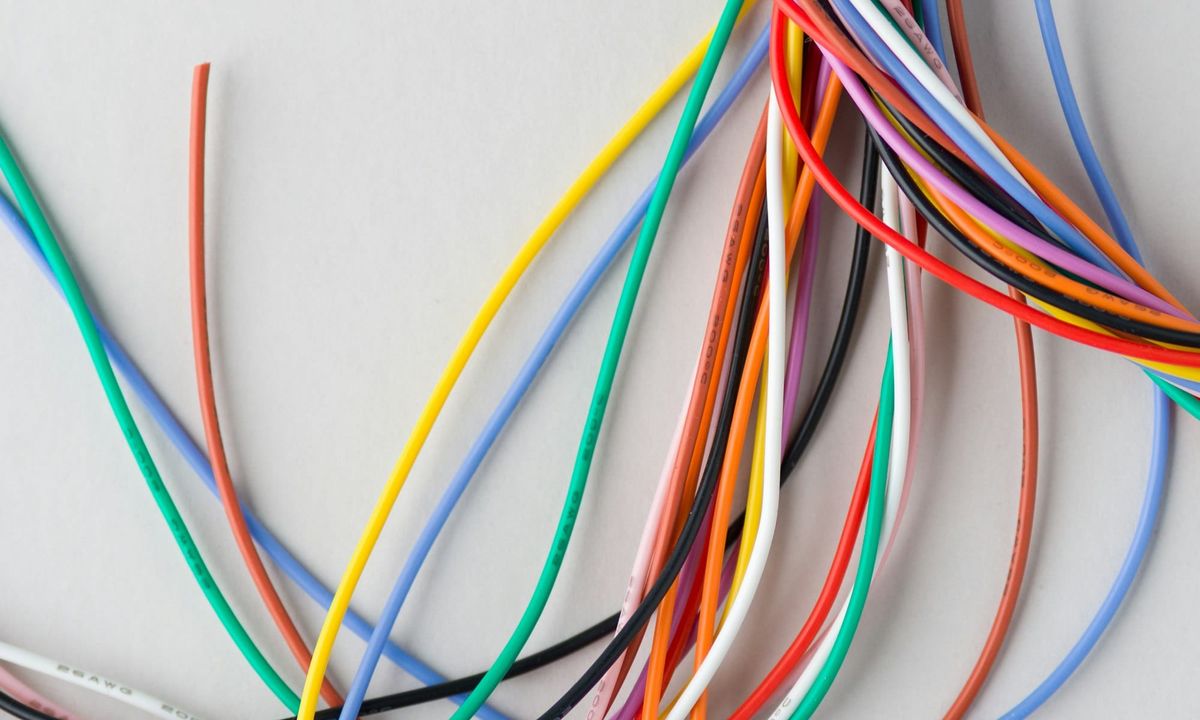
On 19 November 2026 the Japan Automobile Manufacturers Association (JAMA) said its members, Toyota, Nissan and Honda among them, will standardize some of what goes into their cars: common quality criteria for steel, shared rules for plastics, and one colour code for wire harnesses, the bundles of cable that run through a car. Will it cut costs? Some, mostly at the parts suppliers, and only as fast as each company actually switches. Under Japanese competition rules a trade association's standard is voluntary, so each of JAMA's 14 automakers decides for itself whether to use it. That word, voluntary, is the whole story.
What did Toyota, Nissan and Honda agree to standardize?
Not cars, and not even parts in the sense of one bumper fitting three models. JAMA chairman Koji Sato, who is also Toyota's vice chairman, announced it at a news conference in Tokyo. The first targets are specifications: how steel is graded and tested, how plastic resins are handled, what colour each wire is. Japan already has a public standard for car wire. The cost, as The Auto Wire's reporting puts it, is in what each automaker has stacked on top of it.
JAMA hasn't published the details yet: no steel grades, no resin list, no date in any document I could find. One report says 2027; another says no date has been set in writing. I'd treat the timing as open.
Sources: JAMA and JAPIA, 14 July 2026 (my translation); The Auto Wire, 19 November 2026.
Why couldn't Toyota just do this on its own?
My first reaction was that it could. If a big customer relaxes a pointless rule, its suppliers save money. Why wait for Nissan and Honda?
The answer is in a set of slides JAMA and the parts makers' association, JAPIA, showed to reporters on 14 July. Toyota has been running exactly this kind of clean-up since the end of 2017. It calls it the Smart Standard Activity. One example: the rule for how a wire harness connector should look was so vague that any connector with a black speck on it was thrown away, even when it worked perfectly. Clarifying the rule cut inspection and scrap. Toyota handled about 7,500 cases like that between 2018 and 2025 and adopted roughly two thirds of them.
And then the line that explains this week's news. On slide 10, a supplier's reaction is quoted: with Toyota alone, the effect is small and doesn't really help. (That's my translation of the Japanese.) The slides call the problem a double standard. If Toyota loosens a rule and Nissan doesn't, the supplier still runs the stricter version on the same line, with the same inspectors. The saving only appears when the second and third versions disappear too.
What happened when American cities tried to standardize fire hydrants?
"Differences in hose connections on the hydrants, both diameters and threads, were part of the design that protected manufacturers from competition."
Momar D. Seck and David D. Evans, NIST, NISTIR 7158, 2004
On Sunday, 7 February 1904, a fire started in a basement in Baltimore's business district. Engine companies from Washington, DC arrived by train within hours, and, in the words of a 2004 report by the US National Institute of Standards and Technology (NIST), "their hoses would not fit Baltimore hydrants due to the difference in threads." More companies came from Philadelphia, New York and other cities. Some fit, some didn't. The fire burned for 30 hours and destroyed 1,526 buildings across seventy city blocks.
It wasn't carelessness. Hydrant makers patented their own designs, threads included, and Albert Merrill at the National Bureau of Standards counted about 600 sizes and variations of hose coupling across the country. The National Fire Protection Association (NFPA) and the fire insurers had pushed for a national standard before the fire, and it "received little support." In 1905, the year after, an NFPA committee wrote one.
Guess first: a hundred years after the Baltimore fire, how many of the 48 largest US cities had hydrants fully matching the 1905 standard?
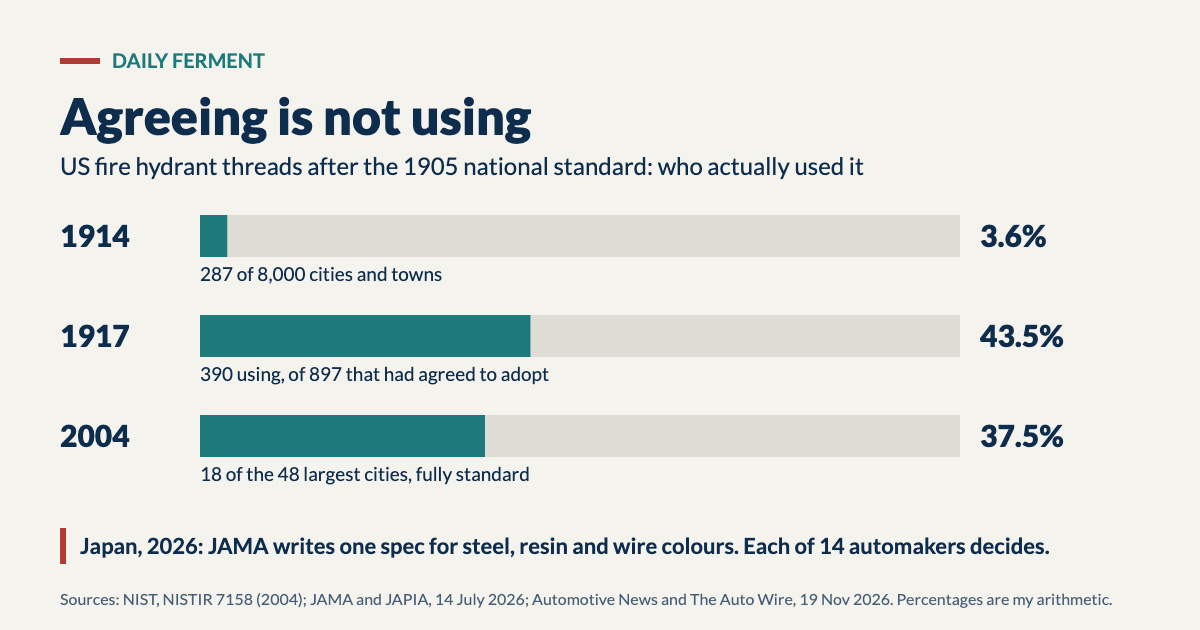
18 of 48, as NIST counted them in 2004. About 40 had at least the standard hose connections. Source: NIST, NISTIR 7158, 2004.
The 1905 standard is still the one in use today. By 1914, only 287 of the 8,000 cities and towns in the US had hydrants that matched it. In 1917, 897 cities had agreed to adopt it, and 390 were actually using it. NIST's report has a dry sentence about how the rest moved: "Some of the cities made the change only after they experienced their own major fire." Oakland, California, was one of them. In the Oakland Hills fire of October 1991, engines with standard couplings couldn't connect to the city's 3 inch hydrants. Twenty five people died. Afterwards, every hydrant in the city was replaced.
A century after Baltimore, only 18 of the 48 most populous US cities had hydrants that fully met the standard.
- 7 February 1904 Washington, DC engines reach the Baltimore fire; their hoses don't fit the hydrants
- 1905 An NFPA committee sets the national hydrant thread standard
- 1914 287 of 8,000 US cities and towns conform
- 1917 897 cities have agreed to adopt it; 390 use it
- 1924 About 700 cities
- 20 October 1991 Oakland Hills fire: standard couplings can't connect to Oakland's 3 inch hydrants
- 2004 18 of the 48 largest cities fully standard
- End of 2017 Toyota starts its own clean-up of supplier rules
- 19 November 2026 JAMA announces shared specs for steel, resin and wire harnesses
Sources: NIST, NISTIR 7158, 2004; JAMA and JAPIA, 14 July 2026; Automotive News, 19 November 2026.
What does that mean for Japan's car industry?
US fire hydrant threads
- Where the variety came from Hydrant makers' patented designs; about 600 coupling variations
- The standard NFPA, 1905, still current
- Who decided to use it Each city, on its own budget
- What sped it up Often a city's own big fire
Japan's car parts specs
- Where the variety came from Each automaker's own requirements on top of public standards
- The standard JAMA shared specs for steel, resin and wire colours, details not yet published
- Who decides to use it Each of 14 automakers; participation is voluntary
- What might speed it up Competition from Chinese automakers, the stated reason
Sources: NIST, NISTIR 7158, 2004; JAMA and JAPIA, 14 July 2026; The Auto Wire. The pairing is mine.
The parallel isn't perfect. Hydrants are buried in streets and last for decades; a steel spec can change with the next model. And JAMA's members aren't scattered towns. They're 14 companies meeting in the same rooms: 48 companies and 222 people turned up at a joint session at Mazda's headquarters on 2 July. That is faster machinery than anything firefighters had in 1905.
But the shape is the same. A standard that everyone has agreed to and only some use leaves the supplier where it started, running two or three versions. 897 cities agreeing and 390 using is exactly the gap to watch. JAMA's own slides are careful on this point: each company decides whether to take part, and quality standards are still written by each automaker. The guideline gives them a shared way to decide. It doesn't decide for them.
Then there's the question at the top of the Reddit threads about this news: whether any of it makes cars cheaper. I can't find a source that says so, and I'd be guessing. The first saving lands with the supplier who stops inspecting connectors three ways. Whether it moves on to the automaker's price, and then to yours, depends on bargaining nobody publishes. The stated aim, in Kyodo's report as The Auto Wire relays it, is to move money into next-generation vehicles, where American and Chinese companies are ahead, not to cut sticker prices. I wrote about how that competition is reshaping markets in the piece on petrol cars becoming the minority in China.
How sure am I?
- Established
- What JAMA announced, as reported by Automotive News and The Auto Wire; Toyota's 7,500 cases, the 67% adoption rate, the supplier comment and the voluntary participation, from JAMA and JAPIA's own slides; the hydrant figures, from NIST.
- Inferred
- That a voluntary shared spec will spread unevenly across the 14 automakers, as hydrant threads did across cities, unless something forces the pace.
- Guess
- Whether any of the savings reach car prices. I found no source either way.
Sources: as listed below.
A shared standard only saves money once the last buyer drops its own version, so agreeing on it is the cheap part and getting everyone to use it is where the cost and the time go.
What I'd watch is not the next announcement but the first list of who has switched. The Baltimore lesson is that the standard was never the hard part. The standard took one committee and one year. Adoption took a century and, in some cities, a fire. Toyota has been working on its own costs for a while, as the Scion KEI-01 piece shows from another angle. This time it can't get there without its rivals.
More on Daily Ferment: Toyota will build a kei truck in Indiana that can't go faster than 25 mph and China's solar curbs ban know-how. Britain banned workers.
Sources
- Hans Greimel, Automotive News, Toyota, Nissan, Honda back Japan plan to standardize parts, lower costs, 19 November 2026
- Johnny Lloyd, The Auto Wire, Japan's automakers are writing one spec for steel, plastic and wiring, 19 November 2026
- Mike Floyd, Automotive Addicts, Toyota, Nissan and Honda team up to cut costs with shared parts standards, 20 November 2026
- JAMA and JAPIA, Smart Standard Activity media briefing slides (Japanese, PDF), 14 July 2026
- Momar D. Seck and David D. Evans, NIST, Major U.S. Cities Using National Standard Fire Hydrants, One Century After the Great Baltimore Fire (PDF), NISTIR 7158, August 2004