A UK tribunal made the government admit its secret order to Apple. Trade secret law has the same rule: a secret you don't keep stops being one.
The Investigatory Powers Tribunal made the UK confirm its secret encryption order to Apple. Officials had briefed the press, so the secret no longer held.
On 19 November 2026 the Investigatory Powers Tribunal in London ruled that the UK Home Office must confirm it gave Apple a technical capability notice, a secret order under the Investigatory Powers Act 2016 meant to give police and intelligence services access to encrypted iCloud data. Why did the government lose the right to stay silent? Not because the judges weighed encryption against security. They found the government's own officials had already confirmed the order to newspapers and let Apple brief US officials. A secret its owner had stopped keeping, the tribunal said in effect, could not be protected as one.
What did the tribunal decide about Apple's encryption order?
The Home Secretary's position was "neither confirm nor deny", known as NCND. She told the tribunal it "would be damaging to national security" to say publicly whether a notice had been given to Apple. Three judges, Lady Carmichael, Mr Justice Chamberlain and Mr Justice Johnson, rejected that.
The background is familiar to anyone following this since early 2025. The Washington Post reported that the Home Office had served a notice on Apple in January 2025 covering iCloud data of Apple users anywhere in the world. Apple didn't comply. It withdrew its Advanced Data Protection feature from UK users instead, saying it had "never built a backdoor or master key" and never would. Apple, Privacy International and Liberty then challenged the Home Secretary's powers in the tribunal, and until now the government wouldn't say in court whether the thing being challenged existed.
- January 2025 The Home Office serves a technical capability notice on Apple, as later reported by the Washington Post
- 21 February 2025 Apple withdraws Advanced Data Protection from UK users
- 19 August 2025 Tulsi Gabbard posts about the order on X; the post is viewed more than three million times
- 17 September 2026 The tribunal hears the government's claim to neither confirm nor deny
- 19 November 2026 The tribunal rejects it; the Home Office confirms the notice
- First half of 2027 Expected substantive hearing, much of it in open court
Sources: Investigatory Powers Tribunal, [2026] UKIPTrib 9; Computer Weekly, 19 November 2026.
Why couldn't the government keep it secret?
My first reaction was that this was a technicality: everybody knew about the order, so confirming it changes nothing. Reading the judgment, the technicality is the point.
The tribunal accepted that NCND is a legitimate policy, and that "its efficacy depends on it being maintained generally." Then it looked at what the government had actually done. Two newspapers, The Times and the Financial Times, had reported briefings from government officials confirming the notice. The judges wrote: "we infer that the briefings that are reported by The Times and The Financial Times did take place." The Home Office had also authorised Apple to brief members of the US executive, "a further clear departure from NCND." Tulsi Gabbard, then the US Director of National Intelligence, posted about it on X on 19 August 2025 and the post was viewed more than three million times.
The government said its leak investigations hadn't found a source. The tribunal said that claim had "little or no evidential value" without any detail of what the investigations involved. And it noted what it had been told: that an affirmative answer "can be found by simply typing the question into Google's chatbot."
"The cumulative effect of these departures from NCND is that anyone with even a passing interest in this topic already knows."
Investigatory Powers Tribunal, OPEN judgment, 19 November 2026The Home Office case deserves to be put fairly. NCND only works if it is used every time, including when the answer is harmless, so that silence never signals anything. The tribunal itself said in April 2025 that the policy's usefulness "is not defeated by occasional and exceptional departures." After the ruling a Home Office spokesperson confirmed the notice and said decisions on public safety "must be made by democratically elected governments and independent judges, not in the boardrooms of technology companies." That's a real argument about who decides. It just isn't an argument about secrecy any more.
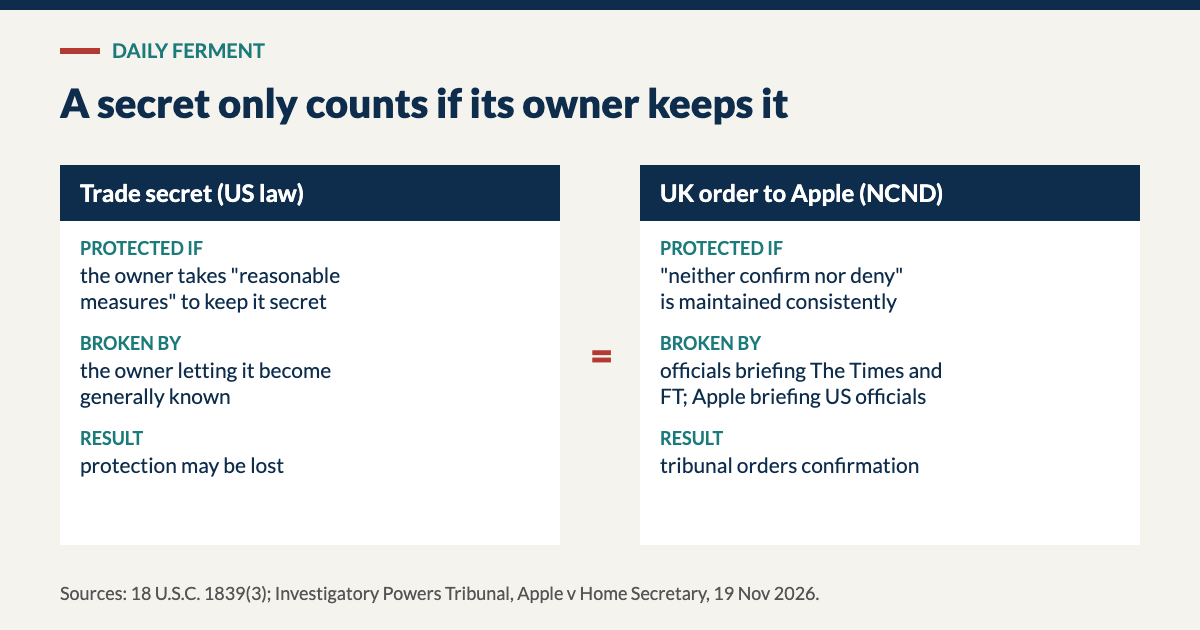
What does trade secret law say about a secret you don't keep?
Commercial law has a rule for this, written for companies. Under the US Defend Trade Secrets Act, information counts as a trade secret only if "the owner thereof has taken reasonable measures to keep such information secret" and it gets its value from "not being generally known." Cornell's legal encyclopedia puts the consequence plainly: if the information becomes generally known, or the owner fails to take reasonable measures, it "may lose trade secret protection."
The logic is that a court won't spend its power protecting something the owner treated as ordinary. A company that let its own staff describe the formula in public would struggle to show it had taken reasonable measures. The protection follows the behaviour, not the label.
A company's trade secret
- Protected if The owner "has taken reasonable measures to keep such information secret"
- Value comes from "Not being generally known"
- Lost when It becomes generally known, or the owner stops taking reasonable measures
The UK's order to Apple
- Protected if NCND is "maintained consistently in that case"
- Value comes from Silence that never signals anything
- Lost when Officials briefed The Times and the Financial Times, and Apple was allowed to brief US officials
Sources: 18 U.S.C. 1839(3); Cornell LII, Wex; Investigatory Powers Tribunal, 19 November 2026. The pairing is my reading; the tribunal does not mention trade secrets.
Held next to that rule, the tribunal's reasoning looks less like a special ruling about spies and more like a general one about secrets. The test wasn't whether the information was sensitive. It was whether the owner had kept it. The tribunal said so almost in those words: NCND's "utility ... in an individual case depends on its being maintained consistently in that case."
I'd mark that as my reading, not the tribunal's. It never mentions trade secrets. But the shape is the same, and it matters for what comes next. The ruling means "much of the substantive hearing" on whether the Home Secretary had the power to issue the notice can now take place in open court, with a hearing expected in the first half of 2027. Apple users in the UK still don't have Advanced Data Protection back, and nothing in this judgment changes that.
I've written before about whether a country can fine a website it can't reach, which is the same cross-border problem from the other end: a UK order that reaches iCloud users worldwide. And about whether surveillance camera locations should be public, where the answer also depended on what the secrecy was for.
How sure am I?
- Established
- What the tribunal found and ordered, the quotes from the judgment, the Home Office's response, and the wording of the US trade secret definition.
- Inferred
- That the tribunal's reasoning works like the trade secret "reasonable measures" test. The judgment never makes that comparison.
- Guess
- That the same consistency test will be used against other secret notices and other NCND claims. Nothing in this ruling says Advanced Data Protection is coming back to the UK.
A government, like a company, can only ask a court to protect a secret it has kept itself, and the UK lost the first round of its Apple encryption case on that point before anyone argued about encryption.
More on Daily Ferment: Can a country fine a website it can't reach? and Should camera locations be public? Ask what the camera is for
Sources
- Investigatory Powers Tribunal, OPEN judgment, Apple Inc and others v Secretary of State for the Home Department, [2026] UKIPTrib 9, 19 November 2026.
- Blackstone Chambers, Apple Inc v Secretary of State for the Home Department, 19 November 2026.
- Bill Goodwin, UK court confirms existence of government surveillance order against Apple, Computer Weekly, 19 November 2026.
- Cornell Legal Information Institute, 18 U.S. Code § 1839, Definitions (Defend Trade Secrets Act).
- Cornell Legal Information Institute, Wex, trade secret.