Claude found 663 theorems in Gödel's notebooks. About 400 check out as he wrote them. Restorers settled how to count the rest in 1964.
Claude listed 663 theorems from Kurt Gödel's 1940s workbooks. About 400 hold as he wrote them; about 200 had to be repaired. The Venice Charter of 1964 says how to count the repairs.
Claude, Anthropic's AI model, has pulled 663 theorems out of 16 notebooks Kurt Gödel filled in the early 1940s, according to Jan von Plato, the Helsinki logician who has led the project to read them since 2017. The Guardian reported it on Friday, 13 November, under a line saying the notebooks are "now said to contain hundreds of proved theorems". So what did Claude actually find in Kurt Gödel's notebooks? When the 663 were run through Coq, a program that checks proofs, about 400 were verified as stated, about 200 had to be repaired first, and about 50 were false.
That split is the part I want to understand, because it decides what "Gödel proved hundreds of theorems" means.
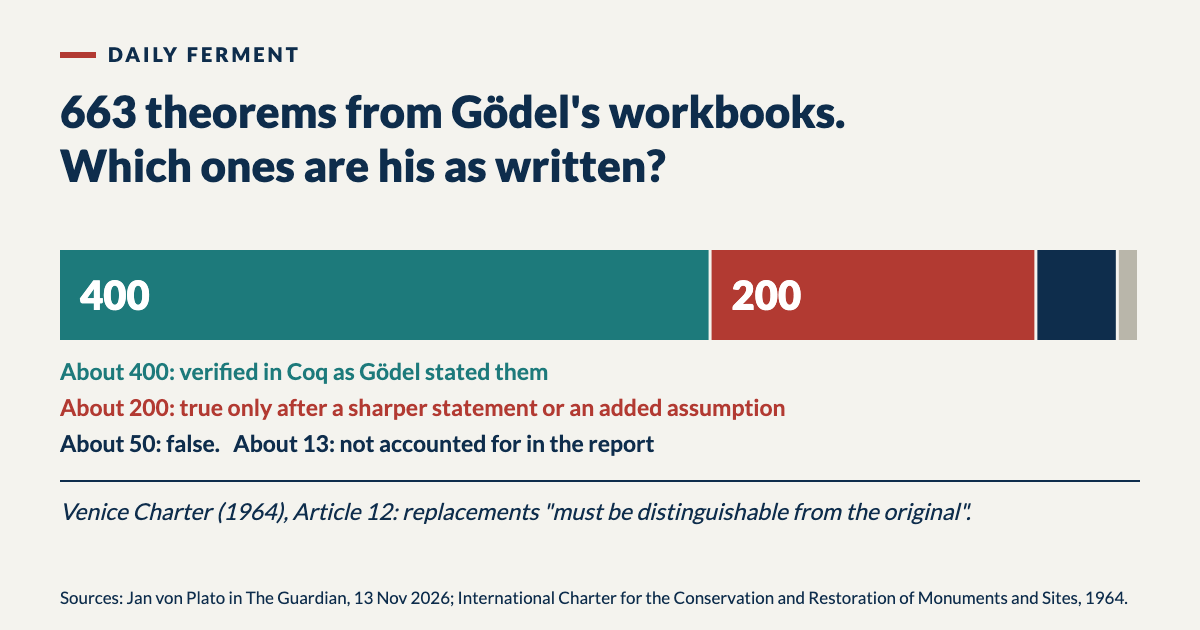
Source: Jan von Plato, quoted in The Guardian, 13 Nov 2026. The three groups add to about 650; about 13 are not accounted for in the report.
What are Gödel's workbooks?
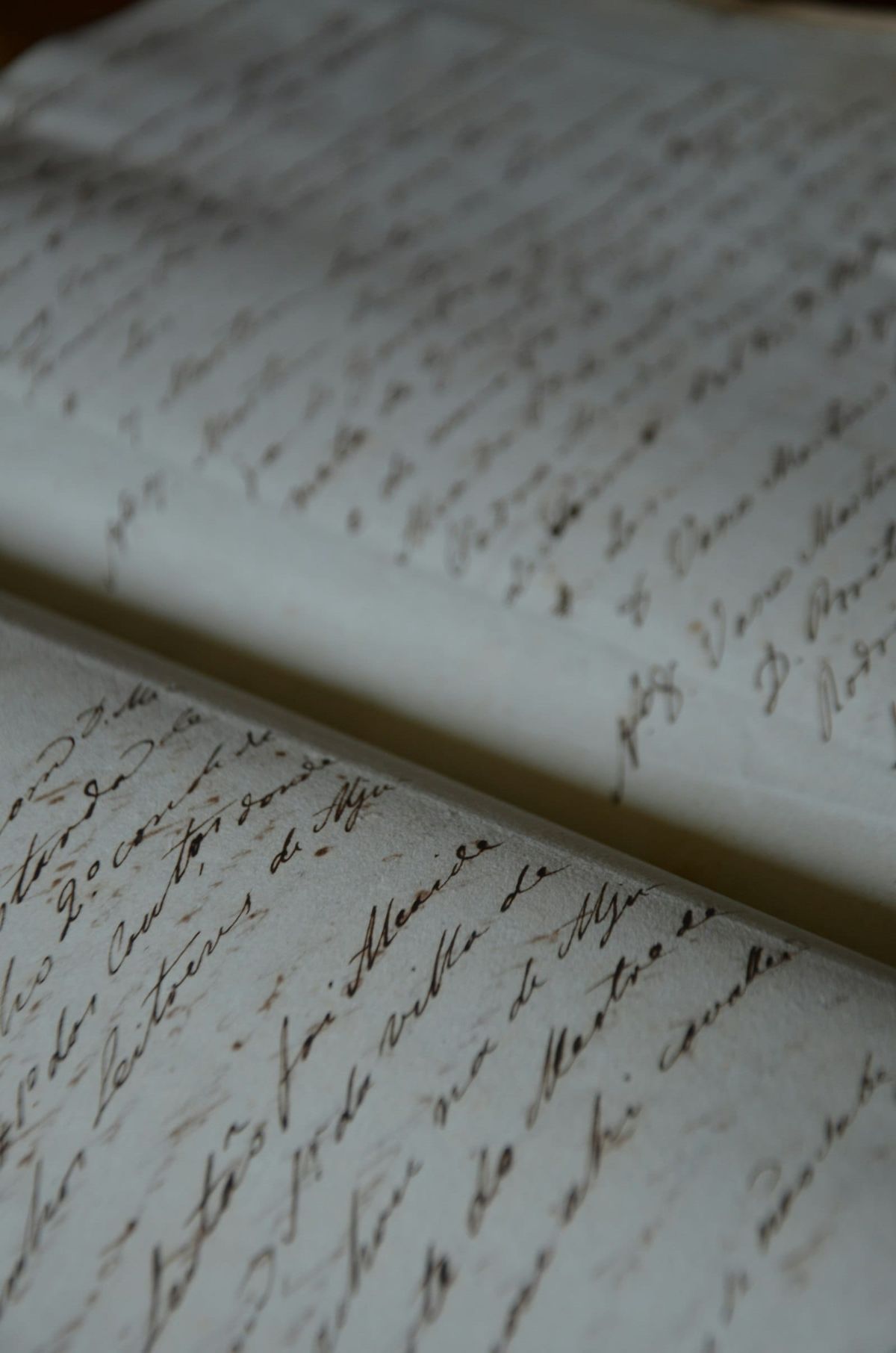
Gödel is the logician whose incompleteness theorems of 1931 showed the limits of what mathematical systems can prove: there are true statements they can neither prove nor disprove. After the 1930s he published very little. The notebooks in question, the "workbooks", run to 1,009 pages, much of them in Gabelsberger, a German shorthand that was already obsolete when he used it. Von Plato taught himself to read it and says he is "one of only six people who can read it in the world". His team got through about a page a week.
In September he gave Claude his transcriptions, six books he had written on Gödel and other secondary literature. Within a couple of days, he told the Guardian, he had "a 650-page explanation of the workbooks. It had to be controlled page for page".
- 1931 Gödel publishes the incompleteness theorems.
- Early 1940s Gödel fills 16 workbooks, 1,009 pages, much of it in Gabelsberger shorthand.
- 1966 Paul Cohen wins the Fields medal; Gödel says he had the axiom of choice result in the 1940s but cannot produce the proof.
- 1978 Gödel dies.
- 2017 Jan von Plato starts the Helsinki project, with a European Research Council grant.
- Sep 2026 Von Plato gives Claude his transcriptions; a 650-page explanation follows in days.
- 13 Nov 2026 The Guardian reports 663 theorems, about 400 verified as stated.
Source: The Guardian, 13 Nov 2026.
My first reaction: this is a discovery
Hundreds of unknown results from the most famous logician of the last century is a big claim, and the best single story in it is real history. After Paul Cohen won the Fields medal in 1966 for showing that the continuum hypothesis and the axiom of choice are independent statements, Gödel said he had done it in the 1940s, and couldn't produce the proof. Von Plato's first question to Claude was whether the workbooks held it. The answer was "yes, almost". One definition was wrong, but Gödel had the right one two years earlier. The reconstructed proof passed Coq.
So my first reaction was that the headline was fair. A team that read a page a week got a map of a thousand pages in two days, and the map shows Gödel was further ahead than anyone knew.
Checking that against the numbers
Guess first: of the 663 results Claude pulled from Gödel's workbooks, how many checked out in Coq exactly as he wrote them?
About 400, roughly 6 in 10. About 200 needed a repair first and about 50 were false. Source: Jan von Plato in The Guardian, 13 Nov 2026.
Then I read how the 663 were chosen. Von Plato asked Claude for every theorem for which Gödel "either had a proof, had sketched a proof or had an idea for a proof". So 663 is not a count of proofs. It's a count of results Gödel was working toward, at three different stages.
And the Coq results split them again. About 400 were verified as stated. That is the clean number: Gödel wrote a statement down, and it holds. About 50 were false, which Gödel sometimes knew; his own margins carry "falsch!" and "schlecht!". The middle group is the interesting one. About 200 were "repaired, meaning that perhaps the statement of the theorem had to be made more precise, or some assumption had to be added." Those three numbers add to about 650, so roughly 13 aren't accounted for in what was reported.
A repaired theorem is a true theorem. It isn't necessarily the one Gödel wrote. Someone added the assumption that makes it true, and the Guardian piece doesn't say who: Claude, von Plato or the team.
There's a second, quieter place where the reader enters. Coq doesn't read Gabelsberger. Every one of the 663 had to be turned from a transcription into a formal statement before Coq could check anything, and Coq checks the proof against that statement, not against Gödel's intent. I made the same point when Lean was said to have verified OpenAI's proofs: the checker is only as faithful as the sentence someone wrote for it.
Joel David Hamkins, a logician at Notre Dame who hasn't seen the reconstruction, put it in one line:
"How much is Claude and how much is Gödel is a job for the historians."
Joel David Hamkins, University of Notre Dame, in The Guardian, 13 November 2026How restorers answered the same question
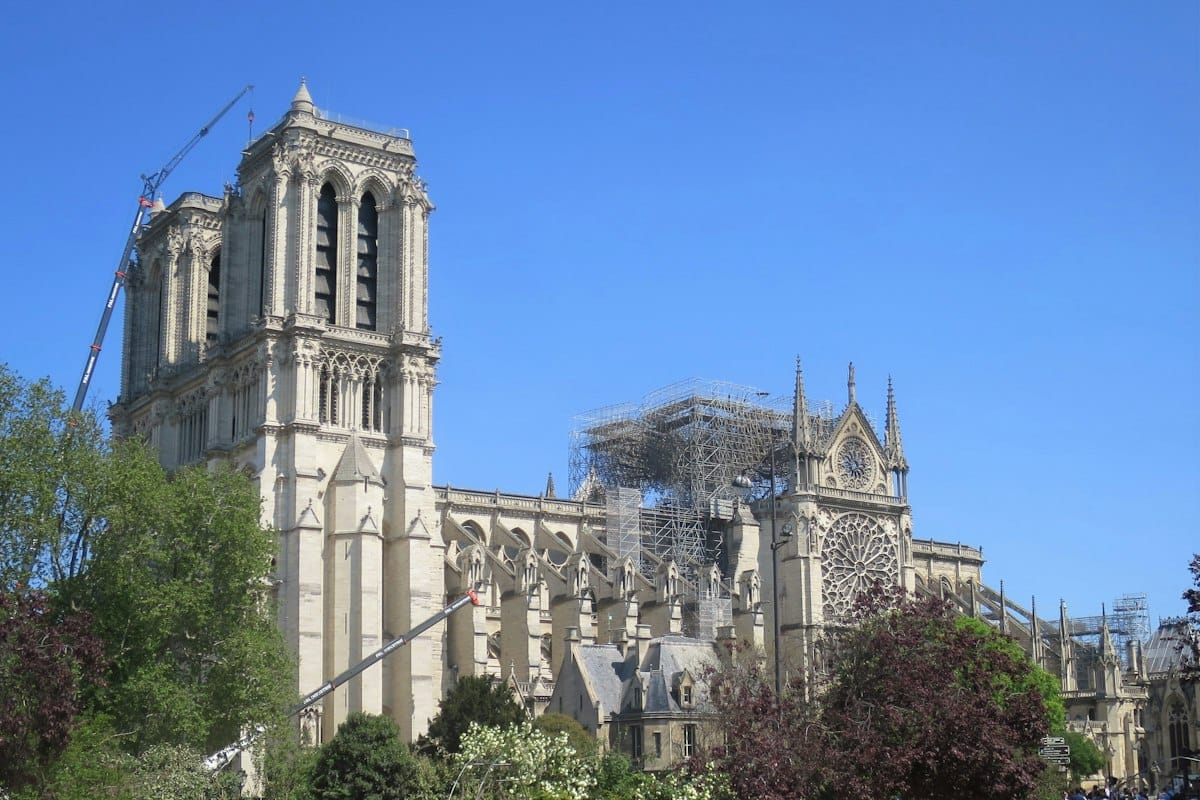
People who restore old buildings argued over this exact problem for a century and wrote the answer down. The Venice Charter, adopted at an international congress of architects and technicians of historic monuments in Venice in 1964, has two rules that fit the Gödel workbooks almost word for word.
Article 9 says restoration "must stop at the point where conjecture begins", and any extra work that is needed "must bear a contemporary stamp". Article 12 says replacements of missing parts must fit the whole "but at the same time must be distinguishable from the original so that restoration does not falsify the artistic or historic evidence."
Restoring a monument (Venice Charter, 1964)
- Original the old material and authentic documents
- Gaps missing parts of the building
- Rule for new work must be distinguishable and "bear a contemporary stamp"
- Where to stop "where conjecture begins"
Reading Gödel's workbooks (2026)
- Original about 400 results that hold as he wrote them
- Gaps about 200 that need a sharper statement or an added assumption
- Rule for new work not stated yet: who repaired what is not in the report
- Where to stop ideas and sketches are counted with proofs in the 663
Sources: Venice Charter, Articles 9 and 12; The Guardian, 13 Nov 2026.
Put the 663 through those two articles. The 400 are original material. The 200 are restorations, and the Charter's rule is that you can do them, and should, but you mark them so nobody later mistakes the new stone for the old. The axiom of choice proof, with one definition swapped for the one Gödel had used two years earlier, is a reasonable restoration with a clear stamp on it, because von Plato has said exactly what was changed. The danger isn't in the repairs. It's in a headline count that folds repaired and original into "hundreds of proved theorems", which is the kind of evidence the Charter says restoration must not falsify.
This matters more than it would for a building, because historians will cite Gödel's priority from this list for decades. Credit in mathematics is about who stated what first. Hamkins's other line is blunt: "You don't get credit for work you don't tell anyone about." It is the same kind of re-labelling problem I wrote about when science changed what a famous fossil was: the label follows the object around long after anyone remembers how it was assigned.
The claim, in one sentence
When an AI repairs a dead mathematician's statements before checking them, the repaired results are partly its own, and a count of his discoveries only means something if those are kept visibly apart, the rule restorers wrote for buildings in 1964.
How sure am I?
- Established
- The counts and quotes as von Plato and Hamkins gave them to The Guardian; the text of the Venice Charter. No paper or list of the 663 has been published that I could open.
- Inferred
- That the repairs and the translation into Coq are both places where the AI's and the team's work enters, and that a single headline count blurs them.
- Guess
- That the published list will tag each result as verified, repaired or false. If it does, my worry mostly goes away.
What I'd want to see: the list of 663 published with each result tagged as verified, repaired (with the change shown) or false, and the Coq statement next to the transcription. Von Plato says the work goes on, and that Gödel's physics and cosmology notebooks are next once his logic projects are done. If the list arrives with that tagging, the 200 become one of the best things in the project rather than a footnote.
More on Daily Ferment: AI benchmarks miss most work. Drug trials once missed women.; The skin cancer AI that won would have sent 18 melanomas home
Sources
- Alex Bellos, 'Ahead of his time': AI helps unlock discoveries hidden in notebooks of man who transformed maths, The Guardian, 13 November 2026.
- International Charter for the Conservation and Restoration of Monuments and Sites (the Venice Charter), Venice, 1964, Articles 9 and 12; listed by ICOMOS.