A judge says Samsung, SK Hynix and Micron moved like hawks flying in formation. Ecologists have a test for that.
Three chipmakers pivoted to AI memory together. A judge says that alone proves nothing. What keeps the RAM price-fixing case alive is what AI demand cannot explain.
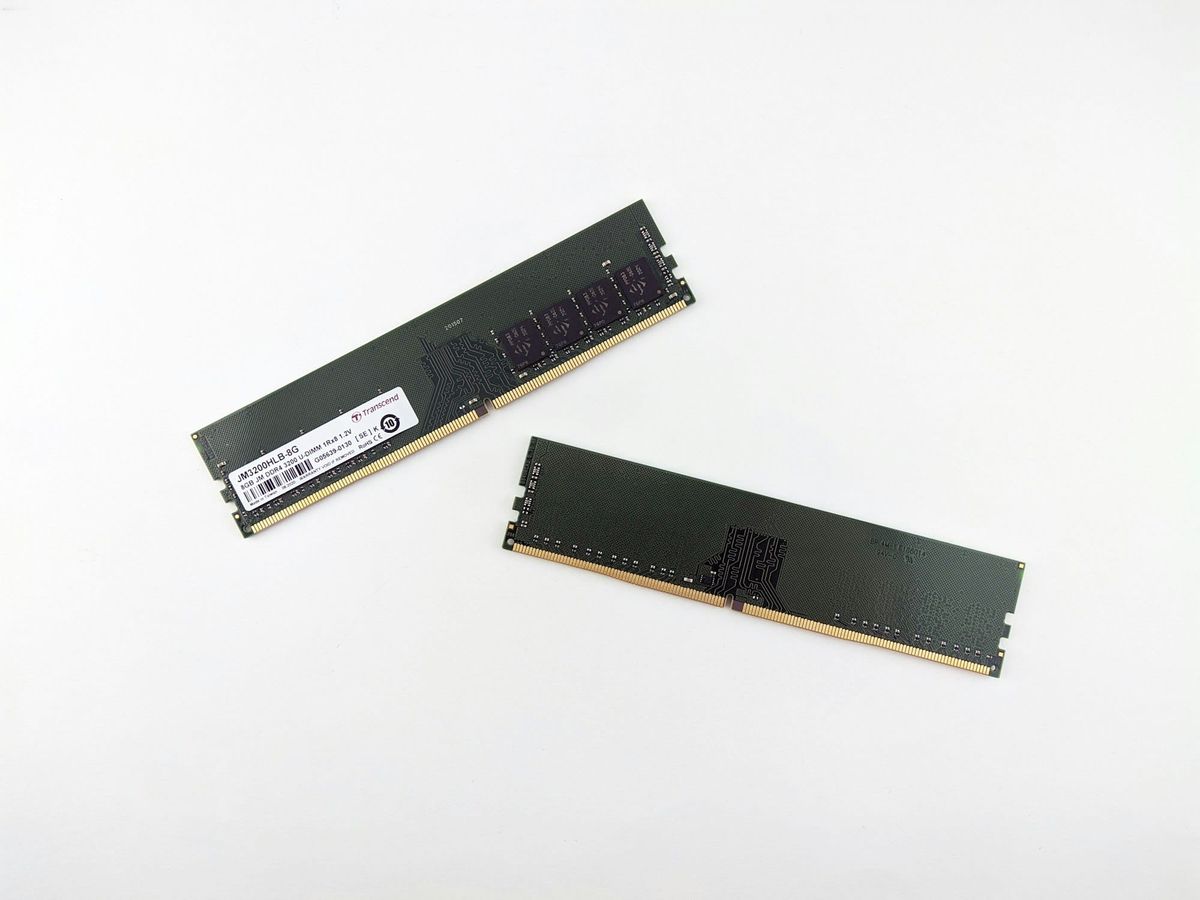
Three companies sell more than nine in ten of the world's DRAM memory chips, and within six months of each other, in 2022 and 2023, all three cut supply. On 14 November 2026 Judge Noël Wise of the US District Court for the Northern District of California refused to throw out a price-fixing lawsuit against Samsung Electronics, SK Hynix and Micron Technology. Does that mean they rigged RAM prices? No. It means the buyers suing them have described enough moves that the AI boom does not explain for the case to go on. Nothing has been proven.
What I wanted to understand is how a judge tells three firms reacting to the same news apart from three firms that agreed on something. Ecologists have the same problem with animals, and they have been working on it since 1953.
What does the DRAM price fixing lawsuit say?
The facts here come from the judge's order, 20 pages, in Garciaguirre v. Samsung Electronics (docket). At this stage a court takes the complaint as true, so everything below is what the plaintiffs allege. Seventeen consumers and small businesses from five states sued on 25 June 2026 under Section 1 of the Sherman Act, the US law against agreements that restrain trade.
In the 1990s about twenty firms made DRAM. By the third quarter of 2025 these three held more than 91% of global DRAM revenue: SK Hynix 33.2%, Samsung 32.6%, Micron 25.7%. SK Hynix announced production cuts on 26 October 2022 and Micron on 16 November 2022. Samsung said in January 2023 there would be "no artificial production cut", then announced one on 7 April 2023.
Source: allegations in the complaint, as set out in Garciaguirre v. Samsung, N.D. Cal., order of 14 Nov 2026. Not proven.
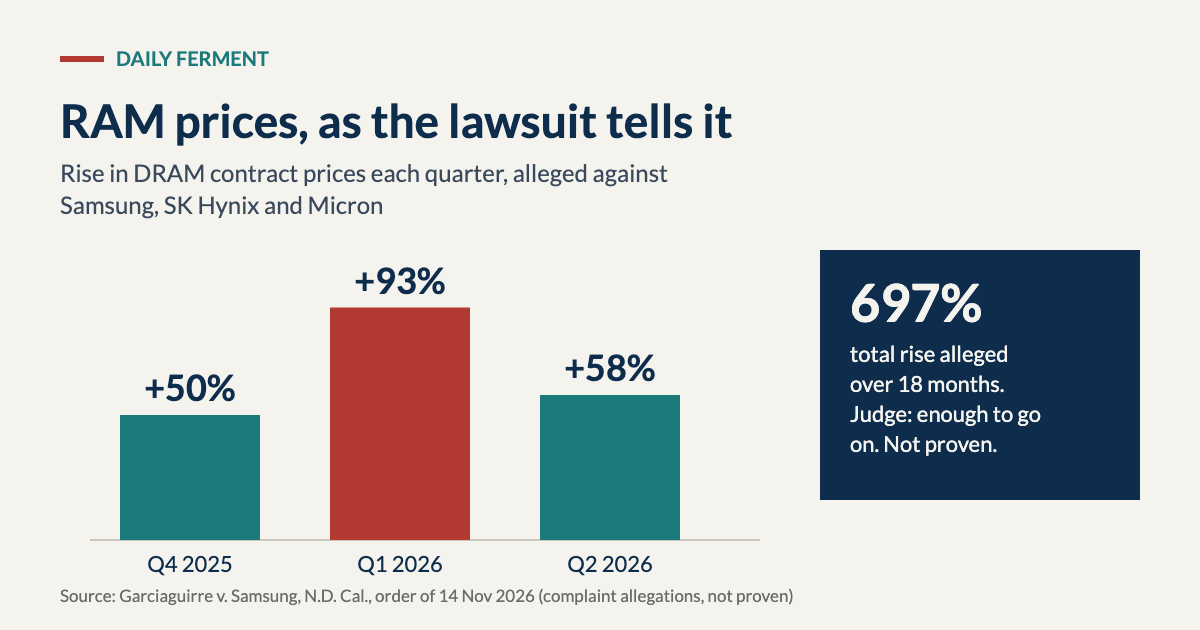
From 2023 all three moved factory capacity to high bandwidth memory, or HBM, the stacked memory that goes next to AI chips. According to the complaint it takes about three to four times the silicon wafer area per gigabyte of ordinary DDR5, and it cannot go in a PC, a server or a phone. Ordinary DRAM got scarce. By the third quarter of 2025 its price was up 171.8% in a year. Contract prices rose about 50% in the last quarter of 2025, 93% in the first quarter of 2026 and 58% in the second. The plaintiffs put the total at 697% over eighteen months.
Then three things happened that matter most to the judge. None of the three expanded ordinary DRAM capacity; the complaint calls those prices "the single most powerful supply signal the DRAM industry has ever produced". On 3 December 2025 Micron said it would close Crucial, the consumer memory brand it had run since 1996. And in January 2026 all three started asking customers the same kind of questions: who the memory was for, how much, and whether the demand was real.
- 1999 to 2002 DRAM price-fixing cartel; Samsung later fined $300M, Hynix $185M (US DOJ).
- 2016 to 2018 Earlier supply squeeze; the suit over it is dismissed, upheld in 2022 (DRAM II).
- 26 Oct 2022 SK Hynix announces production cuts.
- 16 Nov 2022 Micron follows.
- 7 Apr 2023 Samsung cuts, after saying in January it would not.
- 2023 AI boom; all three shift capacity to HBM.
- 3 Dec 2025 Micron says it will close Crucial.
- Jan 2026 All three start vetting customers with similar questions.
- 25 Jun 2026 Seventeen buyers sue.
- 14 Nov 2026 Motion to dismiss denied.
- 7 Dec 2026 The companies' answers are due.
Sources: Garciaguirre v. Samsung, N.D. Cal., order of 14 Nov 2026 (allegations, not proven); US DOJ, 13 Oct 2005.
The companies' answer, as the order sums it up, is that each made "rational" choices in its own self-interest. AI demand exploded, AI chip makers wanted HBM, and every firm with a factory followed the demand. That is a strong argument. In a market of three, everyone watches everyone. At the hearing their lawyers quoted the late Judge Richard Posner: "[c]ompetitors in concentrated markets watch each other like hawks."
"Plaintiffs' allegations go beyond hawks watching each other; their contentions are more akin to hawks flying in formation ... an activity that hawks ordinarily do not do."
Judge Noël Wise, order of 14 November 2026My first reaction, and why it was too quick
My first reaction was that the companies should win this easily. Of course three firms facing the same AI boom would all pivot to HBM. And the same three have won before: in 2022 the US Court of Appeals for the Ninth Circuit upheld the dismissal of a suit over an earlier squeeze, from 2016 to 2018, a case the order calls DRAM II.
Judge Wise agrees with a good part of that. She called the three-firm market structure "neutral". She gave no weight to Micron's 2022 talk to investors of "supply discipline", because DRAM II had already found similar talk not enough. She gave no weight to executives meeting at trade conferences. And she wrote that the pivot to HBM on its own "might not be sufficient".
So the parallel moves are not what kept the case alive. What did is narrower, and it is exactly what an ecologist looks for.
The cross: sheep on two islands
Ecologists call it spatial synchrony: separate populations of animals rising and falling together. A 2004 review by Andrew Liebhold, Walter Koenig and Ottar Bjørnstad gives three main causes. Animals move between the populations. Or the populations depend in the same way on shared weather, such as temperature or rainfall, which is called the Moran effect, after Patrick Moran's 1953 paper on the Canadian lynx. Or they share predators or prey. The review is blunt about the hard part: "Identification of the causes of synchrony is often difficult."
Put the chipmakers in those terms. AI demand is the weather: it hits all three at once. Talking to each other is the movement between populations. Seeing all three move together cannot tell you which one you are looking at.

The cleanest example I found is from St Kilda in Scotland. In 1998 Grenfell and eight colleagues published counts in Nature of wild sheep on two islands in the archipelago. The two populations rose and fell in step for forty years. Their abstract says why islands helped: "interpretation of synchrony is often complicated by migration between populations."
Then they did the useful part. Instead of stopping at "it must be the weather", they worked out how much shared environment it would take to keep the two populations that closely in step. Their model needed "a high and frequent degree of environmental correlation", and large-scale weather accounted for only part of it. The method is the point: work out what the shared cause can explain, then look hard at what is left.
That is the order's structure too. The judge gives the weather its due: the shared AI boom explains the pivot, and a market of three explains the watching. Then she looks at what is left.
Timing. The companies said the customer vetting was needed because "booming AI demand had consumed available capacity". The judge found "a mismatch in time": the vetting started in January 2026, after the boom began in 2023, after the HBM pivot, and around the time ordinary DRAM became more profitable than HBM. Shared weather hits everyone when it arrives. It does not make three firms adopt substantively the same questions at the same moment three years later.
Direction. Shared weather predicts the response. Record prices predict new capacity. None came.
Things you cannot undo. Closing Crucial, locking up HBM supply in long contracts, delaying new DRAM plants. The judge called these "difficult if not impossible to unwind" and borrowed a 1990 line about oil refineries: capacity cuts "are not readily reversible. Once a company is committed to reducing its capacity it cannot easily recover if the other companies do not follow its lead."
And history. In 2005 the US Department of Justice fined Samsung $300 million for fixing DRAM prices from April 1999 to June 2002; Hynix had paid $185 million and Infineon $160 million. One of the methods the DOJ named was "exchanging information on sales to certain customers to monitor and enforce adherence to the agreed prices." The complaint says the 2026 vetting does the same job. In the ecologists' terms, that is a known route along which animals have moved before.
Sheep on St Kilda (Nature, 1998)
- What moves together Two island populations, for 40 years
- The shared cause Weather
- The other route Animals moving between populations, the reason islands were chosen
- The test How much shared environment the synchrony needs
- What was left Weather explained only part
Samsung, SK Hynix, Micron (order, 2026)
- What moves together Supply cuts, HBM pivot, DDR4 exits
- The shared cause AI demand
- The other route Firms talking; a cartel in 1999 to 2002
- The test What AI demand cannot explain
- What was left Vetting three years late, no new capacity at record prices, moves hard to undo
Sources: Grenfell and others, Nature 394 (1998); Garciaguirre v. Samsung, N.D. Cal., order of 14 Nov 2026.
Where the comparison is unfair to the companies
Sheep do not choose. Firms do, and a firm can follow a rival's lead without ever talking to it; the law calls that conscious parallelism, and it is legal. An ecologist can live with "probably mostly weather". A court needs an agreement.
The evidence is also nothing alike. The St Kilda team had forty years of counts. Judge Wise has a complaint she must treat as true, and the companies have not filed their answers yet; those are due by 7 December 2026. Discovery may show the vetting answered something real, such as buyers hoarding or ordering twice. The test at this stage is only whether the facts are "largely inconsistent with unilateral conduct but largely consistent with explicitly coordinated action". That is plausibility, not proof.
What it means if you are buying RAM
Guess first: by how much did contract prices for ordinary DRAM rise in the first three months of 2026?
About 93%, in one quarter. The complaint puts the rise at about 50% in the quarter before and 58% in the quarter after. Source: allegations in the complaint, as set out in the order of 14 Nov 2026.
Nothing quickly. A ruling on a motion to dismiss does not change a price. The initial case management conference is set for 12 January 2027, according to LitNews. Two things are worth watching. Whether discovery turns up communications between the three. And whether any of them announces new capacity for ordinary DRAM. The shared weather story predicts that one of them eventually will, because that is what high prices are for. The longer none does, the harder that story gets to tell.
It is the same pattern as the data center grid costs that landed on household bills: AI demand arrives, and somebody else finds out what it costs.
How sure am I?
- Established
- What the order says and decides, including that the facts are allegations taken as true; the 2005 DOJ case; what the two ecology abstracts say.
- Inferred
- That the judge's reasoning follows the ecologists' method of subtracting the shared cause and weighing what is left. She does not say so; the parallel is mine.
- Guess
- Whether discovery finds any agreement, and whether prices fall. Nothing in the ruling decides either.
Three chipmakers facing the same AI boom would move together anyway, so the RAM price-fixing case rests on what that boom cannot explain: customer questions adopted together years late, and capacity left unbuilt at record prices.
There is an awkward part I have not settled. In AI labs can't agree to slow down I looked at the same law from the other side, where firms want to coordinate and Section 1 is what stops them. Here three firms say they never coordinated at all, and the evidence that they might have is that they acted like a flock. I am not sure what an honest firm in a market of three is supposed to look like.
More on Daily Ferment: Data centers drove the new power lines. Households got about half the bill and AI labs can't agree to slow down. They can agree on how to test.
Sources
- US District Court for the Northern District of California, Order Denying Motion to Dismiss, Garciaguirre v. Samsung Electronics Co., Ltd., No. 5:26-cv-06345-NW, ECF No. 68, 14 November 2026 (docket on CourtListener).
- US Department of Justice, Samsung Agrees to Plead Guilty and to Pay $300 Million Criminal Fine for Role in Price Fixing Conspiracy, 13 October 2005.
- Grenfell, B. T. and others, Noise and determinism in synchronized sheep dynamics, Nature 394, 674 to 677, 13 August 1998.
- Liebhold, A., Koenig, W. D. and Bjørnstad, O. N., Spatial synchrony in population dynamics, Annual Review of Ecology, Evolution, and Systematics 35, 2004 (abstract).
- LitNews, Judge Refuses to Dismiss DRAM Supply Conspiracy Suit Against Samsung, SK Hynix, Micron, 14 November 2026.