Job ads will have to show the salary. The price tag explains who that helps.
Britain will make every job ad show the salary. US evidence says posted pay lifts wages a little, mostly because rival employers can see the number.
On 5 November 2026 the UK Prime Minister, Andy Burnham, announced that every employer in Britain will be legally required to publish the salary in its job adverts. The government's own press release calls it "say what you pay".
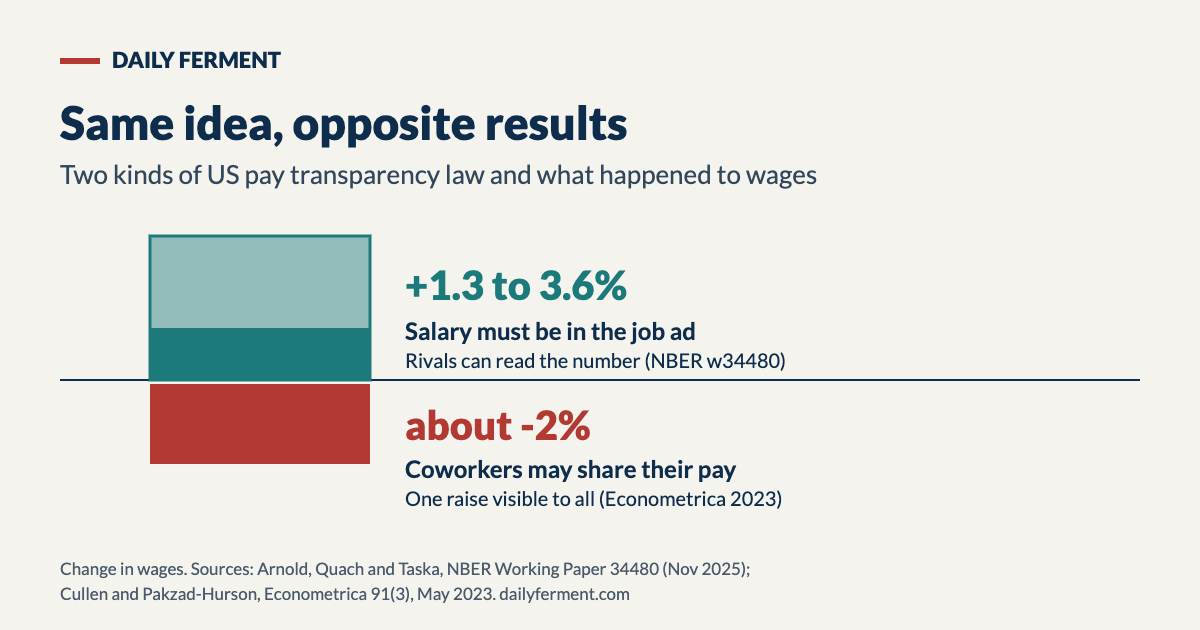
So do pay transparency laws work? The best evidence says yes, a little, and not for the reason most people give. When US states made salaries mandatory in job postings, wages rose by 1.3 to 3.6%, mostly because rival employers could suddenly see each other's numbers. A different kind, laws protecting coworkers who share their pay with each other, lowered wages by about 2%. Which kind Britain ends up with depends on details the government has not written yet.
What did Britain actually announce?
Less than it sounds. The press release says the government will legislate "as soon as possible", with "further details on scope, required information, implementation, and enforcement to be set out in due course." It does not say whether a range is allowed, how wide it can be, or when the rule starts.
The case it makes rests on two numbers. Fewer than half of employers (41%) always publish a salary range, and only 18% always publish a specific salary, according to the CIPD's 2024 pay report cited in the release. And early analysis of the government's consultation, which closed on 27 October according to Personnel Today, found 94% of respondents in favour, including 93% of businesses.
Sources: gov.uk, 5 Nov 2026 (CIPD 2024 figures as cited there; early consultation analysis).
Not everyone is pleased. The CIPD's chief executive, Neil Carberry, told People Management that advert drafting is best left to good employer practice. The British Retail Consortium wants ranges allowed rather than exact figures.
Britain is not alone. The EU's Pay Transparency Directive gives applicants the right to "the initial pay or its range" and bans employers from asking about pay history. Member states had until 7 June 2026 to write it into law. In the US, ten states and five cities had job posting laws by March 2025, starting with Colorado in January 2021.
My first reaction, and why it was wrong
My first thought was that the gain comes from the candidate. You know the number, so you ask for more, or you stop wasting a week on a job that pays too little. The government's release leans the same way: it says hidden pay forces women "to negotiate blind".
Then I read the paper that actually measured it. David Arnold, Simon Quach and Bledi Taska studied the US job posting laws in NBER Working Paper 34480, using job ads, Glassdoor salaries and government payroll data. Posting pay became far more common, up 30 percentage points. Wages rose 1.3 to 3.6% depending on the data. Employment, the number of postings and the skills employers asked for didn't move.
Guess first: after the US laws, what happened to posted pay at employers who were already publishing it before?
It went up too, by 3.6% for jobs that showed pay both before and after the change. Source: Arnold, Quach and Taska, NBER w34480, Nov 2025.
The detail that changed my mind: employers who were already posting their pay before the law also raised it. Nothing changed for their candidates. What changed was that their competitors' numbers were now public. The authors read it as competition, and current staff got raises too, not only new hires.
What did the price tag actually do?
That sent me to the history of the price tag, which NPR's Planet Money told in a 2015 episode.

For most of history, buying anything meant haggling. Quakers were the exception: they insisted on one fixed price, because charging people differently seemed unfair to them.
When shops grew in the 1800s, haggling stopped scaling. Robert Phillips of Columbia told the show that "clerks usually had long apprenticeships before they could actually be allowed behind the counter." Price tags, from around 1870, meant a shop could hire someone with no training. John Wanamaker in Philadelphia sold the idea as treating every customer the same.
So the price tag did two things at once. It took the haggling out of the single sale. And it put a number in the window that any rival could walk past and read. That second part is my inference, not something the episode says, but it is the part that matches the Arnold finding.
Price tags, from about 1870
- Replaced haggling at the counter
- Helped first shops, which could hire clerks without long apprenticeships
- Lost out the best hagglers: one price for everyone
- Outward effect a number any rival shop could read (my inference)
Salary in the job ad, US laws from 2021
- Replaces negotiating blind
- Measured effect wages up 1.3 to 3.6%, postings with pay up 30 points
- The other kind coworker pay-sharing laws: wages down about 2%
- Outward effect firms already posting pay raised it too
Sources: NPR Planet Money, 2015; Arnold, Quach and Taska, NBER w34480, Nov 2025; Cullen and Pakzad-Hurson, Econometrica, May 2023.
The first part has a cost, and economics has measured it. Zoë Cullen and Bobak Pakzad-Hurson, in Econometrica (May 2023), studied US laws that protect workers' right to tell each other what they earn. Wages fell by about 2%. Their explanation is the haggler's problem: once one raise is visible to everyone, an employer refuses it, because paying one person more means paying everyone more. A fixed price is good for people who never haggled and bad for the best hagglers.
Where does the comparison break?
A job is not a shirt. A shop sells the same shirt to everyone; an employer pays different people for different experience, which is why the British Retail Consortium is already asking for ranges. Stretch the range far enough and it stops being a price tag at all.
Here the US data is calmer than I expected. Arnold and his co-authors found the top and bottom of posted ranges moved together, with "essentially zero impact" on how wide they were. Employers did not respond by widening ranges until they meant nothing. Whether British employers behave the same way, I don't know.
The other gap is the EU's wording. The directive lets the pay be given in a job ad "prior to the job interview or otherwise." Information you get after applying works for the candidate, but no rival employer reads it. If the outward number is what does the work, that flexibility matters more than it looks.
What I'll watch for in the UK details
I'm watching for three details, none written yet. Whether a range is allowed and whether its width is limited. Whether the number has to be in the public advert, or only given to applicants. And whether Britain copies the EU and bans questions about current pay, which the Equality and Human Rights Commission asked for, according to Personnel Today. A public number plus no pay-history question looks like the US job-ad laws. A private number given on request looks closer to the coworker case, where the employer simply stops making exceptions.
Britain has run a version of this experiment before. When the FCA stopped insurers charging loyal customers more than new ones, the gap closed mostly because the price for new customers went up, as I found when I looked at the loyalty penalty in insurance. One price for everyone, and the people who used to get the special deal lost it. That is the Cullen and Pakzad-Hurson effect in a different market. And a posted number doesn't fix every unfairness in hiring: the same request can get different treatment depending on who it is for, which is what a hiring audit run on an AI coding model found.
How sure am I?
- Established
- The UK announcement and what it leaves open; the EU directive's text and its 7 June 2026 deadline; Arnold, Quach and Taska's 1.3 to 3.6% and the rise at firms that already posted pay; Cullen and Pakzad-Hurson's roughly 2% fall under coworker pay-sharing laws.
- Inferred
- That the public, comparable number is what drives the gain, and that the UK law will behave like the US job-ad laws if the number has to sit in the advert.
- Still a guess
- That wide ranges or pay given only on request would blunt the effect in Britain. There is no UK evidence yet.
A salary in a job ad raises pay the way the price tag disciplined shops: by letting rival employers see the number, not by helping the candidate haggle.
More on Daily Ferment: Acquitted nine years ago, still on the police certificate. A court says stop. and AI agents could end the lazy-deposit discount. UK insurance shows who pays.
Sources
- Prime Minister's Office, New 'say what you pay' law to help young people into work, gov.uk, 5 November 2026.
- Jo Faragher, 'Say what you pay' to become legal requirement, Personnel Today, 6 November 2026.
- Employers to be required to disclose salaries in job adverts under new laws, People Management, 6 November 2026.
- British Retail Consortium, PM announces requirement for salary information in job adverts, 6 November 2026.
- Directive (EU) 2023/970 on pay transparency, Articles 5 and 34, 10 May 2023.
- David Arnold, Simon Quach and Bledi Taska, The Impact of Pay Transparency in Job Postings on the Labor Market, NBER Working Paper 34480, November 2025 (full text).
- Zoë B. Cullen and Bobak Pakzad-Hurson, Equilibrium Effects of Pay Transparency, Econometrica 91(3), May 2023.
- Jacob Goldstein and Jess Jiang, The Birth And Death Of The Price Tag, NPR Planet Money, episode 633, 2015.